A Texas family held this coastal ranch for generations; now 2,500 acres have become part of a 17,500-acre wildlife refuge | World News

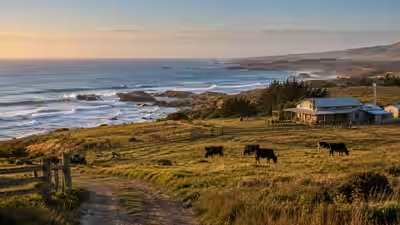

For generations, the Ward family knew a stretch of the Texas coast as “Down Below,” a working ranch where cattle grazing, hunting and family traditions unfolded across prairie, wetlands and marshes. Now, 2,500 acres of that land have entered a very different chapter. The property has been permanently protected and added to the Justin Hurst Wildlife Management Area near Freeport, creating more than 17,500 acres of connected conserved habitat in Brazoria County. The deal brought together the Ward family, the Coastal Prairie Conservancy and the Texas Parks and Wildlife Department, turning land that had been privately stewarded for generations into part of a much larger conservation landscape.
A family ranch with roots stretching back generations
The newly protected property was not simply another parcel of undeveloped Texas land. Known within the Ward family as “Down Below”, it had been owned and cared for by generations of the family, whose Texas roots reach back to Emily Austin Perry, the sister of Stephen F. Austin. Her descendants were among the settlers associated with Austin’s “Old Three Hundred”, linking the property to a much longer history of ranching and settlement along the Texas coast. Over the decades, the Wards maintained the landscape as a working ranch while also managing it for wildlife. Lee Taylor Ward, a lifelong rancher and outdoorsman, was particularly devoted to the property. His family said he believed the land mattered not only to them, but also to wildlife, ranching and the future of the Texas coast.
The 2,500-acre tract is now part of a much larger habitat
The conservation deal adds 2,500 acres immediately west and north of the existing Justin Hurst Wildlife Management Area. Before the expansion, the wildlife management area covered roughly 15,033 acres; the addition brings the connected protected landscape to more than 17,500 acres. The property contains a mixture of coastal prairie, wetlands and tidal marsh, habitats that are increasingly valuable along a heavily developed stretch of the Texas Gulf Coast. According to the Texas Parks and Wildlife Department, the wider area provides habitat for species including Black Rails and Mottled Ducks, alongside migratory waterfowl, shorebirds and other coastal wildlife. Protecting the Ward property also strengthens the connection between existing conserved lands, including the nearby San Bernard National Wildlife Refuge, creating a larger and more continuous landscape for wildlife.
The family’s traditional land management will continue
Although ownership has changed, the land will not simply be left untouched. The Texas Parks and Wildlife Department plans to continue many of the management practices the Ward family used over the years, including cattle grazing, prescribed burning and regulated hunting. Those activities can play an important role in maintaining the character of coastal prairie and other habitats when they are carefully managed. The Ward family’s approach had already combined ranching with stewardship, helping preserve the ecological qualities of the property while keeping it a working landscape. The acquisition therefore represents less of a complete change in how the land is treated and more of a permanent commitment to maintaining it for wildlife and future generations. TPWD said the property will eventually be incorporated into the broader public-access framework of the Justin Hurst Wildlife Management Area.
A family legacy becomes a permanent part of Texas conservation
The acquisition was made possible through funding from a RESTORE Act grant, which directs money connected to the Deepwater Horizon oil spill towards restoration and protection projects along the Gulf Coast. Additional support came through the Partnership for Gulf Coast Land Conservation and the Galveston Bay Estuary Program Conservation Assistance Program. For the Ward family, however, the significance reaches beyond funding or acreage. Permanently protecting “Down Below” ensures that a landscape associated with generations of family memories will remain intact even as development pressure continues along the Texas coast. Emily Ward said her late husband, Lee Taylor Ward, loved the property and believed its importance extended beyond the family. Now, the 2,500-acre ranch will form part of a 17,500-acre protected landscape where coastal prairie, wetlands and marshes can continue supporting wildlife long into the future.The expansion is another example of how private land can become an important part of large-scale conservation. Rather than isolating protected areas, the project connects another substantial tract of coastal habitat to the existing Justin Hurst Wildlife Management Area and nearby conserved lands. That continuity matters for wildlife living across wetlands, prairie and marsh, particularly along a Gulf Coast facing increasing development and environmental pressures. For the Ward family, the decision also gives a centuries-old connection to the Texas landscape a lasting future. The ranch may no longer belong to the family, but the way they cared for it will continue to influence its management. What was once known simply as “Down Below” is now part of one of the Texas coast’s largest connected protected landscapes.
Source link