
Mike Tyson started keeping pigeons as a bullied Brooklyn boy, finding love and comfort in them; decades later, he still has hundreds of birds across the US | World News

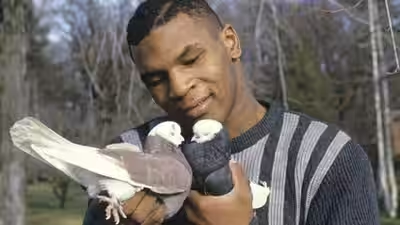

Long before Mike Tyson became one of boxing’s most feared heavyweight champions, pigeons were a source of love and comfort for him. Tyson has recalled being bullied as a child growing up in Brooklyn and finding refuge in the pigeons he kept, saying that spending time with them helped take his mind off the world around him and the people who picked on him. The birds became so important that Tyson later described pigeons as the first loving relationship he ever had. They were also unexpectedly connected to the beginning of his fighting life. Tyson has said that when a neighbourhood bully killed one of his pigeons in front of him, he fought back, marking what he has described as his first fight. More than five decades later, his fascination with the birds remains strong. In March 2025, Tyson said he owned hundreds of pigeons, perhaps as many as 1,000, across the US.
Mike Tyson’s connection with pigeons began in Brooklyn
Tyson’s relationship with pigeons goes back to his childhood in Brooklyn, where he became involved with the birds long before he entered boxing. His affection for them developed at a time when he was dealing with difficulties at home and being bullied by other children. In a 2011 New Yorker account, Tyson explained that spending time with pigeons helped take his mind away from the world he was living in and the people who bullied him. The birds gave him something to care for and a space where he could escape from the pressures around him. Tyson has also recalled that he was around 11 when pigeons became closely connected with his life and eventual involvement in fighting.Tyson’s attachment to pigeons was unusually deep for a childhood hobby. He has described them as his first loving relationship, a phrase that captures how emotionally important the birds became to him. His interest was not simply about owning animals. He spent time caring for them, watching them fly and becoming familiar with the different types of pigeons and their behaviour. The rooftop pigeon coops of Brooklyn became a place where he could spend time away from the difficulties of his childhood. The New Yorker reported Tyson explaining that the birds helped him take his mind off the world around him, particularly the people who bullied him.

One pigeon became connected to his first fight
Perhaps the most remarkable part of Tyson’s pigeon story is the connection he has drawn between the birds and his development as a fighter. According to accounts of Tyson’s childhood, a neighbourhood bully took one of his pigeons, killed it and threw the bird at Tyson. Tyson reacted by punching the boy. CBS reported in 2011 that Tyson’s first punch came after a neighbourhood bully killed one of his beloved pigeons. Tyson has repeatedly told versions of this story and has connected the incident with the beginning of his fighting instinct. It should be treated as Tyson’s own account of an important moment in his life, rather than as proof that the incident alone caused his boxing career.
Pigeons remained with him as boxing took over
As Tyson’s life changed and he rose through the boxing world, his relationship with pigeons did not disappear. He continued keeping birds even after becoming heavyweight champion and one of the most recognisable athletes in the world. The New Yorker reported in 2011 that Tyson had raised pigeons before he began boxing, while earlier reporting documented his continued involvement with pigeon keeping in adulthood. The contrast was striking. Outside the ring Tyson became known for extraordinary power and aggression, yet around his pigeons he displayed a markedly gentler side. One account described him gently kissing a pigeon on the beak before releasing it, highlighting how different his relationship with the birds could look from his public image as a fighter.Tyson eventually took his lifelong interest further by becoming involved in competitive homing-pigeon racing. In 2011, Animal Planet’s six-part series Taking on Tyson followed the former heavyweight champion as he attempted to build a team and compete in the sport. CBS reported that Tyson was a longtime pigeon fancier but a novice at racing, with experienced racers helping him learn the competitive side of the hobby. Homing-pigeon racing involves releasing birds away from their home lofts and timing how quickly they return. The races can progress from relatively short distances to hundreds of miles.
Tyson treated pigeon racing almost like another form of competition
The competitive element appealed to Tyson because it gave him another form of challenge after years in boxing. His involvement was not limited to watching birds fly. He learned about breeding, training and preparing pigeons for races and worked with experienced people in the sport. The 2011 series showed Tyson moving into a world that was unfamiliar to him despite his lifelong experience with pigeons. His passion also attracted controversy. Animal rights organisation PETA criticised his involvement in pigeon racing, arguing that racing could expose birds to injuries, exhaustion and other risks. Tyson’s supporters and people involved in the sport, meanwhile, presented it as an established competitive tradition centred on the birds’ homing ability.
His collection has been much larger than a normal backyard flock
Tyson’s pigeon collection has varied considerably in size over the years, and figures reported at different times should not be treated as a single permanent total. In 2011, The New Yorker reported that Tyson had around 3,000 birds, while other contemporary accounts also put his collection in the thousands. At other points, reports focused on much smaller numbers kept at particular homes. These differences are important because Tyson has maintained birds in different locations and because the size of a racing or breeding collection can change over time. What is clear is that his involvement has extended far beyond keeping a handful of pet pigeons.
Tyson still has hundreds of pigeons decades later
The most useful current figure comes directly from Tyson himself. In a March 2025 interview with PEOPLE, the then-58-year-old Tyson said he owned hundreds of pigeons, adding that the total could be “maybe a thousand”. He said the birds were spread across California, New Jersey, Florida and Las Vegas. This is the strongest basis for saying that Tyson still keeps hundreds of pigeons across the US. Because the figure is Tyson’s own estimate rather than an independently verified count, it is more accurate to report it as hundreds, possibly around 1,000, rather than stating that he definitely owns exactly 1,000 birds.Tyson’s latest comments make clear that pigeons are not simply a nostalgic reminder of his childhood. He told PEOPLE that he has been involved with pigeons for longer than he has done anything else, including boxing. He also said that pigeons had both got him into trouble and got him out of trouble and described them as something that had been part of his entire life. His remark that boxing is over but pigeons are still here neatly captures the unusual longevity of the relationship. The heavyweight championship years came and went, but the birds remained a constant presence.
From Brooklyn rooftops to birds across America
The geography of Tyson’s pigeon keeping has changed dramatically since his childhood. What began with birds around Brooklyn’s rooftops eventually became a passion involving lofts and birds in different parts of the country. His 2025 account places pigeons in California, New Jersey, Florida and Las Vegas, showing that the hobby has followed him through several stages of his adult life. Yet the basic attraction appears unchanged. Tyson still photographs and makes videos with his birds and has even included them in promotional material. For someone whose public identity was built around violence and competition, his decades-long devotion to pigeons offers a very different picture of the man away from the boxing ring.
Source link


