
World

Meet Benjamin Davis, the 16-year-old Massachusetts student who built a machine that turns 3D-printer waste into reusable filament and won $75,000

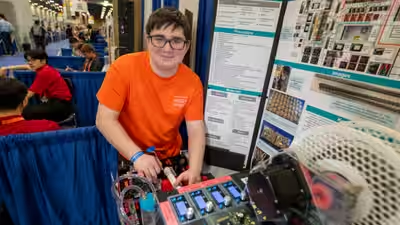
Meet Benjamin Davis, the 16-year-old Massachusetts student who built a machine that turns 3D-printer waste into reusable filament and won $75,000
Davis, a student at Bishop Feehan High School in Attleboro, Massachusetts, built the machine as part of his science research project. The system uses waste plastic, including waste generated during 3D printing and converts it into filament that can again be fed into a 3D printer.

A failed 3D print typically goes straight to the trash with a tangle of plastic filament, a misshapen object or a handful of scraps that no longer feel useful. For 16-year-old Benjamin Davis, those leftovers were something else altogether. For Davis, they were raw material, waiting for another chance. The Massachusetts high school student spent hundreds of hours developing a small recycling system to convert discarded 3D-printing plastic into usable filament. His invention addressed a growing waste problem and won him $75,000 at one of the world’s largest science competitions, states an online report by the Society for Science.

Recycling plastic scraps into filament

Davis, a student at Bishop Feehan High School in Attleboro, Massachusetts, built the machine as part of his science research project. The system uses waste plastic, including waste generated during 3D printing and converts it into filament that can again be fed into a 3D printer. The process could let users recycle material from failed prints and other plastic waste instead of buying new filament over and over again. The invention uses two methods of processing plastic: pultrusion and extrusion. The Society for Science reported that Davis developed a system that was roughly 45 percent more efficient than using the existing approaches separately.The machine was also meant to be used practically. It is designed to produce higher quality recycled filament and is relatively easy to operate, adds the report. Davis’s design costs about 90% less than recycling machines on the market, potentially making small-scale plastic recycling more accessible to schools, hobbyists and individual 3D-printer users.

The secret waste of 3D printing

The project deals with a problem that is easily overlooked. 3D printing is now a common technology in classrooms, homes, labs and workplaces but the creation of an object often involves more plastic than the finished product suggests. Failed prints and supports and leftover filament can build up quick. The Society for Science cites information that states that up to 67% of the filament in a regular 3D-printing project becomes waste. Instead of treating them as disposable, Davis’s machine is designed to put those scraps back into the cycle of production. That idea is part of a larger push toward more sustainable manufacturing, in which materials are collected and reused rather than constantly replaced by new ones.

Over 800 hours of experimentation

Getting the machine to work was not straightforward. Davis put in over 800 hours on the project, went through over 50 iterations of the components, and did several large redesigns. Each version gave him another opportunity to fine-tune the system and work out problems with the recycling process. Eventually, the project was taken to the 2025 Regeneron International Science and Engineering Fair (ISEF) in Columbus, Ohio, where Davis competed against other young researchers from around the world.

Acknowledgment of $75,000

Davis snagged a $75,000 Regeneron Young Scientist Award and was runner-up in the competition’s top award category at the 75th annual ISEF. Not only was his project notable for recycling plastic, but it also tried to solve several practical problems at the same time: efficiency, filament quality, ease of use and cost. It’s also desktop-sized, hinting at a future where recycling could happen closer to where plastic waste is created, instead of requiring users to mail material to a large industrial facility.

The next step for Davis

The award was another prod for Davis to continue exploring in the field. His work in plastic recycling and extrusion has made him more interested in advanced manufacturing and mechanical and materials engineering. Those interests could affect his studies when he goes off to college. For now, his invention presents a simple but potentially powerful idea: the plastic waste from a 3D printer doesn’t have to be the end of the story.Image Courtesy: 3dprint website


Source link

Related Articles

Leave a Reply

Your email address will not be published. Required fields are marked *

Back to top button
×
newsnation.aanest.com
Logo
Date of Publish : 16 September 2026, 2:16 am Digital Edition : News nation
Meet Benjamin Davis, the 16-year-old Massachusetts student who built a machine that turns 3D-printer waste into reusable filament and won $75,000

Davis, a student at Bishop Feehan High School in Attleboro, Massachusetts, built the machine as part of his science research project. The system uses waste plastic, including waste generated during 3D printing and converts it into filament that can again be fed into a 3D printer. A failed 3D print typically goes straight to the trash with a tangle of plastic filament, a misshapen object or a handful of scraps that no longer feel useful. For 16-year-old Benjamin Davis, those leftovers were something else altogether. For Davis, they were raw material, waiting for another chance. The Massachusetts high school student spent hundreds of hours developing a small recycling system to convert discarded 3D-printing plastic into usable filament. His invention addressed a growing waste problem and won him $75,000 at one of the world’s largest science competitions, states an online report by the Society for Science.Recycling plastic scraps into filamentDavis, a student at Bishop Feehan High School in Attleboro, Massachusetts, built the machine as part of his science research project. The system uses waste plastic, including waste generated during 3D printing and converts it into filament that can again be fed into a 3D printer. The process could let users recycle material from failed prints and other plastic waste instead of buying new filament over and over again. The invention uses two methods of processing plastic: pultrusion and extrusion. The Society for Science reported that Davis developed a system that was roughly 45 percent more efficient than using the existing approaches separately.The machine was also meant to be used practically. It is designed to produce higher quality recycled filament and is relatively easy to operate, adds the report. Davis’s design costs about 90% less than recycling machines on the market, potentially making small-scale plastic recycling more accessible to schools, hobbyists and individual 3D-printer users.The secret waste of 3D printingThe project deals with a problem that is easily overlooked. 3D printing is now a common technology in classrooms, homes, labs and workplaces but the creation of an object often involves more plastic than the finished product suggests. Failed prints and supports and leftover filament can build up quick. The Society for Science cites information that states that up to 67% of the filament in a regular 3D-printing project becomes waste. Instead of treating them as disposable, Davis’s machine is designed to put those scraps back into the cycle of production. That idea is part of a larger push toward more sustainable manufacturing, in which materials are collected and reused rather than constantly replaced by new ones.Over 800 hours of experimentationGetting the machine to work was not straightforward. Davis put in over 800 hours on the project, went through over 50 iterations of the components, and did several large redesigns. Each version gave him another opportunity to fine-tune the system and work out problems with the recycling process. Eventually, the project was taken to the 2025 Regeneron International Science and Engineering Fair (ISEF) in Columbus, Ohio, where Davis competed against other young researchers from around the world.Acknowledgment of $75,000Davis snagged a $75,000 Regeneron Young Scientist Award and was runner-up in the competition’s top award category at the 75th annual ISEF. Not only was his project notable for recycling plastic, but it also tried to solve several practical problems at the same time: efficiency, filament quality, ease of use and cost. It's also desktop-sized, hinting at a future where recycling could happen closer to where plastic waste is created, instead of requiring users to mail material to a large industrial facility.The next step for DavisThe award was another prod for Davis to continue exploring in the field. His work in plastic recycling and extrusion has made him more interested in advanced manufacturing and mechanical and materials engineering. Those interests could affect his studies when he goes off to college. For now, his invention presents a simple but potentially powerful idea: the plastic waste from a 3D printer doesn’t have to be the end of the story.Image Courtesy: 3dprint website

Source link