World

Washington releases 20 lab-raised sunflower sea stars into the Salish Sea to restore the endangered species and damaged kelp forests | World News

Washington releases 20 lab-raised sunflower sea stars into the Salish Sea to restore the endangered species and damaged kelp forests
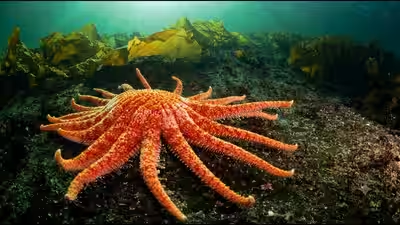
Image: University of Washington

A remarkable conservation effort is unfolding in Washington’s San Juan Islands, where the Samish Indian Nation and University of Washington researchers have released 20 lab-raised sunflower sea stars into the Salish Sea. The endangered predators were raised for three years at Friday Harbour Laboratories before being carefully transported to waters off Decatur Island. Their return to the wild marks a significant milestone in efforts to rebuild a species devastated by sea-star wasting disease, which caused catastrophic population declines across the Pacific coast. Sunflower sea stars play a vital role in maintaining healthy marine ecosystems because they prey on sea urchins that can consume vast areas of kelp when left unchecked. By restoring these natural predators, scientists and tribal conservationists hope to strengthen damaged kelp forests and restore balance to the coastal food web.

Why sunflower stars are crucial to Washington’s kelp forests

Sunflower sea stars are important predators in Pacific Northwest coastal ecosystems, particularly because they prey on purple sea urchins that graze heavily on kelp. A prior study published in Proceedings of the Royal Society B, titled ‘Sunflower sea star predation on urchins can facilitate kelp forest recovery,’ found that sunflower stars consumed an average of about 0.68 purple sea urchins per day in laboratory experiments. The researchers, led by A. W. E. Galloway and S. A. Gravem, used experiments and ecological modelling to show that even modest recovery of sunflower sea-star populations could reduce urchin densities and create more favourable conditions for kelp. Their findings suggest that the loss of these predators following sea-star wasting disease may have contributed to the expansion of urchin barrens and decline of kelp forests. Restoring sunflower stars could therefore help re-establish a natural predator-prey balance and give degraded kelp ecosystems a better chance of recovery.

20 lab-raised sunflower stars return to the wild

The 20 sunflower stars released in Washington were raised by researchers at Friday Harbour Laboratories on San Juan Island. Scientists have spent years learning how to breed and care for the species, which was comparatively little studied before its dramatic population collapse. As reported by NPR, the animals were about three years old when they were released, with some reaching roughly the size of an adult’s outstretched hand. Researchers had even given several of them names, including Nacho, Baby Carrot and Pluot, reflecting how closely the laboratory team had cared for them during their development. The release itself required careful planning. Researchers transported the stars in tubs aboard the Samish research vessel Chinook (Yómech), then divers carried them underwater and placed them on the seafloor near Decatur Island. Once released, the animals quickly began exploring their surroundings, moving across rocks and seeking shelter among kelp fronds. For the researchers, watching a lab-raised star encounter a natural habitat for the first time represented an emotional milestone.

20 lab-raised sunflower stars return to the wild(Image: AI Generated)

20 lab-raised sunflower stars return to the wild(Image: AI Generated)

A conservation effort shaped by disease and Indigenous stewardship

The project has not been without setbacks. The original release was planned for October 2025, but researchers discovered that sea-star wasting disease was still active in the San Juan Islands and postponed the operation. The release eventually went ahead in April 2026 after conditions improved. The disease is particularly devastating because sunflower stars were once widespread across the Pacific coast but were hit extraordinarily hard by the outbreak. International scientists have classified the species as critically endangered, while conservation groups have pushed for stronger legal protection. The Samish Indian Nation sees the recovery effort as part of a broader responsibility to protect the waters and ecosystems connected to its traditional territory. Although sunflower stars were not as culturally prominent as salmon, tribal leaders recognise their role in maintaining kelp forests. Samish tribal chair Tom Wooten explained that the stars matter because they prey on the green urchins that can devastate kelp. If the released stars survive and reproduce, they could eventually help restore a missing predator to the region’s food web. Scientists caution that 20 animals alone cannot rebuild an entire population, but the release provides a valuable real-world test of whether laboratory-raised sunflower stars can adapt, survive and eventually contribute to the recovery of one of the Pacific Northwest’s most threatened marine ecosystems.


Source link

Related Articles

Leave a Reply

Your email address will not be published. Required fields are marked *

Back to top button
×
newsnation.aanest.com
Logo
Date of Publish : 24 August 2026, 1:36 pm Digital Edition : News nation
Washington releases 20 lab-raised sunflower sea stars into the Salish Sea to restore the endangered species and damaged kelp forests | World News

Image: University of Washington A remarkable conservation effort is unfolding in Washington’s San Juan Islands, where the Samish Indian Nation and University of Washington researchers have released 20 lab-raised sunflower sea stars into the Salish Sea. The endangered predators were raised for three years at Friday Harbour Laboratories before being carefully transported to waters off Decatur Island. Their return to the wild marks a significant milestone in efforts to rebuild a species devastated by sea-star wasting disease, which caused catastrophic population declines across the Pacific coast. Sunflower sea stars play a vital role in maintaining healthy marine ecosystems because they prey on sea urchins that can consume vast areas of kelp when left unchecked. By restoring these natural predators, scientists and tribal conservationists hope to strengthen damaged kelp forests and restore balance to the coastal food web.Why sunflower stars are crucial to Washington’s kelp forestsSunflower sea stars are important predators in Pacific Northwest coastal ecosystems, particularly because they prey on purple sea urchins that graze heavily on kelp. A prior study published in Proceedings of the Royal Society B, titled ‘Sunflower sea star predation on urchins can facilitate kelp forest recovery,’ found that sunflower stars consumed an average of about 0.68 purple sea urchins per day in laboratory experiments. The researchers, led by A. W. E. Galloway and S. A. Gravem, used experiments and ecological modelling to show that even modest recovery of sunflower sea-star populations could reduce urchin densities and create more favourable conditions for kelp. Their findings suggest that the loss of these predators following sea-star wasting disease may have contributed to the expansion of urchin barrens and decline of kelp forests. Restoring sunflower stars could therefore help re-establish a natural predator-prey balance and give degraded kelp ecosystems a better chance of recovery.20 lab-raised sunflower stars return to the wildThe 20 sunflower stars released in Washington were raised by researchers at Friday Harbour Laboratories on San Juan Island. Scientists have spent years learning how to breed and care for the species, which was comparatively little studied before its dramatic population collapse. As reported by NPR, the animals were about three years old when they were released, with some reaching roughly the size of an adult’s outstretched hand. Researchers had even given several of them names, including Nacho, Baby Carrot and Pluot, reflecting how closely the laboratory team had cared for them during their development. The release itself required careful planning. Researchers transported the stars in tubs aboard the Samish research vessel Chinook (Yómech), then divers carried them underwater and placed them on the seafloor near Decatur Island. Once released, the animals quickly began exploring their surroundings, moving across rocks and seeking shelter among kelp fronds. For the researchers, watching a lab-raised star encounter a natural habitat for the first time represented an emotional milestone.20 lab-raised sunflower stars return to the wild(Image: AI Generated)A conservation effort shaped by disease and Indigenous stewardshipThe project has not been without setbacks. The original release was planned for October 2025, but researchers discovered that sea-star wasting disease was still active in the San Juan Islands and postponed the operation. The release eventually went ahead in April 2026 after conditions improved. The disease is particularly devastating because sunflower stars were once widespread across the Pacific coast but were hit extraordinarily hard by the outbreak. International scientists have classified the species as critically endangered, while conservation groups have pushed for stronger legal protection. The Samish Indian Nation sees the recovery effort as part of a broader responsibility to protect the waters and ecosystems connected to its traditional territory. Although sunflower stars were not as culturally prominent as salmon, tribal leaders recognise their role in maintaining kelp forests. Samish tribal chair Tom Wooten explained that the stars matter because they prey on the green urchins that can devastate kelp. If the released stars survive and reproduce, they could eventually help restore a missing predator to the region’s food web. Scientists caution that 20 animals alone cannot rebuild an entire population, but the release provides a valuable real-world test of whether laboratory-raised sunflower stars can adapt, survive and eventually contribute to the recovery of one of the Pacific Northwest’s most threatened marine ecosystems.

Source link