
World

Scientists used a microlight aircraft to teach bald ibises a migration route; years later, Europe got its first self-sustaining colony in 400 years | World News

Scientists used a microlight aircraft to teach bald ibises a migration route; years later, Europe got its first self-sustaining colony in 400 years

For centuries, the northern bald ibis was missing from Europe’s skies, its migratory population wiped out in Central Europe by the 17th century. Bringing it back required more than releasing captive-bred birds into the Alps: conservationists first had to teach them where to go. The Waldrappteam found an ingenious solution, training young ibises to follow a microlight aircraft south towards their wintering grounds in Italy. The experiment began producing remarkable results. In 2007, the birds completed their first successful flight over the Alps behind the aircraft, and by 2011 they were returning without human guidance. Years later, Europe had its first self-sustaining colony in 400 years.

Microlight aircraft helped bald ibises relearn their ancient migration route

According to the study published by Cambridge University Press, titled ‘On the road to self-sustainability: reintroduced migratory European northern bald ibises Geronticus eremita still need management interventions for population viability’, the northern bald ibis, Geronticus eremita, was once a familiar sight in Central Europe, particularly around the Alps. The birds survived in the region until the 17th century, when intensive hunting drove them to extinction. Chicks were considered a delicacy, and pressure from hunting eventually wiped the species out in Central Europe. The zoo describes the Waldrappteam as an effort to restore the migratory bird to the Alps after centuries of absence.The disappearance was particularly difficult to reverse because migration is not simply an instinct that every young bird can perform without guidance. The Oryx study explains that juveniles normally learn their migration route by following other members of their species to the wintering grounds. That created a problem for captive-bred birds being prepared for release: without experienced migrants to follow, simply putting them back into the landscape would not necessarily give them the knowledge needed to complete their annual journey.

Human foster parents trained young ibises to follow a microlight

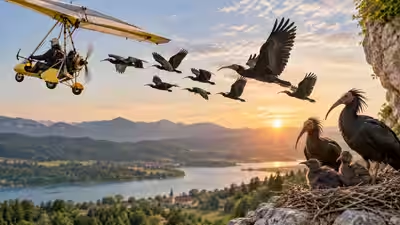
According to Hellabrunn Zoo, the Waldrappteam developed a human-led migration system to solve that problem. Zoo-hatched chicks had human foster parents, and once the young birds could fly, they were trained to follow a microlight aircraft. In autumn, the aircraft travelled south towards the birds’ wintering grounds, with the young ibises following behind. Hellabrunn explains that the birds would then return to their breeding grounds using the route they had learned.Birds in the research either had been raised in zoo breeding colonies and prepared for release by human foster parents, or had been born in the wild to previously released birds. The researchers state that birds prepared for release were “trained to follow a microlight plane” to the common wintering ground, where they were integrated into the population. From 2011 onwards, increasing numbers of chicks were instead raised naturally by their biological parents and could follow other ibises on their first migration.

Human foster parents trained young ibises to follow a microlight

Image AI generated

The first successful microlight migration came in 2007

The first breakthrough came in 2007, when the Waldrappteam successfully flew northern bald ibises over the Alps to Italy behind a microlight aircraft. Four years later, in 2011, the birds began returning to their starting point in Burghausen, Germany, without being led. The project then took several more years to establish a self-sufficient breeding colony, becoming the zoo’s first such colony in Europe for 400 years.The wider project grew steadily. The scientific paper says that a European research project began in 2002 and became a European Union LIFE+ funded translocation and conservation project in 2014. By late 2021, the reintroduced Waldrappteam population contained about 200 birds across four breeding colonies: two in southern Germany and two in Austria. The colonies were treated as one population because the birds shared the same wintering ground at WWF Oasi Laguna di Orbetello in Tuscany, Italy.

Illegal hunting and power poles remained major threats

Researchers analysed 384 northern bald ibises from generations produced between 2008 and 2019, finding survival probabilities of 0.64–0.78, with 45% of mature females reproducing and an average of 2.15 fledglings per nest. However, their population viability analysis estimated a growth rate of 0.95 and a 24% extinction probability within 50 years. Of 326 management scenarios tested, 94% met the study’s criteria for a viable population, showing that further action was still needed. The main threats were illegal hunting in Italy and electrocution on unsecured power poles, while retrofitting dangerous poles in Germany reduced the country’s electrocution loss rate by 91%.By teaching captive-bred ibises to follow a microlight aircraft, conservationists recreated the migration knowledge that had disappeared with the original population. The birds eventually learned to make the journey without human guidance, while later generations could learn the route naturally from other ibises.


Source link

Related Articles

Leave a Reply

Your email address will not be published. Required fields are marked *

Back to top button
×
newsnation.aanest.com
Logo
Date of Publish : 14 September 2026, 3:52 pm Digital Edition : News nation
Scientists used a microlight aircraft to teach bald ibises a migration route; years later, Europe got its first self-sustaining colony in 400 years | World News

For centuries, the northern bald ibis was missing from Europe's skies, its migratory population wiped out in Central Europe by the 17th century. Bringing it back required more than releasing captive-bred birds into the Alps: conservationists first had to teach them where to go. The Waldrappteam found an ingenious solution, training young ibises to follow a microlight aircraft south towards their wintering grounds in Italy. The experiment began producing remarkable results. In 2007, the birds completed their first successful flight over the Alps behind the aircraft, and by 2011 they were returning without human guidance. Years later, Europe had its first self-sustaining colony in 400 years.Microlight aircraft helped bald ibises relearn their ancient migration routeAccording to the study published by Cambridge University Press, titled ‘On the road to self-sustainability: reintroduced migratory European northern bald ibises Geronticus eremita still need management interventions for population viability’, the northern bald ibis, Geronticus eremita, was once a familiar sight in Central Europe, particularly around the Alps. The birds survived in the region until the 17th century, when intensive hunting drove them to extinction. Chicks were considered a delicacy, and pressure from hunting eventually wiped the species out in Central Europe. The zoo describes the Waldrappteam as an effort to restore the migratory bird to the Alps after centuries of absence.The disappearance was particularly difficult to reverse because migration is not simply an instinct that every young bird can perform without guidance. The Oryx study explains that juveniles normally learn their migration route by following other members of their species to the wintering grounds. That created a problem for captive-bred birds being prepared for release: without experienced migrants to follow, simply putting them back into the landscape would not necessarily give them the knowledge needed to complete their annual journey.Human foster parents trained young ibises to follow a microlightAccording to Hellabrunn Zoo, the Waldrappteam developed a human-led migration system to solve that problem. Zoo-hatched chicks had human foster parents, and once the young birds could fly, they were trained to follow a microlight aircraft. In autumn, the aircraft travelled south towards the birds' wintering grounds, with the young ibises following behind. Hellabrunn explains that the birds would then return to their breeding grounds using the route they had learned.Birds in the research either had been raised in zoo breeding colonies and prepared for release by human foster parents, or had been born in the wild to previously released birds. The researchers state that birds prepared for release were “trained to follow a microlight plane” to the common wintering ground, where they were integrated into the population. From 2011 onwards, increasing numbers of chicks were instead raised naturally by their biological parents and could follow other ibises on their first migration.Image AI generatedThe first successful microlight migration came in 2007The first breakthrough came in 2007, when the Waldrappteam successfully flew northern bald ibises over the Alps to Italy behind a microlight aircraft. Four years later, in 2011, the birds began returning to their starting point in Burghausen, Germany, without being led. The project then took several more years to establish a self-sufficient breeding colony, becoming the zoo's first such colony in Europe for 400 years.The wider project grew steadily. The scientific paper says that a European research project began in 2002 and became a European Union LIFE+ funded translocation and conservation project in 2014. By late 2021, the reintroduced Waldrappteam population contained about 200 birds across four breeding colonies: two in southern Germany and two in Austria. The colonies were treated as one population because the birds shared the same wintering ground at WWF Oasi Laguna di Orbetello in Tuscany, Italy.Illegal hunting and power poles remained major threatsResearchers analysed 384 northern bald ibises from generations produced between 2008 and 2019, finding survival probabilities of 0.64–0.78, with 45% of mature females reproducing and an average of 2.15 fledglings per nest. However, their population viability analysis estimated a growth rate of 0.95 and a 24% extinction probability within 50 years. Of 326 management scenarios tested, 94% met the study's criteria for a viable population, showing that further action was still needed. The main threats were illegal hunting in Italy and electrocution on unsecured power poles, while retrofitting dangerous poles in Germany reduced the country's electrocution loss rate by 91%.By teaching captive-bred ibises to follow a microlight aircraft, conservationists recreated the migration knowledge that had disappeared with the original population. The birds eventually learned to make the journey without human guidance, while later generations could learn the route naturally from other ibises.

Source link