
Scientists are using worms that eat human waste to turn toilet waste into compost, but parasitic eggs can survive the process |

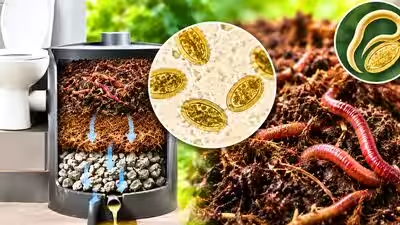

Tiger worm toilets are designed to turn human waste into vermicompost using worms that feed on and break down organic material. The approach can reduce the amount of waste that builds up in a toilet and has been studied as a form of non-sewered sanitation. Researchers tested whether tiger worms could destroy Ascaris eggs under conditions designed to replicate a tiger worm toilet. The research, published in the Royal Society of Chemistry titled ‘Experimental evaluation of Ascaris egg survival during vermicomposting of faeces,’ found that the eggs remained intact and viable even after prolonged exposure to the worms. The researchers used pig faeces containing a known concentration of Ascaris suum eggs and monitored what happened inside laboratory-scale biodigesters. Some eggs were found in the vermicompost, while others moved into the coir, gravel and effluent.
How researchers tested tiger worms and Ascaris eggs in faecal waste
The researchers wanted to determine whether tiger worms could degrade or inactivate Ascaris eggs while processing faecal material. To test this, they built six laboratory-scale biodigesters containing Eisenia fetida, commonly known as tiger worms. Three identical control units were set up without worms. Each system contained a gravel drainage layer and a coconut coir bedding layer. The biodigesters received 100 grams of pig faeces each day for four weeks. The faeces had been deliberately spiked with Ascaris suum eggs at a concentration of 80 eggs per gram. After the feeding period, researchers examined material from different layers to determine where the eggs had gone and whether they remained viable. The experiment found no evidence that tiger worms degraded the eggs under the conditions tested.

PC: AI Generated
Where did the Ascaris eggs end up inside the systems
In the biodigesters, between 48 and 72% of the recovered eggs were found in the coir layer. By contrast, 71 to 74 % of the eggs in the control units remained in the original pig faeces layer. Eggs were also detected in the gravel and effluent of the biodigesters, although these contained smaller proportions. The researchers noted that worm movement between layers may have helped displace eggs and move them downwards through the system. The vermicompost itself contained about 1.5 to 2.5% of the recovered eggs. No eggs were detected in the gravel or effluent of the control units, where worms were absent.
How Ascaris eggs survived after weeks with tiger worms
The researchers also wanted to know whether the eggs could still survive. Their analysis found that all the Ascaris eggs were recovered from both biodigester and control layers. The eggs remained intact throughout the experimental period. The study followed the systems for different periods after feeding, with some biodigesters examined after 6, 10, and 14 weeks. Even after prolonged exposure to tiger worms, the researchers found no evidence that the eggs had been inactivated. The number of eggs recovered from the biodigesters was also similar to that found in the control systems. Taken together, the results reveal that tiger worms did not measurably degrade or inactivate the eggs under the conditions tested.
What happens to waste from tiger worm toilets after treatment
The findings also raise questions about how material from tiger worm toilets should be handled after treatment. Under the conditions tested, the researchers said the vermicompost and effluent should not be considered safe for agricultural use without further treatment or safe disposal. This is especially important in areas where ascariasis is common. The study also refers to World Health Organization guidance, which sets a limit of no more than one viable helminth egg per gram of total solids for treated products intended for safe reuse or disposal. The researchers recommend testing end products from tiger worm toilets for helminth eggs, particularly where the risk of transmission is high.
Source link


