
Nearly 2,000-year-old vessel with two snake heads found at a Roman villa in Spain; archaeologists link it to the secretive cult of Sabazios | World News

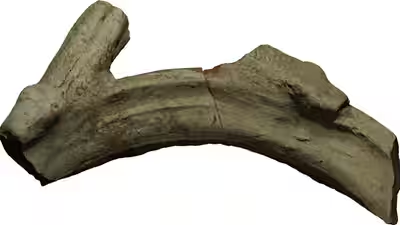

At the Roman villa of Collet, on a low cliff above Spain’s Bay of Palamós, archaeologists have uncovered fragments of a large ceramic vessel that appears to reveal one of the empire’s more secretive religious practices. Its handle, moulded into a two-headed serpent covered in tiny incised scales, was broken and buried close to a bread oven sometime during the Augustan period, roughly two thousand years ago. Researchers now argue the piece belonged to the cult of Sabazios, a Thracian and Phrygian god whose worship in the Roman world rarely left the home. Evidence for the cult on the Iberian Peninsula is thin, mostly clustered near the ancient city of Emporiae, making the Collet find a rare rural example. Laboratory testing of the vessel’s clay points further still, suggesting it may have travelled from Roman Africa rather than being made locally, hinting at how far the cult’s quiet influence could reach.
What does the snake-headed vessel reveal
The fragments were recovered from the Roman villa of Collet, which sits on a rocky outcrop roughly 20 metres above the Bay of Palamós, in the ancient territory linking the ciuitates of Gerunda and Emporiae. According to the study published by Cambridge University Press, titled ‘Of snakes and gods: early evidence for the cult of Sabazios in the Roman villa of Collet’, the site was first identified in the late nineteenth century. Still, it was not properly excavated until the early 2000s, with work on the villa itself beginning in 2015. Archaeologists have since traced five distinct phases of activity at Collet, starting with a modest rural settlement built around a wine cellar and grain store at the end of the second or start of the first century BC.The snake-decorated fragments turned up just outside the villa’s east wall, in a layer connected to the construction of a bread oven during the Augustan period. The surrounding pottery, including Baetican and Tarraconensis amphorae, fragments of grey Emporitan ware and a piece of Italian terra sigillata, confirms that the vessel was already broken and buried by this time. A second wave of finds from the oven’s period of use, including a cup of Italian terra sigillata and a slightly later amphora style, pin the deposit firmly to the first half of the first century AD.
Why does the vessel have two snake heads
What survives of the vessel is only part of its everted rim and a single handle, but the decoration leaves little doubt about its intended purpose. The handle bears a coarse but elaborate design showing a snake with a head at each end, meeting the rim on either side, its body covered in small semi-circular incisions meant to suggest overlapping scales. Simple incised eyes and a moulded line marking the mouth give the two serpent heads a somewhat stylised, though still recognisable, form.Researchers compared the shape to a known typology of Sabazios-linked vessels from Germania and Belgica, established by the scholar M. Amand, though the Collet piece does not fully match that classification. The fragments lack the pouring spout typical of that type, and their decoration more closely resembles examples recorded at Carnuntum in Austria, albeit vessels believed to be later and produced in workshops in northern Gaul. Because the body of the vessel was never recovered, the researchers stop short of assigning it to any established category, describing it instead as a distinctive, if related, local variant.
Who was Sabazios and how was his cult worshipped
Sabazios was a god of the Thracian and Phrygian peoples of the Balkans, and his worship in the Roman world stayed largely private, practised within households rather than in public shrines. One of the clearest parallels comes from a house in Pompeii, where a small brick altar in a garden courtyard was found alongside two terracotta vessels decorated with snakes and toads, motifs closely associated with the god. Because the cult relied on symbolic objects such as bronze hands, small plaques and specific ceramic bowls rather than temples or inscriptions, tracing its spread depends heavily on recognising this recurring imagery.Evidence for the cult on the Iberian Peninsula remains sparse, largely confined to its northern edge. A bronze bust interpreted as a Sabazios figure was found at l’Alcúdia near Elche, a bronze hand recovered off Cartagena is thought to have come from a shipwreck, and a possible sanctuary at the Cueva Negra site in Murcia remains disputed among scholars. The strongest evidence lies near Empúries, the ancient city of Emporiae, where an Augustan-era tomb produced a triptych of bronze plaques depicting Sabazios and the twin gods Castor and Pollux, suggesting an itinerant priest may once have carried the cult inland from the coast.
How did researchers trace the vessel’s possible African origin
Examination of the ceramic paste under a binocular microscope revealed a compact, well-fired red fabric containing quartz, mica and small white mineral nodules likely formed from altered calcium carbonate, while x-ray diffraction confirmed the presence of feldspar alongside these zeolite-like deposits. A trace of white slip on the fragment’s surface, made from the same finely ground minerals, further set the piece apart from pottery produced at the nearby Collet Est workshop.These traits point away from a local Catalan origin and towards production somewhere in Roman Africa, even though comparable Sabazios vessels are almost unknown there. Only a single similar vessel of Tunisian origin, held in a German museum collection and undated, offers even a loose parallel. The researchers conclude that the Collet fragment represents an early rural example of Iberian “serpent-ware,” suggesting that even a minor, intimate cult such as that of Sabazios could travel far beyond the cities where it first took root, reaching quietly into the countryside of the western provinces.
Source link