
In 2013, Nasa sent 20 giant balloons drifting over Antarctica to track particles falling from space and uncover what happened when they reached Earth |

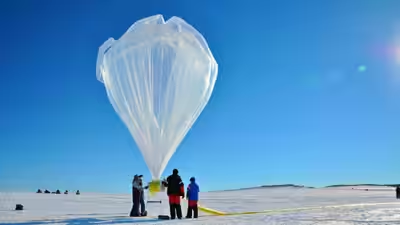

High above the ice in Antarctica, a group of enormous balloons was quietly tracking a phenomenon that could not be seen from the ground. In January 2013, Nasa’s BARREL mission sent 20 balloons drifting through the polar winds, carrying instruments designed to detect faint X-rays produced when energetic particles entered Earth’s upper atmosphere. The experiment was part of a much larger effort to understand what happens inside the Van Allen radiation belts, where charged particles can become trapped by Earth’s magnetic field and later escape towards the poles.As the balloons moved with the winds, their measurements were matched with observations from Nasa’s Van Allen Probes, which were travelling through the radiation belts themselves. The unusual pairing gave scientists a chance to examine both ends of the same process: particles moving through near-Earth space and the traces they left behind when they reached the atmosphere.
Nasa’s BARREL mission: How 20 giant balloons were used in 2013 to track X-rays over Antarctica
The first Antarctic BARREL campaign involved 20 balloons. They were released at intervals of roughly a day or two, allowing the team to build up a spread of measurements as the balloons moved with the circumpolar winds.These were not ordinary weather balloons. According to Nasa, when fully inflated, a BARREL balloon was about 90 feet (27 metres) across, while the scientific payload underneath was relatively small. Each flight carried instruments capable of detecting X-rays generated high in the atmosphere. The balloons could remain airborne for several days, and some stayed aloft for as long as 40 days.The launch sites included the South African National Antarctic Expedition base at SANAE IV and Halley Research Station. Antarctica offered a useful vantage point because Earth’s magnetic field guides charged particles towards the polar regions. That made the continent a practical place to watch radiation belt particles arriving in the atmosphere.

PC: Nasa
How scientists tracked particles escaping Earth’s radiation belts
The balloons were not primarily studying Antarctica or its atmosphere. Their target was much farther up.Earth is surrounded by the Van Allen radiation belts, regions containing energetic charged particles held in place by the planet’s magnetic field. The population of these particles changes as conditions in near-Earth space respond to activity from the Sun. During periods of disturbance, the radiation environment around Earth can become more hazardous for spacecraft.Particles do not simply remain trapped in the belts. Some are scattered out and travel along Earth’s magnetic field lines towards the atmosphere. Understanding how quickly this happens, and under what conditions, helps scientists build a clearer picture of how the belts gain and lose energetic particles.
Why scientists looked for X-rays in the atmosphere
An energetic electron falling into the atmosphere does not arrive unnoticed. When these particles collide with atoms and molecules, they can produce X-rays. BARREL’s instruments were built to detect that radiation.This gave scientists an indirect way of counting and studying particles that had escaped the radiation belts. Instead of trying to follow every electron individually, the balloons measured the X-ray signature produced when populations of energetic electrons reached the atmosphere.The balloons were effectively watching the consequences of particle loss while another spacecraft was measuring conditions inside the radiation belts themselves.
How scientists tracked particles from space to the atmosphere
Reportedly, BARREL was designed to work with Nasa’s Van Allen Probes, two spacecraft launched in 2012 to travel through the radiation belts. The satellites could measure the particles, fields and waves present in the belts, while the balloons observed the particles that had already begun making their way into the atmosphere.When observations from the two missions overlapped, scientists could compare the conditions in space with the resulting precipitation into the atmosphere. This was particularly useful during periods of geomagnetic activity, when the behaviour of the radiation belts could change.The aim was not simply to collect two separate sets of measurements. By putting the observations together, the researchers could investigate whether changes seen inside the belts matched increases or decreases in the particles reaching the atmosphere.
The magnetic pathways that made the poles important
The choice of polar regions was tied to Earth’s magnetic field. Its field lines extend towards the northern and southern magnetic regions, providing pathways along which charged particles can move into the upper atmosphere.That is why the broader BARREL mission eventually operated in both hemispheres. The first campaigns, however, were conducted in Antarctica in 2013 and 2014. Later campaigns included balloon flights from Sweden, above the Arctic Circle. Nasa describes the mission as studying X-rays in Earth’s atmosphere near both the North and South Poles.So the description of BARREL as a polar balloon experiment covers the mission as a whole, rather than meaning that the original January 2013 flights took place at both poles. Those first 20 balloons were launched in Antarctica.
What the experiment could tell scientists about space weather
Space weather is partly a question of how energy and charged particles move through the environment around Earth. Solar activity can alter the radiation belts, and changes in those belts can affect the radiation conditions encountered by satellites.Knowing how particles are lost from the belts is therefore part of understanding the wider system. BARREL’s measurements helped researchers examine one of those escape routes: energetic electrons travelling down magnetic field lines and producing detectable X-rays when they reached the atmosphere.The information was also valuable because the Van Allen Probes and BARREL were observing different parts of the same process. One set of instruments was in space inside the radiation belts; the other was much closer to Earth, waiting for some of the escaping particles to reveal themselves through their atmospheric X-ray signatures.
The experiment continued after the first 20 balloons
The January 2013 campaign was only the beginning. After the first Antarctic flights, the BARREL team prepared another 20-balloon campaign for the following Antarctic summer, which began in December 2013 and continued into February 2014.The mission later expanded beyond Antarctica. Balloon campaigns were conducted from Sweden, with launches near Kiruna above the Arctic Circle. Nasa records seven BARREL campaigns between 2013 and 2020, with a total of 58 science flights from Antarctica and Sweden.
Source link