
In 1995, Clint Eastwood sold a large California property for $3.08 million; the land was placed under permanent conservation protection instead of being developed | World News

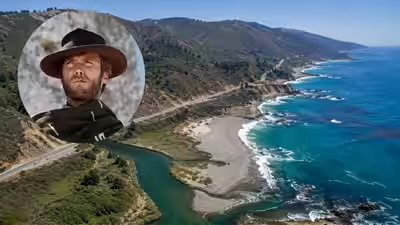

In 1995, actor and filmmaker Clint Eastwood sold roughly 280 acres of his California coastal property to Monterey County for $3.08 million, helping ensure that a large stretch of scenic land would remain undeveloped. The property, associated with Eastwood’s long-held Malpaso holdings near Carmel Highlands, was divided into five parcels and was acquired by the county for open-space preservation. Rather than becoming available for future construction, the land was placed under a conservation easement intended to protect it permanently. The transaction formed part of a wider conservation effort around Carmel and the Carmel River, where several important coastal properties were facing development pressure. Eastwood’s role in the episode was more complicated than a simple donation, since the county purchased the land, but the resulting protection prevented its future development.
Clint Eastwood’s long connection to the land
Eastwood began acquiring property around Malpaso Creek in the late 1960s, building a substantial collection of land along the rugged Monterey County coast. Contemporary accounts reported that his broader holdings in the area eventually covered roughly 650 acres, although the portion involved in the 1995 county transaction was considerably smaller. Eastwood had purchased land in the area during a period when development was increasingly changing parts of the Carmel region, while the coastal landscape around Malpaso Creek retained large areas of undeveloped terrain. The property’s location along Highway 1 and near the Big Sur coast also gave it considerable scenic and environmental importance.
The $3.08 million sale
In 1995, Monterey County purchased approximately 279 to 280 acres of Eastwood’s Malpaso property for $3.08 million. The land consisted of five parcels and was acquired for open-space purposes. Contemporary reporting connected the transaction to California’s Proposition 70, a state bond measure that provided money for acquiring and protecting open space. The deal therefore involved a direct purchase rather than a straightforward charitable donation by Eastwood. The distinction matters because the conservation result came through a public acquisition in which the county became the owner of the property.
The land was protected from future development
One of the most significant aspects of the transaction was what happened after the county acquired the property. The Malpaso land was subject to a conservation easement that required its protection in perpetuity. The restriction was designed to prevent the county’s ownership from later being converted into a development opportunity. The arrangement meant that the property could remain open space rather than being subdivided or built over. Contemporary reporting also noted that the land was not simply turned into a conventional public park, with questions surrounding public access remaining separate from the permanent protection of the property itself.
The property had been facing a very different future
The significance of the acquisition becomes clearer when viewed against the development pressures affecting the Carmel area at the time. Nearby land around the Carmel River was also being considered for residential development, prompting conservation groups and local authorities to look for ways to preserve remaining open spaces. The Malpaso transaction became connected to a broader series of property deals involving the Eastwoods, Monterey County and the Big Sur Land Trust. Together, those efforts helped protect several hundred acres of environmentally and scenically important land around the Carmel coast.
The deal was linked to the fight over Odello Ranch
The 1995 Malpaso sale was particularly important because it was intertwined with the preservation of the nearby Odello Ranch, a former artichoke-growing property at the mouth of the Carmel River. Development plans had proposed dozens of homes on the approximately 134-acre property. The Eastwoods subsequently became involved in the complicated effort surrounding the site, purchasing the property after a development option was abandoned. The episode eventually helped lead to the preservation of much of the land rather than the residential development originally contemplated.
Eastwood later helped protect more coastal land
The conservation story did not end with the Malpaso transaction. In 1997, Eastwood and Maggie Johnson announced an arrangement involving the transfer of substantial Coast Ranch land to the Big Sur Land Trust. Contemporary reports valued the property involved at about $6 million and said the arrangement would keep most of the land from being developed. The deal included restrictions affecting development rights and helped preserve open space around the Carmel River. The preservation effort also involved Monterey County land retained for flood-control purposes and agricultural protections on other portions of the property.
The financial side of the Malpaso deal drew scrutiny
The transaction was not without controversy. A later investigation by Coast Weekly examined the financial circumstances surrounding the Malpaso purchase and noted that Monterey County records had placed the property’s assessed value at about $308,682 in July 1994, far below the $3.08 million purchase price. That difference alone does not establish that the county overpaid, since a tax assessment is not necessarily the same as a property’s market value or its value for conservation purposes. However, the disparity became part of the scrutiny surrounding the transaction. The investigation also reported that county officials did not have a record of what Eastwood had originally paid for the property.
Conservationists saw both benefits and complications
The wider Eastwood land deals generated debate among conservationists and others involved in Monterey County land-use policy. Supporters pointed to the substantial amount of coastal and riverfront land that ultimately escaped development. Critics, meanwhile, questioned the financial and development-rights arrangements involved in the transactions, particularly around Odello Ranch. The debate illustrates that conservation victories involving private landowners and public authorities can involve complicated exchanges of property, development rights, water rights and tax considerations. Even with those disputes, the physical conservation outcome was significant because large areas that had faced development pressure were ultimately placed under long-term protection.
Malpaso Creek made the land environmentally significant
The Malpaso property was valuable not only because of its dramatic coastal scenery but also because of its ecological setting. Malpaso Creek runs through the rugged Carmel Highlands landscape before reaching the Pacific, while the surrounding region contains important coastal habitats and Monterey pine forest. Monterey County planning documents have identified the Malpaso area as having significant conservation value, including its importance to Monterey pine habitat. Protecting undeveloped land in this landscape therefore helped preserve more than a scenic backdrop. It also maintained a relatively intact portion of a sensitive coastal environment where development could have fragmented habitat and altered the character of the landscape.
It was a sale rather than a celebrity land donation
The distinction between a sale and a donation is central to telling the story accurately. Eastwood did not simply give the roughly 280 acres to Monterey County for free. The county paid $3.08 million to acquire the five parcels, with Proposition 70 funding playing a role in the open-space acquisition. What makes the episode a conservation story is what happened through and after that purchase. The land was acquired for preservation and subjected to a permanent conservation restriction, removing the possibility of ordinary future development.
A larger conservation legacy around Carmel
The Malpaso transaction became one part of a broader pattern of land preservation associated with Eastwood’s property interests around Carmel. His involvement with the Mission Ranch, his earlier land transactions in Carmel Valley and the later preservation of land connected to Odello Ranch all contributed to a complicated local history in which privately held property was repeatedly at the centre of debates over development and conservation. The 1995 sale stands out because it converted roughly 280 acres of Eastwood’s coastal holdings into county-owned open space protected by a permanent conservation easement.The strongest legacy of the transaction is therefore not simply that a Hollywood star owned a large piece of California. It is that a substantial portion of his Malpaso property changed hands through a public conservation purchase at a time when development pressure was affecting the Carmel coast. Roughly 279 to 280 acres were sold for $3.08 million and placed under permanent conservation protection, ensuring that the land would not follow the conventional path from private ownership to subdivision and construction. The surrounding transactions were financially and politically complicated, but the central conservation outcome remains clear. A large area of environmentally and scenically important coastal land was secured as protected open space rather than developed.
Source link