A heart-shaped mourning pendant depicted in a 1635 painting resurfaced nearly 400 years later; it contains a tassel made from a dead child’s hair | World News

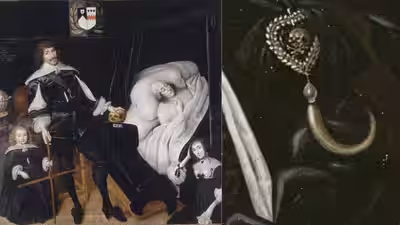

A heart-shaped mourning pendant depicted in a 1635 painting has resurfaced nearly 400 years later, revealing a deeply personal story of grief from 17th-century England. The jewel commemorates Robert Aston, the six-year-old son of English landowner Sir Thomas Aston, who died in 1634. It contains a tassel made from the boy’s blond hair and bears Latin inscriptions expressing his parents’ sorrow. The pendant appears in Sir Thomas Aston at the Deathbed of His Wife, a painting by artist John Souch now held by Manchester Art Gallery. Its modern owners possessed the jewel for decades without knowing its historical significance. They recognised it while visiting an exhibition featuring the painting and contacted historian and jewellery specialist Martyn Downer.
The heart-shaped mourning pendant and the child behind it
Known as the Aston Deathes Hedde, the pendant is an example of memento mori jewellery, designed to remind people of death and the fleeting nature of life. It is heart-shaped and surrounded by a golden wreath. Black-and-white enamel decorates the piece, which features a skull motif and Latin inscriptions on both sides.The jewel was made to commemorate Robert, who died on May 4, 1634, aged six. A tassel containing a lock of his blond hair hangs beneath it. Such keepsakes allowed families to preserve a physical connection with loved ones who had died.The pendant’s inscriptions express the depth of the family’s loss. Its rediscovery has allowed specialists to examine details that cannot be fully deciphered from the small image in the painting.
The 1635 painting that preserved the jewel’s image
The pendant appears in Sir Thomas Aston at the Deathbed of His Wife, painted by Cheshire artist John Souch in 1635. The life-size portrait depicts Sir Thomas mourning his wife, Magdalen Aston, who died during childbirth that year.Sir Thomas stands beside their three-year-old son, Thomas. Magdalen lies in bed, while a covered cradle refers to the loss of their baby. The composition combines a family portrait with symbols of death, faith and the fragility of human life.The family had already suffered several bereavements. Robert, Elizabeth and Jane had died young before the painting was completed. Thomas, the child shown beside his father, died in 1636, just a year later.The painting is now held by Manchester Art Gallery. It offers historians a glimpse into the family’s losses and the ways grief was represented in early modern England.
Latin inscription reveals the parents’ grief
The pendant carries Latin inscriptions expressing the anguish Robert’s death caused his parents. According to a translation of the text, it reads in part:“Your Robert died 4 May 1634 … In whom was our delight, through whom was our consolation, with whom the hope of his parents first perished.”The inscription describes Robert as a source of happiness and comfort for his parents. It also conveys how his death affected their hopes for the future.Although Souch depicted the pendant in the painting, its full inscriptions could not be read from the artwork alone. Examining the surviving jewel has helped reveal the meaning behind an object that scholars had previously seen only in painted form.
How the long-lost pendant was rediscovered
The pendant remained in the Aston family until it was sold in 1862. Its subsequent history was largely forgotten. The current owners acquired it around three decades before its significance came to light, unaware that it was the same jewel depicted in Souch’s painting.The discovery followed a visit to an exhibition featuring the portrait. The owners recognised the pendant in the artwork and contacted Martyn Downer, a historian and specialist dealer in historical jewellery and objects.Downer investigated the piece and identified its connection to the painting. The discovery also gave researchers an opportunity to compare the physical object with Souch’s depiction and examine its construction, decoration and inscriptions directly.
Why the jewel is being compared with Shakespeare ’s Hamnet
The pendant has been described as a “Hamnet-era” mourning jewel because it dates from a period when child mortality and family bereavement were familiar features of life in England.William Shakespeare’s son Hamnet died in 1596 at the age of 11. Robert Aston died in 1634, nearly four decades later. Both stories concern parents who lost young children, but there is no evidence linking the Aston family or the pendant directly to Shakespeare.The comparison is historical rather than personal. It places the jewel within a broader period in which families used portraits, inscriptions and personal objects to remember the dead.The pendant demonstrates how mourning could be expressed through intimate possessions. Its lock of hair and inscription transformed a small piece of jewellery into a lasting memorial to a particular child.
Pendant valued at £650,000
Downer valued the jewel at £650,000, reflecting its rarity and historical significance. He announced plans to exhibit it at the Treasure House Fair at the Royal Hospital Chelsea in London from June 24 to 30, 2026. The fair has since concluded.As of October 19, 2026, Downer’s website continues to list the Aston Deathes Hedde among the objects available for sale. However, it remains unclear whether a sale has been agreed or whether the pendant has been reunited with the painting at Manchester Art Gallery.The jewel’s rediscovery has renewed interest in the portrait and the personal history behind it. The physical pendant provides a rare connection between a surviving historical object and the family tragedy recorded in a 17th-century work of art.Nearly four centuries after it was depicted, the Aston Deathes Hedde offers a tangible glimpse into how one family remembered a child whose death had profoundly affected them.
Source link