
Walt Disney quietly assembled more than 27,000 acres in Florida through secret transactions for about $5 million, averaging roughly $182 an acre; after the buyer’s identity emerged, the land became Walt Disney World

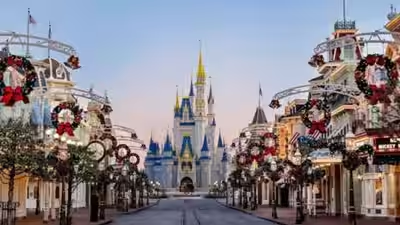

Walt Disney’s plan for what would become Walt Disney World began with a remarkably quiet real-estate operation. According to Disney’s D23 archives, the Florida Historical Society and the Walt Disney Company, Disney Productions spent about 18 months secretly assembling more than 27,000 acres in Central Florida before publicly acknowledging that it was behind the purchases. The operation was designed around a simple concern: If landowners discovered that Disney was buying the property, prices could soar before the company had secured enough acreage.The man tasked with avoiding that outcome was Robert Price “Bob” Foster, a lawyer who had joined Walt Disney Productions after working on Disneyland. In late 1963, Walt and his brother Roy Disney selected Foster to lead the Florida land acquisition effort, which was internally known as “Project X.” Foster initially expected to acquire somewhere between 5,000 and 10,000 acres. Instead, the project ultimately grew into a massive 43-square-mile land assembly.Beginning in 1964, Disney representatives purchased properties through a collection of seemingly unrelated companies. Florida Memory identifies nine front companies used in the acquisitions, including Latin-American Development & Management Corporation and Reedy Creek Ranch Inc. The strategy helped keep the true buyer hidden while parcels were accumulated across parts of Orange and Osceola counties.Foster himself operated under the name “Bob Price” while working on the acquisitions. D23 says he negotiated with more than 100 landowners and helped assemble more than 27,000 acres, including property around Bay Lake and what became Discovery Island. The final purchase covered roughly 27,443 acres. Disney has described the acquisition as costing about $5 million, with an average price of less than $200 an acre. Other historical accounts put the average at approximately $182 to $185 per acre, depending on the transaction figures used.At the time, however, Central Florida did not look like the destination it would eventually become. Much of the property consisted of undeveloped land, swamps, forests and agricultural acreage. Disney had chosen the region partly because its inland location reduced exposure to coastal hurricanes and offered the company an opportunity to build something much larger than Disneyland.The secrecy eventually became impossible to maintain. Local reporters had begun investigating the mysterious purchases as thousands of acres changed hands. In October 1965, Orlando Sentinel reporter Emily Bavar publicly connected the land-buying operation to Disney after questioning Walt Disney during a visit to the company’s California studio. The Sentinel subsequently identified Disney as the mystery buyer, ending the operation’s biggest secret.The following month, Walt and Roy Disney appeared alongside Florida Gov. Haydon Burns at a press conference in Orlando and formally announced the Florida Project. Disney revealed plans for a huge new destination that would go far beyond a traditional theme park. Walt Disney would not live to see the project completed. He died in December 1966, while construction was still underway. But the enormous property he had helped secure gave the company something Disneyland never had: room to expand on an extraordinary scale.The Magic Kingdom eventually opened on October 1, 1971, transforming the former Central Florida acreage into the foundation of Walt Disney World. The land deal also became the beginning of a larger experiment in development and governance. Foster helped establish the legal framework that eventually created the Reedy Creek Improvement District, allowing Disney to manage infrastructure and services across much of the property.What started with a handful of secretive land purchases therefore became one of the most consequential real-estate moves in American entertainment history. Disney did not simply buy land for another theme park. It quietly acquired enough territory to build an entire vacation destination on its own terms.
Source link