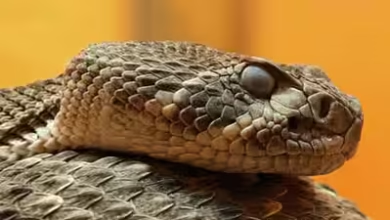
Venomous snakes are more likely than non-venomous species to have conspicuous colours; researchers suggest that visibility may play a role in how predators recognise potential danger

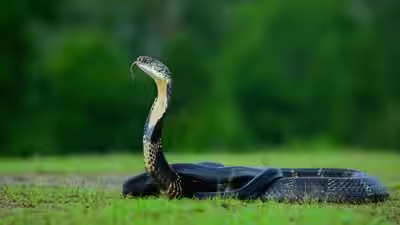

In the wild, survival often depends on staying out of sight. But for some snakes, the opposite may be true. A flash of red, a sweep of yellow or a sharply contrasting pattern can make an animal easier to spot and that visibility may be exactly the point. New research from the University of Galway suggests that venomous snakes are more likely than their non-venomous counterparts to wear colours that stand out against the environments they inhabit.
When being seen can be safer
As per the release published by Eurek Alert, colour serves many purposes in the animal kingdom. It can help creatures disappear into their surroundings, attract mates or confuse predators. It can also send a very different message: stay away. This form of visual signalling, known as warning colouration, is familiar across nature. Wasps, poison dart frogs and coral snakes, for instance, use conspicuous colours and patterns to advertise their potential danger. The new study explores whether a similar relationship between visibility and venom exists across snakes on a much broader scale.Published in the Journal of Animal Ecology, the research examined more than 450 snake species from around the world. Rather than looking at colour in isolation, researchers considered how snakes appeared against the backgrounds of their natural habitats.
Studying snakes in the wild
To understand how these colours function in real environments, the team turned to thousands of photographs collected through iNaturalist, the citizen science platform. The images allowed researchers to assess snakes as they appear in the wild rather than relying solely on specimens photographed or preserved outside their natural surroundings.The analysis revealed a notable pattern. Venomous snakes were, on average, more visually distinct from their surroundings than non-venomous species. Researchers paid particular attention to red and yellow, two colours frequently associated with warning signals across the animal world.The findings do not suggest that every venomous snake is brightly coloured. Many remain muted, camouflaged and difficult to spot. But across the species examined, conspicuous colouration was more strongly associated with venom.
A warning written in colour
The results add weight to the idea that venom and warning colouration may have evolved together in some snakes. Instead of relying entirely on camouflage to avoid predators, certain species may benefit from making themselves recognisable.For a predator, a distinctive pattern could effectively function as an early warning system: approaching this animal may come with consequences. If predators learn to associate particular visual signals with danger, being conspicuous could prevent an attack before it begins.Red and yellow appeared especially effective at creating this visual contrast against natural backgrounds, suggesting that these colours may have an important role in communicating a snake’s potential threat.
Citizen science opens a wider window
The research also demonstrates how citizen-generated images are changing the way scientists study wildlife. Traditional museum collections remain valuable for measuring physical traits and colour with precision, but photographs taken in natural habitats reveal how those traits actually appear in the environments where animals evolved.With thousands of observations now available through platforms such as iNaturalist, researchers can investigate patterns across hundreds of species and geographic regions that would be difficult to study through fieldwork alone.The study ultimately adds a striking twist to a familiar rule of survival. For some venomous snakes, the safest strategy may not be disappearing into the landscape. It may be making sure predators notice them, and think twice before coming any closer.Image Courtesy: istock
Source link