They couldn’t read or write, now these African grandmothers are solar engineers: Trained at an Indian organisation, they are bringing electricity to 75,000 homes worldwide

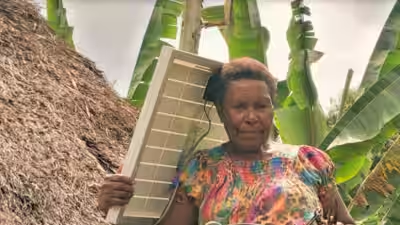

For years, darkness shaped everyday life in several remote African villages. Children struggled to study after sunset, families depended on kerosene lamps and candles, and even ordinary household activities became difficult once night fell. But some of the women who once lived through these conditions are now helping change them. Despite having little or no formal education, rural mothers and grandmothers have trained as solar engineers, learning to assemble, install and repair solar lighting systems. They are taking that knowledge back to their communities, helping households access electricity and showing that technical skills do not have to come from a classroom.The initiative is part of the Solar Mamas programme run by India’s Barefoot College. According to the organisation, it has trained 1,708 rural women from 96 countries, helping bring electricity to more than 75,000 households and saving an estimated 45 million litres of kerosene. The programme focuses on women from marginalised communities, including those who are illiterate or semi-literate and have had limited opportunities for formal education.
From rural villages to solar engineering classrooms
Instead of relying on written textbooks and traditional academic qualifications, Barefoot College uses practical, hands-on training to teach women how solar technology works. Participants learn to assemble circuits, connect components, install solar panels, maintain batteries and repair lighting systems.The residential training at its Tilonia campus in Rajasthan traditionally lasts six months. Women return to their villages with the equipment and skills needed to establish local solar workshops and maintain household lighting systems. The training is designed to make them more than installers: they become the people their neighbours can approach when a system stops working.For many participants, travelling abroad for training is an experience in itself. A 2011 report by The Guardian followed 12 women from Sierra Leone who travelled to India to learn solar engineering. Many were either illiterate or semi-literate and had previously worked as subsistence farmers. After completing their training, they returned to assemble 1,500 household solar units.One of the women, Mary Dawo, described how surprising the idea of solar engineering had been to her. She said she wanted to be part of it. Another participant, Fatmata Koroma, recalled how darkness had once brought snakes, rodents and insects into homes, while children were unable to study comfortably after sunset.
The women bringing light back home
The transformation was particularly visible in southern Tanzania, where six women from remote villages in the Mtwara and Lindi districts trained at Barefoot College in India through the UN Women-supported Rural Women Light Up Africa initiative. After six months of training, the women returned as solar engineers and began installing solar lighting systems in their communities. UN Women’s account reported that 69 households in Chekeleni village had already received solar-powered lighting, while work was continuing in two other villages, Nitekela and Mkwajuni.The systems provided households with a solar panel, a battery, a charger and three lamps. Families could pay for the equipment in instalments over five years, while a community savings arrangement helped cover the women’s stipends and maintenance costs. The engineers were also expected to remain responsible for repairs and upkeep, ensuring that the systems would continue working long after installation.The change was not limited to the arrival of electric lights. Children could study after sunset, women could cook and complete household tasks more comfortably, and families felt safer in their homes. Perhaps one of the most moving details in the UN Women report came from a 10-year-old girl in Chekeleni, who spoke about watching her mother return from training as an engineer and community leader. She said that when she grew up, she wanted to become a leader too, possibly even the president.In Sierra Leone, the women trained by Barefoot College also began taking responsibility for the technology they had learnt to operate. The Guardian reported that Nancy Kanu, one of the programme’s graduates, became a chief solar engineer and taught other women. She remained available to repair faults, replace bulbs and help villagers charge their phones. The work was no longer simply about bringing equipment into a village; it was about building local expertise so communities would not have to depend on outsiders for every repair.
More than electricity
The programme’s significance goes beyond the number of homes receiving solar power. Research published in Nature Energy in May 2024 examined the Solar Mamas programme in Zanzibar and explored how it challenged established gender roles in technical work. The researchers found that training rural women as solar technicians could help disrupt the assumption that engineering and energy-related work belong primarily to men.The study also highlighted why the programme selects women who are established residents of their villages. Their long-term presence makes it possible for communities to rely on them for maintenance and repairs. However, the research noted that entrenched patriarchal attitudes can create obstacles, with some women facing pressure to withdraw from training.For the women who complete it, the work can bring recognition and a new role within their communities. They are no longer seen only through the responsibilities traditionally assigned to them at home. They are technicians, problem-solvers and trainers whose knowledge is essential to the functioning of local infrastructure.Barefoot College’s programme is now also expanding its training network in Africa, with vocational training centres planned or supported in countries including Senegal, Burkina Faso, Liberia and Tanzania. The organisation says these centres will help train more rural women and extend access to solar technology in communities that remain beyond reliable electricity networks.
Source link