Since 2004, Bill Gates has sent millions of anti-malaria nets to Africa, but the donated gear has been devastating local waters for years

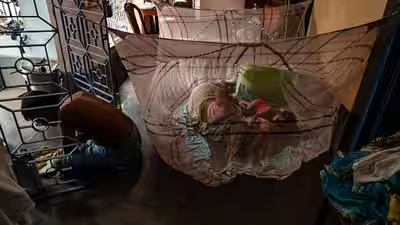

Millions of insecticide-treated mosquito nets distributed across Africa to prevent malaria are being repurposed as fishing gear, raising concerns about declining fish populations, damage to aquatic habitats and the unintended consequences of humanitarian aid. The issue, highlighted in reporting by the International Collective in Support of Fishworkers (ICSF) and National Geographic, illustrates how equipment designed to protect public health can create environmental challenges when used for purposes other than those intended.The Gates Foundation has supported malaria prevention efforts across the world. According to the International Federation of Red Cross and Red Crescent Societies (IFRC), three billion insecticide-treated nets have been shipped worldwide since 2004, most of them to countries in sub-Saharan Africa. The milestone was announced in November 2023.
How mosquito nets became fishing equipment
Insecticide-treated nets are designed to be suspended over beds or sleeping areas, creating a barrier between people and mosquitoes that transmit malaria. When used correctly, they help reduce exposure to infected mosquitoes and play a major role in preventing the disease.However, in some communities, particularly those where fishing provides an essential source of food and income, the fine mesh of these nets has made them attractive for catching fish. Some fishers sew several nets together or drag them through shallow waters to collect fish that might escape conventional fishing equipment.The practice has been documented in parts of sub-Saharan Africa, including communities around lakes and wetlands. A 2015 National Geographic Education blog discussed how some recipients were turning mosquito nets into large fishing sieves, potentially affecting already stressed fish populations. The reasons behind the practice are not always straightforward. For households facing food insecurity or unable to afford conventional fishing nets, repurposing a freely available mosquito net can provide an immediate means of obtaining food.In reporting cited by AS USA, fisher Mwewa Ndefi acknowledged the difficulty of the choice, saying, “I know it’s not right, but without these nets, we wouldn’t eat.” His account highlights the economic pressures that can lead people to use donated equipment in ways its providers never intended.
Why the fine mesh threatens fish populations
The principal concern is the size of the fish caught. Conventional fishing equipment often allows smaller fish to escape, depending on its mesh size and design. Mosquito nets, by contrast, have extremely fine mesh that can trap juvenile fish before they reach maturity.Removing large numbers of young fish from a water body can affect its ability to replenish its population. Fish that are caught before reproducing cannot contribute to future generations, potentially placing additional pressure on stocks already affected by overfishing, habitat degradation and other environmental stresses.The problem can extend beyond the fish that fishers intend to catch. Fine-mesh nets dragged through shallow waters may collect fish eggs and other small aquatic organisms. Such practices can also disturb spawning and nursery habitats used by fish.These effects matter particularly in lakes, rivers and wetlands that support local livelihoods. When fish populations decline, communities that depend on them for food, employment and trade can face additional economic pressure.
Could insecticides also harm aquatic life?
The environmental concerns are not limited to the physical effects of fine-mesh fishing. Many long-lasting insecticidal nets contain chemicals intended to kill or repel mosquitoes. These treatments are designed for use in malaria prevention, not for prolonged use in aquatic environments.The World Health Organisation‘s malaria guidance warns that residual insecticide on discarded mosquito nets can be toxic to aquatic organisms, particularly fish, and advises communities against disposing of the nets in water bodies. Its guidance also stresses that old nets should be collected only when replacement nets are available, and a suitable disposal system is in place.The potential risks depend on the type of insecticide, the condition of the net, how it is used and the local environmental conditions. The available evidence does not establish that every net used for fishing causes measurable contamination or that all affected waters face the same level of risk.Nevertheless, the possibility of chemical exposure adds another concern to the use of treated nets in lakes and rivers, especially where aquatic ecosystems support both biodiversity and human livelihoods.
A life-saving campaign with an unintended consequence
The environmental concerns do not diminish the proven value of insecticide-treated nets. The IFRC reported in 2023 that the three billion nets shipped since 2004 were estimated to have contributed to roughly two-thirds of the reduction in malaria cases over the preceding decades. The organisation also noted that about 68% of households across sub-Saharan Africa owned at least one mosquito net.The challenge is ensuring that communities can continue to benefit from malaria prevention while addressing the reasons some people turn the nets into fishing gear. Providing affordable, appropriate fishing equipment, improving access to food and strengthening awareness of the risks could help reduce the practice.Better systems for collecting worn-out nets and safely disposing of them are also important. The IFRC has acknowledged the environmental footprint of insecticide-treated nets, including their plastic components and packaging, and the need for more sustainable supply chains.Ultimately, the issue highlights a wider challenge for international aid programmes: distributing essential supplies is only part of the task. Understanding local needs, supporting livelihoods and planning for the safe use and disposal of donated equipment can help ensure that efforts to protect human health do not create additional pressures on the ecosystems communities depend on.
Source link