
World

Scientists rebuilt oyster reefs in Florida; within 18 months, the wider marine animal community began returning |

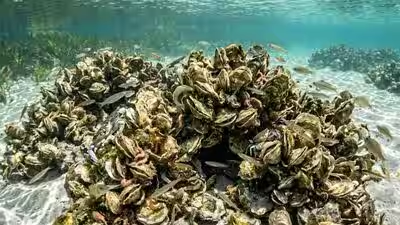
Scientists rebuilt oyster reefs in Florida; within 18 months, the wider marine animal community began returning

Restoring damaged oyster reefs can bring back the small marine animals that depend on them. A study examined restored, living, and dead oyster reefs in Florida’s Indian River Lagoon to track how their macroinvertebrate communities changed after restoration. The researchers collected 20,087 marine invertebrates representing 41 species from 14 families. Over time, the communities on restored reefs began to resemble those on living reefs. According to the study published in Scientific Reports titled ‘Oyster reef restoration facilitates the recovery of macroinvertebrate abundance, diversity, and composition in estuarine communities’, species diversity and community composition showed a closer match within about a year, while overall abundance took longer to recover and reached similar conditions after about 18 months.

How did oyster reef restoration change marine life in Florida’s lagoon

The study focused on oyster reefs in Florida’s Indian River Lagoon, where researchers compared restored reefs with living and dead reefs over time. They took samples of the sites before restoration and at several points afterwards to track changes in the resident macroinvertebrate community. The restoration also led to a steady increase in oyster numbers. Reefs restored in 2017 went from no oysters to an average density of 347.40 oysters per square metre after 24 months, while those restored in 2018 reached 84 oysters per square metre within 12 months. Across the study, researchers collected 20,087 marine invertebrates representing 41 species from 14 families.

How did oyster reef restoration change marine life in Florida’s lagoon

PC: AI Generated

How long did it take for species diversity to recover after restoration

As the restored reefs developed, the variety of species living on them began to change. On the reefs restored in 2017, species richness and Shannon diversity remained similar to dead reefs during the first six months. Both measures then began to increase between six and nine months, and by 12 months, the communities had become more similar to those on living reefs.The reefs restored in 2018 showed a comparable shift, becoming more similar to living reefs by six months. Reef thickness, oyster density, and dissolved oxygen were among the factors associated with diversity. This pattern indicates that species diversity and community structure began returning before overall invertebrate abundance had fully recovered.

What changes shaped the recovery of restored reef communities

The species living on the restored reefs also changed as the habitat developed. During the first month after restoration, the communities on the 2017 reefs remained similar to those on dead reefs, with no significant differences at one week, two weeks, or one month. By six months, their composition was not significantly different from either live or dead reefs. A clearer shift emerged by 12 months, when the restored communities were significantly distinct from dead reefs while showing no significant difference from live reefs. The 2018 reefs followed a similar pattern, becoming comparable to live reefs by six months.

What did flatback mud crabs reveal about oyster reef recovery

One species provided a useful way to track how the reef community responded to restoration. The flatback mud crab, ‘Eurypanopeus depressus’, was chosen because its abundance followed a consistent pattern as the restored habitat developed. Its density remained low on dead and newly restored reefs but began to rise around six months after restoration. On the reefs restored in 2017, crab numbers gradually approached those found on living reefs, reaching similar levels at about 18 months. A comparable pattern was seen in the 2018 reefs, where density approached live-reef levels by 12 months. Crab density was also associated with reef thickness, oyster density, and several environmental conditions, which links the species to changes in reef development.

How did reef structure influence the recovery of marine invertebrates

The recovery of invertebrates was associated with changes in the structure of restored reefs. Species richness and diversity on the 2017 reefs were both correlated with reef thickness and oyster density. The 2018 reefs showed similar relationships, where richness and diversity were associated with reef thickness and oyster density.The researchers found that environmental conditions, water clarity, salinity, temperature, and tidal height helped explain differences in species composition. The findings indicate that restoration was reshaping the reef habitat alongside the return of oysters.


Source link

Related Articles

Leave a Reply

Your email address will not be published. Required fields are marked *

Back to top button
×
newsnation.aanest.com
Logo
Date of Publish : 16 September 2026, 12:16 pm Digital Edition : News nation
Scientists rebuilt oyster reefs in Florida; within 18 months, the wider marine animal community began returning |

Restoring damaged oyster reefs can bring back the small marine animals that depend on them. A study examined restored, living, and dead oyster reefs in Florida’s Indian River Lagoon to track how their macroinvertebrate communities changed after restoration. The researchers collected 20,087 marine invertebrates representing 41 species from 14 families. Over time, the communities on restored reefs began to resemble those on living reefs. According to the study published in Scientific Reports titled ‘Oyster reef restoration facilitates the recovery of macroinvertebrate abundance, diversity, and composition in estuarine communities’, species diversity and community composition showed a closer match within about a year, while overall abundance took longer to recover and reached similar conditions after about 18 months.How did oyster reef restoration change marine life in Florida’s lagoonThe study focused on oyster reefs in Florida’s Indian River Lagoon, where researchers compared restored reefs with living and dead reefs over time. They took samples of the sites before restoration and at several points afterwards to track changes in the resident macroinvertebrate community. The restoration also led to a steady increase in oyster numbers. Reefs restored in 2017 went from no oysters to an average density of 347.40 oysters per square metre after 24 months, while those restored in 2018 reached 84 oysters per square metre within 12 months. Across the study, researchers collected 20,087 marine invertebrates representing 41 species from 14 families.PC: AI GeneratedHow long did it take for species diversity to recover after restorationAs the restored reefs developed, the variety of species living on them began to change. On the reefs restored in 2017, species richness and Shannon diversity remained similar to dead reefs during the first six months. Both measures then began to increase between six and nine months, and by 12 months, the communities had become more similar to those on living reefs.The reefs restored in 2018 showed a comparable shift, becoming more similar to living reefs by six months. Reef thickness, oyster density, and dissolved oxygen were among the factors associated with diversity. This pattern indicates that species diversity and community structure began returning before overall invertebrate abundance had fully recovered.What changes shaped the recovery of restored reef communitiesThe species living on the restored reefs also changed as the habitat developed. During the first month after restoration, the communities on the 2017 reefs remained similar to those on dead reefs, with no significant differences at one week, two weeks, or one month. By six months, their composition was not significantly different from either live or dead reefs. A clearer shift emerged by 12 months, when the restored communities were significantly distinct from dead reefs while showing no significant difference from live reefs. The 2018 reefs followed a similar pattern, becoming comparable to live reefs by six months.What did flatback mud crabs reveal about oyster reef recoveryOne species provided a useful way to track how the reef community responded to restoration. The flatback mud crab, ‘Eurypanopeus depressus’, was chosen because its abundance followed a consistent pattern as the restored habitat developed. Its density remained low on dead and newly restored reefs but began to rise around six months after restoration. On the reefs restored in 2017, crab numbers gradually approached those found on living reefs, reaching similar levels at about 18 months. A comparable pattern was seen in the 2018 reefs, where density approached live-reef levels by 12 months. Crab density was also associated with reef thickness, oyster density, and several environmental conditions, which links the species to changes in reef development.How did reef structure influence the recovery of marine invertebratesThe recovery of invertebrates was associated with changes in the structure of restored reefs. Species richness and diversity on the 2017 reefs were both correlated with reef thickness and oyster density. The 2018 reefs showed similar relationships, where richness and diversity were associated with reef thickness and oyster density.The researchers found that environmental conditions, water clarity, salinity, temperature, and tidal height helped explain differences in species composition. The findings indicate that restoration was reshaping the reef habitat alongside the return of oysters.

Source link