World

Scientists found a new way to make hydrogen from water using light; the material avoids an expensive metal catalyst and could make clean hydrogen production cheaper

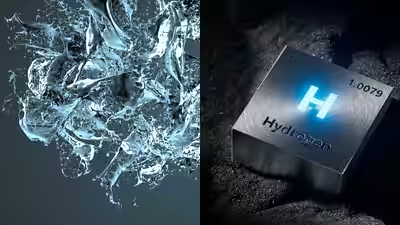
Scientists found a new way to make hydrogen from water using light; the material avoids an expensive metal catalyst and could make clean hydrogen production cheaper
For the new study, researchers focused on a MOF known as BVR-19. Its distinctive feature is an unusual bond between sulfur atoms within its organic component.

Hydrogen has long carried the promise of becoming a cleaner fuel, but making it sustainably remains one of the biggest challenges. Now, researchers at Oregon State University have developed a new material that uses light to split water and produce hydrogen, opening another possible route to solar-powered fuel production without relying on an expensive metal catalyst. Led by Kyriakos Stylianou of the OSU College of Science, the research centres on a specially designed photocatalyst that can harness light energy to accelerate the chemical reactions needed to generate hydrogen, states the research study published by Science Daily.

Turning light into chemical energy

According to the research, a photocatalyst works much like an ordinary catalyst, speeding up a chemical reaction without being consumed by it. The difference is that light activates the material, pushing it into a higher-energy state and allowing it to drive reactions more efficiently. To do that, the OSU team looked to metal-organic frameworks, or MOFs. They are crystalline porous materials made of metal ions and organic molecules called the linkers. Their structures can be modified at the molecular level, giving researchers considerable control over their chemical and physical properties.The sheer design potential of MOFs is enormous and while scientists have already synthesised nearly 100,000 different structures, hundreds of thousands more have been predicted computationally.

An unusual role for sulfur

For the new study, researchers focused on a MOF known as BVR-19. Its distinctive feature is an unusual bond between sulfur atoms within its organic component. When exposed to light, that bond can temporarily break, generating highly reactive sulfur species. These then help capture light energy and move electrons through the material, ultimately supporting the production of hydrogen from water, states the study.This mechanism is significant because the organic component, rather than the metal centre, plays the leading role in the light-driven chemistry. That gives BVR-19 a fundamentally different operating principle from many conventional photocatalytic systems. It also eliminates the need for an additional costly metal catalyst, potentially simplifying the design of future systems aimed at producing hydrogen using sunlight.

Made in water, at room temperature

BVR-19 has another feature that could prove valuable for practical applications. The material forms spontaneously in an aqueous solution at room temperature, meaning its production does not require large amounts of energy, the study mentions.That could become important as researchers look beyond laboratory performance and consider the overall energy and environmental cost of producing photocatalytic materials themselves.

The green hydrogen challenge

Hydrogen is already essential to industries ranging from ammonia production and metal refining to plastics manufacturing, and it is increasingly being explored for fuel-cell vehicles and other energy applications. Much of today’s hydrogen, however, is produced through methane-steam reforming, a process that releases carbon dioxide. Splitting water using renewable electricity or sunlight offers a cleaner alternative, but the economics remain difficult.Conventional hydrogen production through methane-steam reforming costs roughly $1.50 per kilogram, while green hydrogen can cost around $5 per kilogram. Lowering that gap will require cheaper materials, efficient reactions and less energy-intensive production methods, the study also highlights.

A new blueprint for solar fuel

The Oregon State research offers more than a new photocatalyst. By examining how changes to the metal component influence the performance of closely related MOFs, the researchers identified structural clues that can help guide the development of more effective materials. The larger goal is to make solar-powered hydrogen production more efficient and less expensive. BVR-19 remains a research-stage material, and more work will be needed to assess its performance at larger scales and in real-world conditions. But its unusual chemistry offers a promising new direction: using light, water and carefully engineered materials to turn a basic chemical reaction into a potential source of cleaner fuel.Images Courtesy: istock


Source link

Related Articles

Leave a Reply

Your email address will not be published. Required fields are marked *

Back to top button
×
newsnation.aanest.com
Logo
Date of Publish : 05 October 2026, 5:30 pm Digital Edition : News nation
Scientists found a new way to make hydrogen from water using light; the material avoids an expensive metal catalyst and could make clean hydrogen production cheaper

For the new study, researchers focused on a MOF known as BVR-19. Its distinctive feature is an unusual bond between sulfur atoms within its organic component. Hydrogen has long carried the promise of becoming a cleaner fuel, but making it sustainably remains one of the biggest challenges. Now, researchers at Oregon State University have developed a new material that uses light to split water and produce hydrogen, opening another possible route to solar-powered fuel production without relying on an expensive metal catalyst. Led by Kyriakos Stylianou of the OSU College of Science, the research centres on a specially designed photocatalyst that can harness light energy to accelerate the chemical reactions needed to generate hydrogen, states the research study published by Science Daily.Turning light into chemical energyAccording to the research, a photocatalyst works much like an ordinary catalyst, speeding up a chemical reaction without being consumed by it. The difference is that light activates the material, pushing it into a higher-energy state and allowing it to drive reactions more efficiently. To do that, the OSU team looked to metal-organic frameworks, or MOFs. They are crystalline porous materials made of metal ions and organic molecules called the linkers. Their structures can be modified at the molecular level, giving researchers considerable control over their chemical and physical properties.The sheer design potential of MOFs is enormous and while scientists have already synthesised nearly 100,000 different structures, hundreds of thousands more have been predicted computationally.An unusual role for sulfurFor the new study, researchers focused on a MOF known as BVR-19. Its distinctive feature is an unusual bond between sulfur atoms within its organic component. When exposed to light, that bond can temporarily break, generating highly reactive sulfur species. These then help capture light energy and move electrons through the material, ultimately supporting the production of hydrogen from water, states the study.This mechanism is significant because the organic component, rather than the metal centre, plays the leading role in the light-driven chemistry. That gives BVR-19 a fundamentally different operating principle from many conventional photocatalytic systems. It also eliminates the need for an additional costly metal catalyst, potentially simplifying the design of future systems aimed at producing hydrogen using sunlight.Made in water, at room temperatureBVR-19 has another feature that could prove valuable for practical applications. The material forms spontaneously in an aqueous solution at room temperature, meaning its production does not require large amounts of energy, the study mentions.That could become important as researchers look beyond laboratory performance and consider the overall energy and environmental cost of producing photocatalytic materials themselves.The green hydrogen challengeHydrogen is already essential to industries ranging from ammonia production and metal refining to plastics manufacturing, and it is increasingly being explored for fuel-cell vehicles and other energy applications. Much of today's hydrogen, however, is produced through methane-steam reforming, a process that releases carbon dioxide. Splitting water using renewable electricity or sunlight offers a cleaner alternative, but the economics remain difficult.Conventional hydrogen production through methane-steam reforming costs roughly $1.50 per kilogram, while green hydrogen can cost around $5 per kilogram. Lowering that gap will require cheaper materials, efficient reactions and less energy-intensive production methods, the study also highlights.A new blueprint for solar fuelThe Oregon State research offers more than a new photocatalyst. By examining how changes to the metal component influence the performance of closely related MOFs, the researchers identified structural clues that can help guide the development of more effective materials. The larger goal is to make solar-powered hydrogen production more efficient and less expensive. BVR-19 remains a research-stage material, and more work will be needed to assess its performance at larger scales and in real-world conditions. But its unusual chemistry offers a promising new direction: using light, water and carefully engineered materials to turn a basic chemical reaction into a potential source of cleaner fuel.Images Courtesy: istock

Source link