
World

Scientists found a magnetic mineral never before seen naturally in Moon samples; Chang’e-6 brought the material back from the lunar surface, where it survived inside tiny impact-glass particles

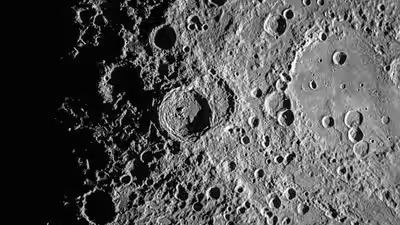
Scientists found a magnetic mineral never before seen naturally in Moon samples; Chang’e-6 brought the material back from the lunar surface, where it survived inside tiny impact-glass particles

About 4.25 billion years ago, the Moon possessed a powerful core dynamo with a field strength comparable to or even exceeding modern Earth’s. This magnetic field, generated by circulating molten metal, completely shut down as the interior cooled and core crystallisation ceased, leaving the Moon without a global magnetic field in the present. While it no longer generates a global magnetic field, traces of its ancient magnetism still remain locked inside lunar soil and rocks.Scientists have been studying these magnetic minerals preserved in the soil in order to reconstruct how the Moon’s magnetic environment changed over time. Researchers analysing metallic iron inside impact glass from Chang’e-6 lunar soil have now identified a previously unknown magnetic mineral in natural Moon samples. They have identified it as a form of metallic iron called γ-Fe. Found inside tiny impact-glass particles, the nanoscale iron can preserve a stable magnetic signal, potentially acting like a microscopic fossil of the Moon’s long-lost magnetic field, as per the findings published in the Proceedings of the National Academy of Sciences (PNAS) on September 16.The study was led by Professor Haifeng Du of the High Magnetic Field Laboratory at the Hefei Institutes of Physical Science (HFIPS) of the Chinese Academy of Sciences (CAS). “This tiny magnetic fossil may help us better understand the Moon’s ancient magnetic history,” said Dr. Long Li from HFIPS, a member of the team.

A rare iron phase hidden in lunar glass

To examine the samples, the researchers used focused ion beam preparation, transmission electron microscopy, and chemical analysis. These techniques revealed numerous nanoscale iron particles embedded throughout the glassy material. Closer examination showed that some of the particles consisted of face-centred cubic γ-Fe. In fact, γ-Fe was the dominant form of iron in the two impact-glass samples studied.Under normal conditions, γ-Fe is stable only at high temperatures. As the material cools, it typically changes into another form known as α-Fe. The researchers found evidence that the unusual conditions produced by impacts on the Moon may allow γ-Fe to survive at the lunar surface.They proposed that several factors could help stabilise the structure, including small amounts of carbon and other elements, the rapid cooling of molten material created during an impact, and protection from the surrounding glassy matrix.The team also used off-axis electron holography to investigate the magnetic behaviour of individual γ-Fe nanoparticles. They found that relatively large γ-Fe particles could form a stable single-vortex magnetic state. The particles also retained a consistent magnetic response when exposed to an external magnetic field.This stability suggests that γ-Fe could act as a previously unrecognised recorder of magnetic information in lunar material, holding clues to conditions that existed in the moon’s past.

A magnetic past

This discovery has broadened the known variety of magnetic minerals found in lunar samples. Since γ-Fe and α-Fe form under different conditions and behave differently magnetically, each could potentially record information from separate stages of lunar impact events.According to scientists, future research is required to determine exactly how much these minerals can reveal about the moon’s ancient magnetic field and how it evolved over time.


Source link

Related Articles

Leave a Reply

Your email address will not be published. Required fields are marked *

Back to top button
×
newsnation.aanest.com
Logo
Date of Publish : 07 October 2026, 12:04 am Digital Edition : News nation
Scientists found a magnetic mineral never before seen naturally in Moon samples; Chang’e-6 brought the material back from the lunar surface, where it survived inside tiny impact-glass particles

About 4.25 billion years ago, the Moon possessed a powerful core dynamo with a field strength comparable to or even exceeding modern Earth's. This magnetic field, generated by circulating molten metal, completely shut down as the interior cooled and core crystallisation ceased, leaving the Moon without a global magnetic field in the present. While it no longer generates a global magnetic field, traces of its ancient magnetism still remain locked inside lunar soil and rocks.Scientists have been studying these magnetic minerals preserved in the soil in order to reconstruct how the Moon's magnetic environment changed over time. Researchers analysing metallic iron inside impact glass from Chang'e-6 lunar soil have now identified a previously unknown magnetic mineral in natural Moon samples. They have identified it as a form of metallic iron called γ-Fe. Found inside tiny impact-glass particles, the nanoscale iron can preserve a stable magnetic signal, potentially acting like a microscopic fossil of the Moon’s long-lost magnetic field, as per the findings published in the Proceedings of the National Academy of Sciences (PNAS) on September 16.The study was led by Professor Haifeng Du of the High Magnetic Field Laboratory at the Hefei Institutes of Physical Science (HFIPS) of the Chinese Academy of Sciences (CAS). "This tiny magnetic fossil may help us better understand the Moon's ancient magnetic history," said Dr. Long Li from HFIPS, a member of the team.A rare iron phase hidden in lunar glassTo examine the samples, the researchers used focused ion beam preparation, transmission electron microscopy, and chemical analysis. These techniques revealed numerous nanoscale iron particles embedded throughout the glassy material. Closer examination showed that some of the particles consisted of face-centred cubic γ-Fe. In fact, γ-Fe was the dominant form of iron in the two impact-glass samples studied.Under normal conditions, γ-Fe is stable only at high temperatures. As the material cools, it typically changes into another form known as α-Fe. The researchers found evidence that the unusual conditions produced by impacts on the Moon may allow γ-Fe to survive at the lunar surface.They proposed that several factors could help stabilise the structure, including small amounts of carbon and other elements, the rapid cooling of molten material created during an impact, and protection from the surrounding glassy matrix.The team also used off-axis electron holography to investigate the magnetic behaviour of individual γ-Fe nanoparticles. They found that relatively large γ-Fe particles could form a stable single-vortex magnetic state. The particles also retained a consistent magnetic response when exposed to an external magnetic field.This stability suggests that γ-Fe could act as a previously unrecognised recorder of magnetic information in lunar material, holding clues to conditions that existed in the moon's past.A magnetic pastThis discovery has broadened the known variety of magnetic minerals found in lunar samples. Since γ-Fe and α-Fe form under different conditions and behave differently magnetically, each could potentially record information from separate stages of lunar impact events.According to scientists, future research is required to determine exactly how much these minerals can reveal about the moon's ancient magnetic field and how it evolved over time.

Source link