
Protest rights in India: When can police stop a protest or detain you? | India News


AI generated image used for representative purpose
NEW DELHI: A protest is a constitutionally protected way to express dissent. However, the right to assemble peacefully does not mean that demonstrations can take place anywhere or without restrictions. Police and local authorities can regulate gatherings to maintain public order, protect public safety and prevent serious disruption. But they must act within the law, and the mere inconvenience caused by a protest does not automatically justify stopping it or taking participants into custody.So, do you need police permission before holding a protest? Can the police order a peaceful gathering to disperse or detain people who refuse to leave? And what can you do if you believe you have been arrested unlawfully? Here is what the law says about your right to protest and the limits on police powers.Police permission and the right to protest“There is no single, nationwide rule that every protest requires police permission,” said senior advocate Vivek Narayan Sharma. The requirements depend on local laws, the proposed venue and the circumstances. Authorities may require permission or impose conditions relating to the venue, timing, route and size of a gathering.The Constitution protects both freedom of expression and the right to assemble peacefully. Articles 19(1)(a) and 19(1)(b) guarantee these rights, while Article 19(3) permits reasonable restrictions on public assemblies in the interests of public order and the sovereignty and integrity of India.Sharma said the Supreme Court has recognised the state’s responsibility to protect the right to peaceful assembly. As he put it, “the state must actively facilitate peaceful assembly, not merely tolerate it.”In Ramlila Maidan Incident v Union of India, the Supreme Court examined the state’s obligations towards a gathering and the limits on police action. The judgment underscores an important distinction: authorities can regulate protests, but they must also respect the constitutional right to hold them.Vishal Gehrana, partner at Karanjawala & Co, said authorities must have a lawful basis for regulating demonstrations.“The authorities may regulate demonstrations to protect public order, public safety, traffic and the rights of others. Such regulation must, however, have a lawful basis and be justified by the circumstances. Preventive powers cannot be used arbitrarily or beyond the purpose for which the law confers them,” he said.

–
When authorities can restrict a demonstrationAuthorities may restrict a protest when there are specific safety concerns, a credible threat to public order or a serious obstruction to essential access. They may also impose restrictions when a valid prohibitory order is in force. However, such measures must be justified by the circumstances, rather than by disagreement with the protesters’ views.One provision that authorities can invoke in urgent situations is Section 163 of the Bharatiya Nagarik Suraksha Sanhita (BNSS), which replaced Section 144 of the Code of Criminal Procedure. It empowers an Executive Magistrate to issue orders to prevent situations involving danger, obstruction or a disturbance of public tranquillity.Such an order must be in writing and state the material facts justifying it. It ordinarily remains in force for up to two months, although the state government may extend it for a further period of up to six months, subject to the law. An affected person can also apply to have the order withdrawn or modified.Does the existence of such an order automatically make every restriction lawful? No. The reasons for issuing it, its scope and the manner in which it is enforced remain relevant.“An order covering an area or the public generally is not automatically unlawful; its factual basis, scope and operation must be examined,” Gehrana said.In Anuradha Bhasin v Union of India, the Supreme Court held that Section 144 orders cannot be used to suppress legitimate expression and that restrictions must be justified, proportionate and open to judicial review.When police can disperse a gathering or take people into custodyPolice can order an assembly to disperse when the legal conditions for doing so are met. Section 148 of the BNSS deals with dispersing unlawful assemblies and certain other gatherings of five or more people that satisfy the statutory conditions concerning public peace.Sharma emphasised that the power to disperse an assembly does not amount to a blanket ban on peaceful protests.“Section 148 BNSS…is a dispersal power, not a blanket prohibition on peaceful protests,” he said.However, ordering a gathering to disperse and arresting its participants are distinct actions. Whether either is lawful depends on the circumstances and the legal grounds invoked. Simply being part of a crowd does not, by itself, establish grounds for arrest.Gehrana said the legality of a mass operation must be assessed individually, rather than on the assumption that the same grounds apply to everyone.“A mass detention is not automatically unlawful merely because several people are taken into custody at the same time. However, the scale of the operation cannot dispense with the requirement for a lawful basis for each person’s deprivation of liberty,” he said.Preventive arrest vs preventive detentionPreventive arrest and preventive detention are often used interchangeably, but they refer to different legal powers.Preventive arrest is intended to stop a cognizable offence that police believe is about to be committed. Preventive detention, by contrast, involves detaining a person under a special law, such as the National Security Act, to prevent certain acts considered threatening to public order or national security.Section 170 of the BNSS allows police to arrest a person without a warrant to prevent the commission of a cognizable offence when the statutory conditions are met, including where the offence cannot otherwise be prevented. An arrest under this provision cannot ordinarily be made solely as a precaution: the police must have the required information and grounds for believing that the offence is likely to occur.Custody under Section 170 cannot exceed 24 hours unless further detention is authorised under another legal provision.These powers do not give police unrestricted authority to detain people attending a protest simply because the gathering is inconvenient or may cause disruption. The circumstances and the legal grounds for the action remain decisive.Sharma said preventive powers must be used only for the purposes for which the law grants them. Gehrana similarly stressed that the legality of an arrest depends on the facts, the power invoked and compliance with the applicable safeguards.“The legality of the action depends on the facts, the power invoked and compliance with the applicable safeguards,” Gehrana said.

–
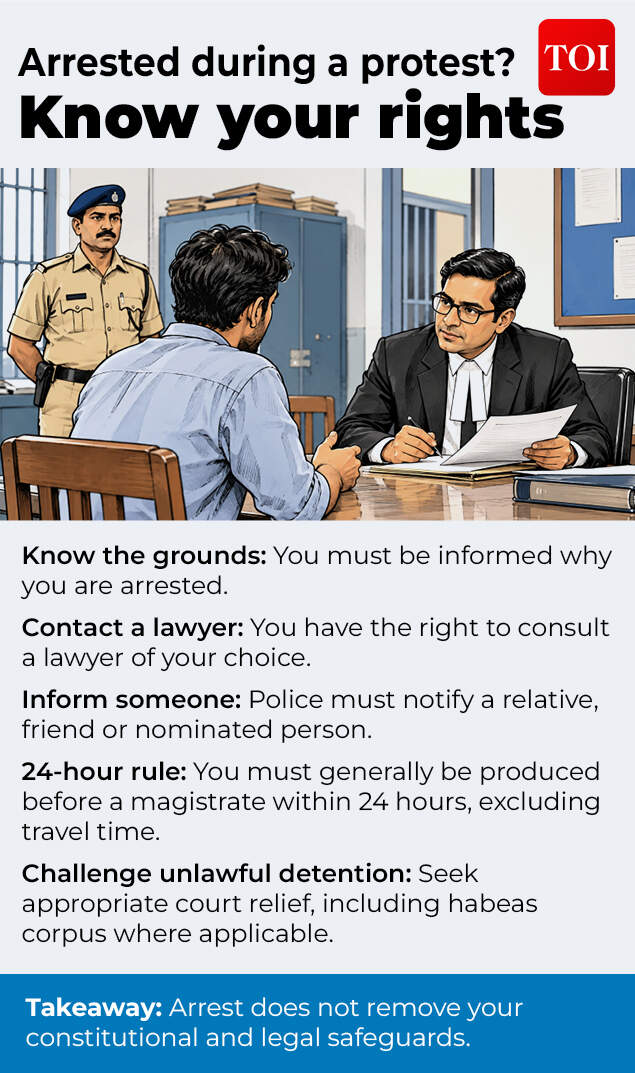
Rights and safeguards after an arrestAn arrest does not strip a person of their basic legal rights. The Constitution and the BNSS provide safeguards that police must follow.An arrested person has the right to be informed of the grounds of arrest and to consult a lawyer of their choice. Article 22(1) of the Constitution protects these rights, while Section 47 of the BNSS requires the arrested person to be informed of the grounds of arrest and, where applicable, their right to bail.Police must also inform a relative, friend or another person nominated by the arrested individual about the arrest and where they are being held. Section 48 of the BNSS sets out this requirement, while Section 53 provides for a medical examination of the arrested person.Another important safeguard is the 24-hour rule. Under Article 22(2) of the Constitution and Section 58 of the BNSS, an arrested person must generally be produced before the nearest magistrate within 24 hours, excluding the time required for the journey. Further custody requires lawful authorisation.The law also provides specific safeguards for the arrest of women. Under Section 43(5) of the BNSS, a woman should generally not be arrested between sunset and sunrise, except in exceptional circumstances and subject to the prescribed procedure, including prior permission from a magistrate.
Share your thoughts in the comments
Be respectful · TOI community guidelines
These protections apply even when police take several people into custody during a protest.“The arrested person must be informed of the relevant rights, and the Magistrate must verify compliance with the applicable requirements,” Gehrana said.
–
Legal remedies if you believe your detention was unlawfulIf you believe you have been unlawfully detained or arrested, you can approach the courts. The appropriate remedy will depend on the circumstances and the legal grounds for your detention.
- Seek bail or challenge continued custody: Apply to the competent court for bail, where available, or challenge the legal basis for continued detention.
- File a habeas corpus petition: Approach a high court under Article 226 of the Constitution or, where appropriate, the Supreme Court under Article 32 to challenge unlawful detention.
- Seek compensation: In appropriate cases, a person whose fundamental rights have been violated may seek compensation. It is not automatic and depends on the facts, evidence and applicable law.
The right to protest peacefully is constitutionally protected, but it is subject to lawful and reasonable restrictions. Police can intervene when the law permits them to do so, but they must have valid legal grounds for their actions and comply with the safeguards protecting individual liberty.
Source link


