

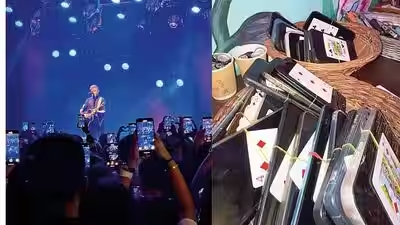

For the longest time, the phone warning at a live show came from a disembodied voice in the dark, asking you to put it on silent mode. But a Nokia tune would trill from the back row anyway. In June, at a concert in Lithuania’s Vilnius, pianist Waldemar Malicki and his fellow musicians made the best of one such rude interruption by picking up the ringtone’s melody and turning it into an impromptu piece of music.Over the years, the requests have gotten craftier. Theatre troupes worked the warning into the opening scene. Comedians made material out of the man with the glowing screen. Someone even set ‘turn off your phone’ to Pachelbel’s Canon in D. The charm offensive kept audiences laughing and the phones tucked away for roughly as long as it took the lights to dim. Now, some are done asking nicely, and the phones are going under lock and key. At comedian Samay Raina’s ‘Still Alive and Unfiltered’ show last Nov, the jokes were unfiltered, but the audience’s phones certainly weren’t. Given his recent run-ins with the law, a joke finding its way onto the internet was no small matter. BookMyShow warned ticket-holders that phones and smartwatches would be sealed in locked pouches. Guests could keep them, but had to step into a designated area to use their devices and have them resealed before returning. They were also advised to carry cash and warned that damaging a pouch would cost them. Anshika, who attended one of Raina’s shows, described how “freeing” it felt to watch something live without the constant urge to record or scroll, in an Instagram post. “We’re so used to capturing everything for reels that we forget to actually feel it in real life,” she said.More often, it’s the camera rather than the phone itself that’s the problem. At German techno DJ Klangkuenstler’s Mumbai show in June, organiser Outworld India sealed phone cameras with security stickers at the entrance, and anyone caught peeling one off risked being shown the door.

Madhubanti Bagchi.
Singer Madhubanti Bagchi thinks music has enough competition at concerts these days without hundreds of phones held aloft to record it all. “Much of the spectacle is designed to look good on social media and has nothing to do with music,” she says. “I felt that I needed to do something purely for music.” Once her India tour wraps up in Feb, Bagchi plans phone-free pop-ups for 50 to 100 listeners. “I don’t want to perform for phones. I want to perform for human beings.” Audiences can access clips through a Google Drive link afterwards. “It’s not going to be a dance or high-energy set,” she says, likening the pop-ups to old-school baithaks.In Chennai, Juvitta John has taken the business of putting phones away rather literally. At the centre of her ‘Lock & Talk’ gatherings is a locker with 24 numbered compartments. The guests — usually 15 to 20 strangers — get 15 minutes to make their last calls and warn anyone who might be looking for them that they’re about to disappear for two hours. The phones then go into the box, the key stays with the organisers, and everyone is expected to talk.Juvitta chanced upon the idea while backpacking through East Java in Indonesia. She dropped her phone, damaged the SIM slot and found herself in a remote area where she couldn’t get it fixed. With no internet for ten days, she got talking to people she might otherwise never have spoken to. This didn’t come particularly easily to her, having spent much of her college life in lockdown. “By the time restrictions ended, even running into old school friends felt uncomfortable. I’d put my earphones on to avoid conversations and stay in my comfort zone,” she recalls. Her accidental digital detox changed that. “I started talking to people around me, having conversations with strangers, listening to their stories and sharing my own. That’s when I realised how much you can learn from someone you’ve just met.”About six months ago, she launched ‘Lock & Talk’, building it into meet-ups like bike rides she had already been organising in Chennai. Taking away the phones, of course, doesn’t magically produce sparkling conversation. “If we just tell the people to talk, they don’t know how to start,” says Juvitta. So, the group plays an icebreaker game called ‘Red Flag, Green Flag’ with questions like ‘is it annoying when a friend insists on photographing a meal while everyone else’s food goes cold?’ or ‘is gossip a form of therapy?’ There’s usually enough disagreement to get people talking.But why are people paying Rs 500 to Rs 600 to spend two hours without their phones? “Many say they’re tired of doomscrolling through Instagram and YouTube,” Juvitta says. One woman signed up during the Big Billion Days sale to escape her shopping apps. Others wanted a break from spending entire weekends gaming. Some of the friendships have outlasted the sessions. “I’ve attended birthday parties and weddings of people I met through ‘Lock & Talk’. Some have even started businesses together,” says Juvitta.At Mumbai’s 3 Art House, handing over your phone involves two decks of playing cards. “If someone’s phone is tagged with the Seven of Hearts, we give them the matching card from the second deck,” says Saili Sohoni, their studio manager. The venue’s No Phone Party grew out of much the same observation as Juvitta’s. At regular parties, a call or notification would interrupt a perfectly good conversation. Or people tended to retreat into their phones. Their idea was to have a few hours with “no pressure to reply, check notifications, or worry about what’s happening online”. Both editions, with room for around 150 guests each, have sold out, with strangers playing games and dancing together.
Share your thoughts in the comments
Be respectful · TOI community guidelines
Alicia Keys, Childish Gambino, and Jack White have banned smartphones at concerts, and Bob Dylan has made his recent tours phone-free. Paul McCartney barred phones at two Los Angeles shows earlier this year, and described it: “like an old gig, like how everyone used to play.” Of course, those old gigs didn’t have Instagram to contend with. The complication to all this unplugging is that in an age when photos and reels double as free publicity, asking people to put their phones away could be something of a gamble. Bagchi doesn’t disagree. “Of course, it’s a gamble, but also a filter,” she says. She knows some people go to concerts to avoid FOMO as much as for the music. “I’m not saying it’s a bad thing, but if every concert becomes this, then we’re going to lose out on actually good concerts and good experiences.” Both 3 Art House and ‘Lock & Talk’ take care of the photography in between and share the pictures afterwards, so nobody goes home without proof they had a good time.
Source link


