
In 1919, German sailors secretly sank 52 warships at Scapa Flow; the wrecks later became valuable for an unexpected reason | World News

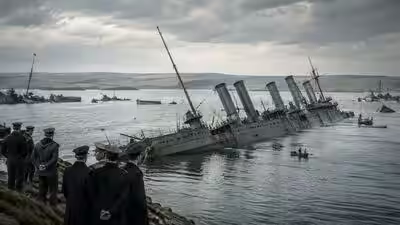

When the First World War finally ended, Germany’s powerful High Seas Fleet was not allowed to sail home. Instead, dozens of warships were sent to Scapa Flow in Scotland, where they remained under uneasy Allied supervision while the terms of peace were being decided. Then, on 21 June 1919, the German commander made a decision that stunned the British. Believing his fleet was about to be seized, Rear Admiral Ludwig von Reuter ordered his crews to scuttle the ships rather than surrender them intact.As reported by NorthLink Ferries, within hours, 52 vessels had slipped beneath the water. Many were later raised and dismantled, but seven wrecks still remain. More than a century later, their story has taken an unexpected turn: steel from ships built before the nuclear age can be prized for its exceptionally low radioactive background, giving these remnants of a defeated fleet an unlikely role in modern science.
Why 74 German warships ended up at Scapa Flow after WWI
When the First World War ended, Germany’s High Seas Fleet did not simply return home. Under the terms of the Armistice, the ships were interned at Scapa Flow, the large natural harbour in Orkney that had served as an important British naval base during the war.The German force was substantial. Seventy-four vessels were eventually held there, including battleships, battlecruisers, cruisers and destroyers. Their crews remained aboard while the Allies argued over what should happen to the fleet during the negotiations that would eventually produce the Treaty of Versailles.For the German sailors, the waiting period was an uncomfortable one. The ships were effectively under Allied control, but they had not formally been handed over as prizes. The future of the fleet remained uncertain, and information reaching the German commander, Rear Admiral Ludwig von Reuter, was sometimes incomplete or out of date.
The 1919 scuttling that sent the German High Seas Fleet beneath Scapa Flow
Von Reuter believed the fleet was about to be taken by the British. He had been preparing for the possibility that the ships might have to be destroyed rather than allowed to pass into Allied hands. There was a particular misunderstanding behind what followed. The deadline associated with the peace negotiations had been extended, but Von Reuter did not know this. On the morning of 21 June, with much of the British fleet away on exercises, he decided that the moment had arrived. A coded order was sent across the German ships.The crews began opening valves and other openings that allowed seawater into the vessels. Some preparations had been made quietly beforehand, making it difficult for the British personnel left behind to stop the operation once it began.The scale of the response was striking. Within roughly 5 hours, 52 German ships had been scuttled. The Royal Navy managed to beach several vessels and prevent them from being lost, but most of the fleet disappeared beneath the water.

The final German deaths of the First World War
The sinking was not entirely bloodless. British sailors attempted to intervene as the German crews abandoned their ships. During the confusion, confrontations broke out, and nine German sailors were shot and killed, 16 others were wounded. They are generally regarded as the final German casualties of the First World War.For Britain and the other Allied powers, the deliberate destruction of the fleet was an unwelcome development. They had expected the ships to be dealt with through the peace settlement and several Allied governments wanted vessels distributed among their own navies.In Germany, however, Von Reuter’s decision was viewed differently. At a time when the country was facing military defeat and national humiliation, the destruction of the fleet was seen by many as an act that had prevented the ships from being handed to former enemies.The admiral himself was taken prisoner along with many of his men. He was eventually released in 1920.
German High Seas Fleet salvage raises dozens of warships from Scapa Flow
The wrecks did not simply remain untouched after the scuttling. Their position created practical problems for the people using Scapa Flow. Some of the ships were in relatively shallow water, obstructing areas used for piers and fishing. Salvage work therefore began soon after the sinkings, with increasingly ambitious efforts following during the 1920s and 1930s.Reportedly, Ernest Cox became the most famous figure associated with the operation. His salvage company bought large numbers of the sunken vessels and developed methods for raising ships that were never designed to be recovered from the seabed.It became an enormous industrial undertaking. As reported by Orkney Museums, Cox and Danks eventually raised 26 destroyers, while other companies recovered additional cruisers, battlecruisers and battleships. Salvage continued in different forms for decades, with some operations extending into the second half of the twentieth century. Eventually, only seven of the German vessels remained.
Why the old steel is unusual
The surviving wrecks have another connection to modern technology that has little to do with naval history.Steel manufactured before the nuclear age can have an exceptionally low radioactive background. Atmospheric nuclear testing and other sources of radioactive contamination after the Second World War introduced small amounts of radionuclides into the environment. Modern steel can therefore carry a radiation signature that was absent from material manufactured before those developments.That makes some pre-1945 steel valuable for extremely sensitive equipment. It can be used where even tiny amounts of background radiation could interfere with measurements, including certain radiation detectors and scientific instruments. The remaining Scapa Flow wrecks have consequently become one source of what is known as low-background steel.The steel is not radioactive in the sense suggested by the phrase sometimes used to describe it. The attraction is almost the opposite: its background radiation is exceptionally low because the metal was produced before widespread nuclear contamination of the atmosphere.
Source link