In 1850, a California rancher brought 45 sheep to San Miguel Island; by 1862 there were 6,000, and after grazing denuded the island the last 148 were eliminated in 1966

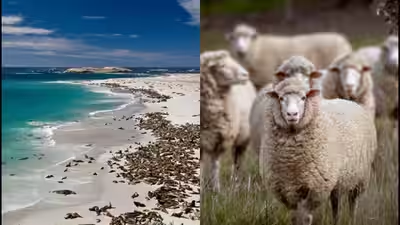

Once, on a remote island battered by fierce winds and surrounded by the Pacific, there existed a peculiar ranching empire. San Miguel Island, now part of California’s Channel Islands National Park, was once home to thousands of sheep, isolated ranching families, and a sprawling ranch complex built partly from shipwreck debris. But decades of unbridled grazing degraded the landscape, stripping away vegetation and increasing erosion. Today, the ruins of that period offer a painful window into the island’s tortured history.
From 45 sheep to thousands
Sheep grazed on San Miguel Island prior to 1850, but the ranching period expanded greatly when California pioneer George Nidever made his home on the island in 1850. He brought in sheep and cattle, hogs and horses, forty-five head in all. In a dozen years the flock had increased to some 6,000 sheep. But the island’s delicate environment could not have supported such heavy grazing indefinitely. In 1863 and 1864 Nidever suffered heavy losses to drought, and the sheep had already done extensive damage to native vegetation. With the loss of grasses and plants, the soil was exposed to wind and water erosion. Sand began to blow over parts of the island, creating an environmental legacy that would outlast the ranchers.
Ranching turns into an industry
After Nidever, the Mills brothers and their Pacific Wool Growing Company turned sheep ranching into a more organized commercial enterprise. They constructed buildings near Cuyler Harbor and continued to graze livestock around the island. William G. Waters would become one of San Miguel Island’s longest-residing residents. He spent nearly 30 years developing a working ranch with fields, livestock facilities, workshops and equipment. About 1906, Waters superintended the building of a remarkable ranch house. It was built to withstand the island’s strong winds and was mostly made of salvaged shipwreck materials, including lumber from the J.M. Coleman. Its double walls, its many rooms, and its enclosed courtyard, reflected the extreme conditions of life on San Miguel.
Lester’s lonely years

By mid-century, the environmental consequences of ranching were becoming increasingly difficult to ignore. The Navy took over the island for military purposes and sheep grazing was gradually restricted.
Herbert and Elizabeth Lester were living on the island with their two daughters when it drew national attention. Herbert Lester managed the ranch for Robert Brooks and he loved the remoteness of San Miguel. The family worked to make the rugged ranch house a home, planting a garden, keeping supplies and educating their children on the island. It was their odd way of life which drew visitors, researchers and adventurers. But there was a lot of hardship to offset the romance of island life. Supplies had to be ferried in from the mainland, the weather could wreak havoc on getting there, and the family relied heavily on their own ingenuity. The Lester’s time on the island abruptly ended in 1942 with the death of Herbert Lester. Finally Elizabeth and her daughters left, closing one of the most colorful chapters in San Miguel’s ranching history.
Sheep grazing comes to an end
By mid-century, the environmental consequences of ranching were becoming increasingly difficult to ignore. The Navy took over the island for military purposes and sheep grazing was gradually restricted. Robert Brooks was ordered to remove his livestock in 1948, but hundreds of sheep remained. Another roundup in 1950 killed some more of the animals, but some feral sheep survived in the rugged canyons of the island. The remaining people kept on living until 1966 when the National Park Service and Navy undertook an intensive effort to wipe out the last flock. Aerial searches identified 148 sheep which were all removed by the end of the operation. And so ended more than a century of continuous sheep grazing on San Miguel Island.
A ranching landscape abandoned
The ranch house that had survived decades of isolation didn’t last much longer. It was destroyed by fire in 1967, the result of an accident during Navy operations. Today all that remains are the rubble and metal fragments, pieces of the foundation, a fallen chimney and remains of a fig tree. The physical ranch may be gone, but the story of the ranch lives on in San Miguel Island landscape. The sheep, the ranchers, and the families who once lived on the windswept island left a legacy that reveals how human activity can alter even the most isolated environments.
Source link