
Gabe Newell has put more than $816 million into deep-sea research; his Inkfish fleet is building a 162-metre science vessel |

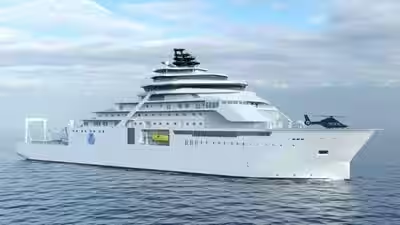

Gabe Newell’s marine research organisation Inkfish has ordered a 162-metre deep-sea research vessel from Norwegian shipbuilder VARD. The ship, named RV11000, is valued at nearly €700 million, or about $816 million, and is scheduled for delivery in the first quarter of 2030. According to Marine Insight, the vessel will be designed to work at depths of up to 11,000 metres, allowing it to support some of the deepest ocean research missions. The project is VARD’s largest order ever for a single vessel and will expand Inkfish’s ability to study remote parts of the ocean.
Capabilities of Gabe Newell’s 162-metre deep-sea vessel
RV11000 is being developed specifically for deep-ocean scientific work rather than general-purpose shipping. Fincantieri, VARD’s parent group, said the vessel will be used for seafloor mapping, coring and sampling, submarine operations and remotely operated vehicle missions.The ship will be 162 metres long and 28 metres wide. Its design is based on the VARD 9 42 platform and has been developed by Vard Design in Alesund, Norway, with Inkfish and technical partner YTMC. Fincantieri said the project builds on the engineering and design foundations of RV6000, a 100-metre research vessel that VARD began building for Inkfish after a contract signed in 2025.The scale of the new ship reflects the demands of reaching the deepest parts of the ocean. According to Marine Insight, RV11000 will be able to support underwater missions at depths of up to 11,000 metres, bringing the full depth of the ocean within the vessel’s planned operating range.
How will RV11000 handle demanding underwater missions
The vessel will carry equipment for launching, recovering and supporting several types of underwater vehicles. Marine Insight reports that this will include a stern-mounted A-frame, systems for remotely operated vehicles, shipboard cranes and an offshore crane.There will also be a dedicated hangar for two submarines and another area for ROV operations. The ship will have a coring system, scientific winches, a moonpool, hatches and a drop keel to support different forms of ocean research.Fincantieri said the hull has been optimised for seafloor mapping, while advanced stabilisers are intended to reduce movement during scientific operations. The vessel will also use a propulsion system combining direct-current technology with battery power.

Image Credit: Kongsberg Maritime
Importance of the large battery for scientific work
One of RV11000’s most notable features is its battery installation. VARD says the ship will have one of the largest battery systems ever fitted to a vessel, with enough capacity to allow up to 12 hours of silent scientific operations.That capability is particularly relevant when researchers need to reduce noise and vibration around underwater equipment. Rather than relying entirely on conventional propulsion during every stage of a mission, the vessel will be able to use its battery system for periods when quieter operation is important.Marine Insight also reports that the battery system will work with the vessel’s propulsion arrangement to improve flexibility and efficiency. The ship will additionally be built to meet the latest cybersecurity requirements set by the International Association of Classification Societies.
New underwater technology available on the vessel
Kongsberg Maritime is supplying a specialised system that will change how autonomous underwater vehicles are handled aboard the ship. In its September 2026 announcement, Kongsberg said it had secured a contract to provide an autonomous underwater vehicle hangar and launch and recovery system for the VARD-built Inkfish vessel.The system will allow HUGIN autonomous underwater vehicles to be launched, recovered and docked below the sea surface. Kongsberg said moving these operations beneath the wave zone can reduce the effect of waves, improving safety and allowing missions to continue in higher sea states.The delivery will include the hangar integration, a skidding system, vehicle logistics and an overhead crane for handling the underwater vehicles. Kongsberg said the equipment is expected to be assembled and tested in Norway, with delivery planned for the end of 2027.

Image Credit: Kongsberg Maritime
How will scientists use the ship during long expeditions
RV11000 is being designed to accommodate the people and facilities needed for extended research missions. Fincantieri said the vessel will provide accommodation for up to 130 crew members and researchers, alongside laboratories, workshops and dedicated scientific spaces.Marine Insight also reports that the ship will have laboratories, offices, workshops and public areas intended to support long-duration missions. Most of the people aboard will be housed in single cabins, giving the vessel the capacity to function as a large research base while operating far from shore.Inkfish also intends for the research carried out through its vessels to contribute data to open scientific repositories. This gives the ship a role beyond individual expeditions, as information gathered during missions can become part of a wider body of scientific knowledge.
Location of construction for this 162-metre vessel
The construction process will involve VARD facilities in both Romania and Norway. Fincantieri said the hull of RV11000 will be built at Vard Shipyards Romania in Tulcea, while outfitting, commissioning and final delivery will take place at one of VARD’s shipyards in Norway.The project also marks another stage in Inkfish’s growing research fleet. Marine Insight notes that RV11000 will join RV Hydra and RV Dagon, while the earlier RV6000 is already under construction. Together, the vessels are intended to give Inkfish greater capacity to support marine research around the world.
Source link


