California scientists grew kelp in a lab at 74,000 spores per millilitre; they are now planting the young forests back into the ocean |


California scientists are growing young bull kelp in laboratory tanks before placing it back into coastal waters where underwater forests have largely disappeared. At Bodega Marine Laboratory, researchers have developed cultures containing as many as 74,000 kelp spores per millilitre, creating a steady supply for restoration work. The effort is aimed at rebuilding parts of Northern California’s kelp forests, which have been badly damaged by warming seas, the loss of sea-star predators and the resulting spread of purple sea urchins. The first young plants are now being moved from controlled laboratory conditions to the ocean.
How the kelp restoration reached 74,000 spores per millilitre
The restoration centres on bull kelp, a large brown algae that once formed extensive underwater forests along Northern California. Courthouse News Service reported that bull kelp can grow as much as a foot a day and reach nearly 100 feet in height, despite living for only about a year.Its decline became especially severe after 2014, when unusually warm ocean conditions coincided with major ecological changes. As Courthouse News Service explained, purple sea urchins multiplied while a disease devastated sea stars that normally helped keep urchin numbers under control. The result was a rapid shift from kelp-covered reefs to areas dominated by hungry urchins.Scientists at UC Davis Bodega Marine Laboratory now collect reproductive material from healthy adult bull kelp and carefully raise it through its early stages. NOAA explained in its 2024 account that the spores are nurtured under controlled seawater and sunlight conditions before being encouraged to settle on special twine.The scale of the lab work has increased considerably. The Greater Farallones Association reported that its Kelp Restoration Team had cultivated bull kelp cultures reaching 74,000 spores per millilitre in tanks at Bodega Marine Laboratory.The team used that material to inoculate 100 metres of restoration twine with juvenile bull kelp. It then successfully placed 54 metres of the twine at Fort Ross Cove. Just weeks later, divers recorded young bull kelp growing on the restoration structures and on the nearby seafloor.The Greater Farallones Association also reported that 199 juvenile bull kelp, measuring between 3 and 120 centimetres, were prepared during the summer for placement on ARKEV restoration units at Stillwater Cove. This marked the first time that the technique had been tested there.

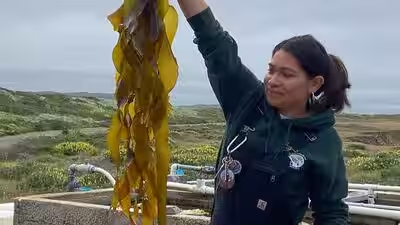
Julieta Gómez, a kelp restoration specialist with the Greater Farallones Association holds up a juvenile kelp specimen at the UC Davis Marine Laboratory. Image Credit: Carly Nairn/Courthouse News
What happens to the kelp before it reaches the sea
The young plants require careful attention because the lab is replacing several parts of their natural environment. Bay Nature reported that researchers grow tiny kelp beneath lights before gradually moving them through different stages of development. At around 3 months old, young plants can be prepared for outplanting.Courthouse News Service described how researchers move the growing kelp from small lab containers into larger vessels as they develop. Light levels must be adjusted as the plants grow, while seawater conditions also have to be managed carefully. Once mature, the kelp produces reproductive patches called sori, allowing researchers to collect another generation of spores.This makes the laboratory more than a nursery for individual plants. It can also serve as a source of reproductive material that can be used repeatedly in restoration work.
Scientists are also removing sea urchins
Growing kelp is only one part of the challenge because young plants are being returned to an environment where they can quickly be eaten. NOAA noted that restoration teams are working with fishers and commercial urchin divers to reduce purple sea urchin numbers around planting sites.Bay Nature described the situation as a difficult cycle. After the loss of predators and the decline of kelp, purple urchins spread across the rocky seafloor and continued feeding on any kelp that managed to appear. This can make an urchin-dominated reef remarkably difficult to turn back into a kelp forest.The Greater Farallones Association said its restoration programme has already removed more than 190,000 pounds of purple sea urchins from restoration sites. The aim is to give newly planted kelp enough room to survive and eventually reproduce.
What could happen if the young forests survive
The hope is not simply to keep a collection of planted kelp alive. Researchers want the young forests to produce their own spores and gradually establish patches that can expand naturally. Researchers have also tested several ways of placing young kelp in the ocean, including lines attached to the seafloor, small stones carrying kelp and bags containing spores.A related California Sea Grant project has explored another approach called Green Gravel. In that work, young kelp spores were grown on small pieces of gravel that could potentially be spread from a boat, reducing the need for divers to place every piece individually. California Sea Grant reported that researchers were also testing terracotta tiles that could be fixed to reefs and monitored more easily.
Can laboratory kelp overcome the wider problem
The Greater Farallones Association’s latest results offer an encouraging sign. Young bull kelp has already been observed growing after lab-raised material was returned to the ocean.However, the lab work cannot solve the environmental pressures on its own. Courthouse News Service reported that researchers are still studying why some locations appear more suitable for bull kelp than others. Freshwater flowing into the sea may play a role in some areas, while ocean temperature and the behaviour of urchins can also affect whether restoration succeeds.
Source link