Bangladesh garment owners threaten to quit wage talks, shut factories indefinitely

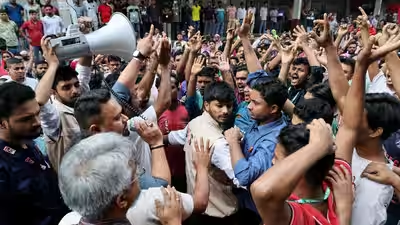

Garment manufacturers in Bangladesh have threatened to withdraw from minimum wage negotiations and shut factories indefinitely if workers continue vandalising industrial units during protests.The Bangladesh Garment Manufacturers and Exporters Association (BGMEA) and Bangladesh Knitwear Manufacturers and Exporters Association (BKMEA) said on Saturday that they were reconsidering their participation in the wage talks, citing a lack of assurances over factory security.“If the situation persists, we must reconsider,” BGMEA president Mahmud Hasan Khan said at a news briefing in Dhaka, referring to the next round of negotiations scheduled for Monday.Khan also said factories unable to operate because of the unrest would remain closed indefinitely under Bangladesh’s labour law. Section 13(1) of the Bangladesh Labour Act allows employers to suspend operations under a “no work, no pay” provision.The warning comes after weeks of protests over wages and working conditions, with demonstrations turning violent in several garment manufacturing centres. Workers have blocked roads, while clashes this month have involved damage to property and the torching of police vehicles.At least 147 factories remained closed on Saturday across Savar, Ashulia and Gazipur, the country’s major garment manufacturing hubs. More than 4,500 factories are registered with industry trade bodies.
Wage talks face fresh uncertainty
The Minimum Wage Board, formed on November 1, is due to meet on Monday to discuss a revised pay structure for garment workers. The current minimum monthly wage stands at Tk12,500 (approx INR 9479), fixed in December 2023.Workers’ representatives have proposed raising the minimum to Tk32,000 (approx INR 24267), more than double the existing rate, according to local media reports. The demand has also been reported at Tk30,000 (approx INR 22751) in other accounts.The workers’ proposal includes Tk19,200 (approx INR 14560) in basic pay, Tk9,600 (approx INR 7280) in house rent and Tk3,200 (approx INR 2426) in allowances covering medical expenses, transport, food and other costs. It also proposes four wage grades, with monthly salaries ranging from Tk32,000 (approx INR 24267) to Tk48,000 (approx INR 36401).Factory owners have yet to submit their formal proposal. They were given four days after the November 9 meeting to prepare their recommendations, which are expected to be discussed at Monday’s session. Local media reports said employers could submit their proposal while staying away from the meeting.Workers say their wages have failed to keep pace with the rising cost of food, housing, transport and healthcare. Inflation in Bangladesh is running at around 8%, further eroding their purchasing power.The minimum wage has risen consistently in Bangladesh but despite these increases, Bangladesh’s garment workers remain among the lower-paid in the region.The threat of an indefinite shutdown has already materialised at several units. Seven factories in Savar and Ashulia have been closed under Section 13(1), according to local media reports.The disruption has prompted concern over the impact on an industry that employs more than four million people and accounts for roughly 80% of Bangladesh’s export earnings.The timing is particularly sensitive, with factories entering the run-up to Christmas, traditionally one of the busiest periods for garment exports.For an industry already facing pressure over production costs, the combination of unresolved wage demands, factory shutdowns and the risk of losing buyer confidence could make the coming weeks critical.
Source link