Archaeologists digging ahead of an electricity substation in western Hungary found more than 200 Celtic silver coins packed in a small clay pot 40cm underground, the largest such hoard there in over 50 years

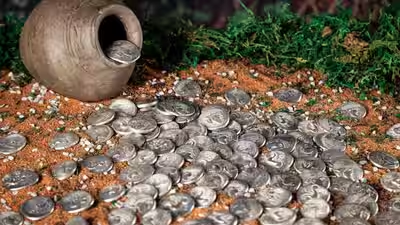

One person’s construction site can be another archaeologist’s treasure trove! What was supposed to make way for a new electricity substation in Szombathely, Hungary, has now led to a remarkable discovery.More than 200 Celtic silver coins, some of which had been preserved inside a small clay pot, were found buried just 30 to 40 centimetres (approximately 12 to 16 inches) beneath the ground. What began as an archaeological investigation ahead of the construction project eventually led researchers to uncover a hoard that had remained hidden for more than 2,000 years.E.ON, the Hungarian energy company, recently announced the discovery in an official statement, with the findings also reported by Live Science. The coins, which weigh more than two kilograms (approximately 4.4 pounds), constitute the largest such hoard discovered in Hungary in over 50 years. According to Eszter Kreiter, an archaeologist at Hungary’s National Archaeological Institute, the last comparable discovery in the country was made in the late 1960s.While the silver coins are the most remarkable find at the centre of the discovery, they are not all that archaeologists came across. The excavation also revealed a brick bearing the footprint of a Roman-era dog, unusual jewellery, prehistoric tools and several other objects that offer a glimpse into the lives of communities that occupied the area thousands of years ago.
The archaeological findings
The team of archaeologists was already aware that the proposed construction site was of archaeological importance. Therefore, excavations were carried out between 2023 and 2025 by specialists from the National Archaeological Institute of the Hungarian National Museum Public Collections Centre. The site required archaeological investigations before and alongside the construction-related earthworks.The archaeological work eventually uncovered nearly 400 archaeological features and several thousand artefacts, with evidence of human activity dating from the fifth millennium BC through to the early modern period.The oldest discoveries included a polished stone tool dating back almost 7,000 years, which was likely used for woodworking. Archaeologists also found a glass bead decorated with a peacock-eye pattern, believed to have been part of jewellery from around the seventh or sixth century BC. Vessels that may have been used to contain food and drink were also discovered alongside burials.Among the other discoveries were two well-preserved stones from a hand-operated mill, found inside a semi-subterranean building dating to the Celtic period.The site also contained evidence of a Roman-era villa estate. Although the original building had been dismantled over the centuries, archaeologists were able to partially reconstruct its layout, including its underfloor heating system. One particularly unusual discovery was a fragment of brick bearing the imprint of a dog’s paw, believed to have been left when the clay was still soft. The brick may once have been used in the construction of the villa’s heating system.
About the Celtic coins
The silver hoard consists of more than 200 coins identified as Velem-type tetradrachms. These coins date from the late second century BC to the early first century BC and were buried in a pit approximately 30–40 centimetres beneath the ground. While some of the coins had been placed inside a small ceramic vessel, agricultural activity over the centuries had disturbed the deposit.According to Live Science, the coins are worth more than $2,000 in today’s market based on their silver content alone. However, their historical and archaeological significance makes them considerably more valuable than the price of the metal they contain.The coins are modelled on Greek tetradrachms, an early form of large silver currency introduced in the late sixth century BC. The Velem type takes its name from Velem-Szent Vid, a fortified Celtic hilltop settlement, or oppidum, located approximately 15 kilometres west of the excavation site. Similar coins have previously been discovered there.Each coin features a stylised head on one side, believed to represent the Greek god Apollo, while the other side depicts a helmeted rider on a horse. These designs reflect the influence of Greek coinage on Celtic communities, which adapted existing designs to develop their own forms of currency.
The history and significance of Celtic coinage
But what do we really know about the Celtic communities and their use of coinage?Some research studies have suggested that Celtic coin production in the region could have begun around the middle of the third century BC, with some of the earliest coins modelled on the silver tetradrachms of Philip II of Macedon. Their designs reflected the influence of Greek currency, although Celtic communities gradually developed distinctive imagery of their own. The purpose of these large silver coins, however, has continued to remain a subject of scholarly discussion.While the precise reason behind the burial of the Szombathely hoard remains unknown, the discovery could open up new avenues of research into the history of Celtic communities and their use of silver currency.According to E.ON’s official statement, the discoveries made during the excavation will soon be presented to the public in a temporary exhibition at the Savaria Museum in Szombathely.
Source link