World

After thieves took about 30 of his village’s 18th-century wall stones in Rufford, Lancashire, councillor Matt Smith hid an Apple AirTag inside a loose one; when it moved overnight, police tracked down the thief

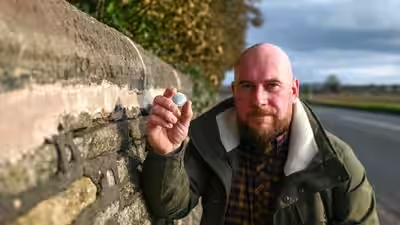
After thieves took about 30 of his village’s 18th-century wall stones in Rufford, Lancashire, councillor Matt Smith hid an Apple AirTag inside a loose one; when it moved overnight, police tracked down the thief

An English mayor was fed up with watching 300-year-old coping stones vanish from an 18th-century ancient wall one by one. With no cameras around, pointing fingers or catching the thief seemed like an impossible task. Matt Smith said people living near Rufford Old Hall in Lancashire “were getting a bit miffed” with stones being taken from the historic boundary wall, spread along a half-mile stretch of road which connects Holmeswood and Rufford in October 2025.Locals noticed the wall was first attacked and stones were taken in May, with two further raids taking place in June and October. “We looked at installing some CCTV, but it costs and with the wall being attacked at random places at random times, in a half-mile stretch of wall, it was going to be hard to cover that area,” the parish councillor said. He said the parish council “put some lovely ‘smile, you’re on camera’ signs up and unfortunately that didn’t deter them”.Thus, to investigate and possibly find a conclusion, he put an Apple AirTag, a coin-sized tracking device, inside one of the stones. “I devised a plan and spoke with the owners,” he said. He said he and the owners “noticed it was the smaller of the stones that were being taken,” so they decided to put a tracking device in what they believed would be the next stone to go.He said he drilled into one of the smaller coping stones and placed an Apple AirTag inside before he “patched up the core, ground it up, put a bit of resin in” and placed it back on the wall.About four weeks later, his phone began to ping with the tracking device on the move to an address in Winstanley in Wigan. He contacted the police, who went to the address and made an arrest. The coping stones were later returned and the “extremely grateful” residents rebuilt the wall.According to a BBC report, the tracker led police to an address in Wigan and eventually saw a man plead guilty to two counts of theft and one count of handling stolen goods at Wigan Magistrates’ Court in October. Craig Barker, 41, from Wigan, pleaded guilty to theft and handling stolen goods and was given a 12-month sentence, suspended for 22 months in October. On the scene, police found a substantial number of coping stones from the vandalised wall, reportedly worth around £7,000 / $9,300—but Smith claimed dozens of others were also found from across the country, making the estimated total value up to £40,000.Speaking after the case, PC Sean Dalby said it highlighted “the strong relationships we have developed with our communities and demonstrates the effectiveness of working together to tackle rural and heritage crime”. “I would like to thank the local residents for their support throughout the investigation, as well as those who gave their time to rebuild the wall free of charge,” he added.The wall is thought to have been built around 1730 for the historic Grade II-listed Rufford New Hall, which was later converted into a hospital in the 1900s, and later into apartments. “It was a great feeling to know we had found the man responsible. I’m glad we stood up and didn’t just tolerate it,” said Smith.


Source link

Related Articles

Leave a Reply

Your email address will not be published. Required fields are marked *

Back to top button
×
newsnation.aanest.com
Logo
Date of Publish : 10 November 2026, 12:18 pm Digital Edition : News nation
After thieves took about 30 of his village’s 18th-century wall stones in Rufford, Lancashire, councillor Matt Smith hid an Apple AirTag inside a loose one; when it moved overnight, police tracked down the thief

An English mayor was fed up with watching 300-year-old coping stones vanish from an 18th-century ancient wall one by one. With no cameras around, pointing fingers or catching the thief seemed like an impossible task. Matt Smith said people living near Rufford Old Hall in Lancashire "were getting a bit miffed" with stones being taken from the historic boundary wall, spread along a half-mile stretch of road which connects Holmeswood and Rufford in October 2025.Locals noticed the wall was first attacked and stones were taken in May, with two further raids taking place in June and October. "We looked at installing some CCTV, but it costs and with the wall being attacked at random places at random times, in a half-mile stretch of wall, it was going to be hard to cover that area," the parish councillor said. He said the parish council "put some lovely 'smile, you're on camera' signs up and unfortunately that didn't deter them".Thus, to investigate and possibly find a conclusion, he put an Apple AirTag, a coin-sized tracking device, inside one of the stones. "I devised a plan and spoke with the owners," he said. He said he and the owners "noticed it was the smaller of the stones that were being taken," so they decided to put a tracking device in what they believed would be the next stone to go.He said he drilled into one of the smaller coping stones and placed an Apple AirTag inside before he "patched up the core, ground it up, put a bit of resin in" and placed it back on the wall.About four weeks later, his phone began to ping with the tracking device on the move to an address in Winstanley in Wigan. He contacted the police, who went to the address and made an arrest. The coping stones were later returned and the "extremely grateful" residents rebuilt the wall.According to a BBC report, the tracker led police to an address in Wigan and eventually saw a man plead guilty to two counts of theft and one count of handling stolen goods at Wigan Magistrates' Court in October. Craig Barker, 41, from Wigan, pleaded guilty to theft and handling stolen goods and was given a 12-month sentence, suspended for 22 months in October. On the scene, police found a substantial number of coping stones from the vandalised wall, reportedly worth around £7,000 / $9,300—but Smith claimed dozens of others were also found from across the country, making the estimated total value up to £40,000.Speaking after the case, PC Sean Dalby said it highlighted "the strong relationships we have developed with our communities and demonstrates the effectiveness of working together to tackle rural and heritage crime". "I would like to thank the local residents for their support throughout the investigation, as well as those who gave their time to rebuild the wall free of charge," he added.The wall is thought to have been built around 1730 for the historic Grade II-listed Rufford New Hall, which was later converted into a hospital in the 1900s, and later into apartments. “It was a great feeling to know we had found the man responsible. I’m glad we stood up and didn’t just tolerate it,” said Smith.

Source link