
World

A Michigan farmer bought back the 131 acres his family had lost over the decades; in 2026, he sold the development rights so the land can never be broken up for housing

A Michigan farmer bought back the 131 acres his family had lost over the decades; in 2026, he sold the development rights so the land can never be broken up for housing
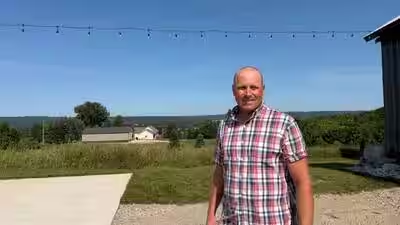
Michigan farmer John Boyer bought back his family’s 131 acres and took a major step to ensure the farmland can never be divided for housing. (Photo: Vivian La/IPR News)

John Boyer grew up surrounded by the rolling fields of corn, oats and wheat that once belonged to his family in East Jordan, Michigan. Decades later, after the 131-acre property had changed hands several times outside the family, Boyer made the decision to buy it back.For Boyer, the purchase was about more than owning farmland. He felt a personal responsibility to bring the property back into the family and continue farming it, while ensuring that development would not gradually encroach on the agricultural community.“For any farmer, everything’s personal,” Boyer was quoted as saying by Bridge Michigan. “Every piece of property, every stone you pick up, you spend countless hours out there.”Now, Boyer has taken another significant step to protect the land. In 2026, he sold the future development rights to the Little Traverse Conservancy through a conservation easement, meaning the property can no longer be divided and developed for housing even if ownership changes in the future.

Protecting the land from being broken up

Under the conservation easement, Boyer continues to own the 131 acres. However, the Little Traverse Conservancy holds the development rights, restricting future residential and commercial development on the property.The protection remains in place even if Boyer eventually transfers the land to his children or sells it to another owner.For Boyer, the decision was driven by a fear that the property could one day be divided into smaller parcels and sold for development.“Then suddenly a productive farm field or ground is gone, and it’s gone for generations,” Boyer said. “It’s gone forever.”His decision comes at a time when farmland across the United States is expected to change hands on a large scale in the coming decades. Farmers are increasingly weighing the value of their land against pressures from rising property prices, climate change and an aging farming population.

Michigan farmland is under growing pressure

According to the most recent US Department of Agriculture farm census, Michigan had about 9.5 million acres devoted to farming in 2022, roughly a quarter of the state. That was down from approximately 9.8 million acres in 2017.Farmland owned by farmers fell by about 208,000 acres, or 3.6%, over the same period, while leased and rented farmland also declined.At the same time, the value of farmland has continued to rise. USDA data cited in the report shows Michigan farmland was valued at about $6,800 per acre last year, a 7.8% increase from 2024 and higher than the national increase of 4.3%.That creates a complicated situation for farmers who own large amounts of land.“It’s a matter of trying to figure out what exactly is going to be the best fit for everybody’s situation. And there’s a lot of pressure. There’s a lot of money,” said Jon LaPorte, a farm business management educator with Michigan State University Extension.

Selling development rights instead of selling the farm

A conservation easement offers landowners another way to benefit financially from their property without giving up ownership.Joe Graham, chief financial and operating officer for the Little Traverse Conservancy, said the arrangement allows farmers to capture some of the value tied to their land while keeping the property in their hands.“We’re offering them another alternative,” Graham said. “We’re offering a way to capture some of the equity and the value they have in that land without having to sell it and see it leave their ownership.”The conservancy currently protects around 30,000 acres through conservation easements across five counties in northern Michigan and the Upper Peninsula. About 6,000 of those acres are farmland.However, such agreements can be difficult decisions because selling development rights generally provides less money than selling the land outright. As farmland values rise, some owners may wonder whether they are giving up potential future income.“There can be a question of timing. ‘Is this the right thing to do? What might we be foregoing later?’” Graham said.For Boyer, however, preserving the land for future generations outweighed the possibility of making more money from development.

‘They don’t make land anymore’

Boyer is not alone in worrying about the long-term future of farmland.Rebecca Carlson, a fourth-generation farmer who operates Overlook Orchards in Northport, Michigan, has also watched land fragmentation become a concern. She said aging farmers can sometimes divide property among several children, creating a patchwork of ownership that can threaten multi-generational farms.Carlson and her husband have expanded their own operation from around 200 acres to 1,300 acres in eight years. They have purchased some land and leased other parcels, often from farming families without a younger generation ready to take over.Leasing can allow farmland to remain in agricultural production while giving farmers access to acreage without the enormous costs associated with buying it.Carlson’s leases generally run for about 30 years, with annual fees varying according to factors such as location and crop productivity.“It’s a great way to maintain your farming, your farm and grow your farm,” Carlson said. “They don’t make land anymore.”According to the 2022 USDA census, around 39% of Michigan’s agricultural land is leased, a figure that remained unchanged from 2017.

Development pressures extend beyond housing

Residential construction is not the only force competing for farmland.Michigan’s push toward a cleaner electricity grid has also increased interest in agricultural land for renewable energy projects, including solar farms, wind turbines and battery storage facilities.Jon LaPorte said landowners naturally consider where they can obtain the greatest value from their property.“From a landowner’s perspective, they’ve got bills to pay the same as a farmer, and they’re looking at situations of, ‘Where can I get the most value?’” LaPorte said.Solar currently accounts for only a small portion of Michigan’s USDA prime farmland, with about 0.09% used for solar, according to data cited from the Solar Energy Industries Association. Still, proposed projects have generated opposition in farming communities.In Wexford County, plans for solar panels covering nearly 1,500 acres of farmland sparked concerns this year about development encroaching on productive agricultural ground.Carlson believes renewable energy projects should instead be placed on areas such as parking structures, highway medians and high-rise buildings whenever possible.“Put them in places that make sense,” she said. “Don’t take away our resources to grow our own food.”


Source link

Related Articles

Leave a Reply

Your email address will not be published. Required fields are marked *

Back to top button
×
newsnation.aanest.com
Logo
Date of Publish : 04 September 2026, 11:55 am Digital Edition : News nation
A Michigan farmer bought back the 131 acres his family had lost over the decades; in 2026, he sold the development rights so the land can never be broken up for housing

Michigan farmer John Boyer bought back his family’s 131 acres and took a major step to ensure the farmland can never be divided for housing. (Photo: Vivian La/IPR News) John Boyer grew up surrounded by the rolling fields of corn, oats and wheat that once belonged to his family in East Jordan, Michigan. Decades later, after the 131-acre property had changed hands several times outside the family, Boyer made the decision to buy it back.For Boyer, the purchase was about more than owning farmland. He felt a personal responsibility to bring the property back into the family and continue farming it, while ensuring that development would not gradually encroach on the agricultural community.“For any farmer, everything’s personal,” Boyer was quoted as saying by Bridge Michigan. “Every piece of property, every stone you pick up, you spend countless hours out there.”Now, Boyer has taken another significant step to protect the land. In 2026, he sold the future development rights to the Little Traverse Conservancy through a conservation easement, meaning the property can no longer be divided and developed for housing even if ownership changes in the future.Protecting the land from being broken upUnder the conservation easement, Boyer continues to own the 131 acres. However, the Little Traverse Conservancy holds the development rights, restricting future residential and commercial development on the property.The protection remains in place even if Boyer eventually transfers the land to his children or sells it to another owner.For Boyer, the decision was driven by a fear that the property could one day be divided into smaller parcels and sold for development.“Then suddenly a productive farm field or ground is gone, and it’s gone for generations,” Boyer said. “It’s gone forever.”His decision comes at a time when farmland across the United States is expected to change hands on a large scale in the coming decades. Farmers are increasingly weighing the value of their land against pressures from rising property prices, climate change and an aging farming population.Michigan farmland is under growing pressureAccording to the most recent US Department of Agriculture farm census, Michigan had about 9.5 million acres devoted to farming in 2022, roughly a quarter of the state. That was down from approximately 9.8 million acres in 2017.Farmland owned by farmers fell by about 208,000 acres, or 3.6%, over the same period, while leased and rented farmland also declined.At the same time, the value of farmland has continued to rise. USDA data cited in the report shows Michigan farmland was valued at about $6,800 per acre last year, a 7.8% increase from 2024 and higher than the national increase of 4.3%.That creates a complicated situation for farmers who own large amounts of land.“It’s a matter of trying to figure out what exactly is going to be the best fit for everybody’s situation. And there’s a lot of pressure. There’s a lot of money,” said Jon LaPorte, a farm business management educator with Michigan State University Extension.Selling development rights instead of selling the farmA conservation easement offers landowners another way to benefit financially from their property without giving up ownership.Joe Graham, chief financial and operating officer for the Little Traverse Conservancy, said the arrangement allows farmers to capture some of the value tied to their land while keeping the property in their hands.“We’re offering them another alternative,” Graham said. “We’re offering a way to capture some of the equity and the value they have in that land without having to sell it and see it leave their ownership.”The conservancy currently protects around 30,000 acres through conservation easements across five counties in northern Michigan and the Upper Peninsula. About 6,000 of those acres are farmland.However, such agreements can be difficult decisions because selling development rights generally provides less money than selling the land outright. As farmland values rise, some owners may wonder whether they are giving up potential future income.“There can be a question of timing. ‘Is this the right thing to do? What might we be foregoing later?’” Graham said.For Boyer, however, preserving the land for future generations outweighed the possibility of making more money from development.‘They don’t make land anymore’Boyer is not alone in worrying about the long-term future of farmland.Rebecca Carlson, a fourth-generation farmer who operates Overlook Orchards in Northport, Michigan, has also watched land fragmentation become a concern. She said aging farmers can sometimes divide property among several children, creating a patchwork of ownership that can threaten multi-generational farms.Carlson and her husband have expanded their own operation from around 200 acres to 1,300 acres in eight years. They have purchased some land and leased other parcels, often from farming families without a younger generation ready to take over.Leasing can allow farmland to remain in agricultural production while giving farmers access to acreage without the enormous costs associated with buying it.Carlson's leases generally run for about 30 years, with annual fees varying according to factors such as location and crop productivity.“It’s a great way to maintain your farming, your farm and grow your farm,” Carlson said. “They don’t make land anymore.”According to the 2022 USDA census, around 39% of Michigan’s agricultural land is leased, a figure that remained unchanged from 2017.Development pressures extend beyond housingResidential construction is not the only force competing for farmland.Michigan's push toward a cleaner electricity grid has also increased interest in agricultural land for renewable energy projects, including solar farms, wind turbines and battery storage facilities.Jon LaPorte said landowners naturally consider where they can obtain the greatest value from their property.“From a landowner’s perspective, they’ve got bills to pay the same as a farmer, and they’re looking at situations of, ‘Where can I get the most value?’” LaPorte said.Solar currently accounts for only a small portion of Michigan's USDA prime farmland, with about 0.09% used for solar, according to data cited from the Solar Energy Industries Association. Still, proposed projects have generated opposition in farming communities.In Wexford County, plans for solar panels covering nearly 1,500 acres of farmland sparked concerns this year about development encroaching on productive agricultural ground.Carlson believes renewable energy projects should instead be placed on areas such as parking structures, highway medians and high-rise buildings whenever possible.“Put them in places that make sense,” she said. “Don’t take away our resources to grow our own food.”

Source link