A Massachusetts woman started growing mushrooms in her basement closet as a hobby; seven years later, her farm was producing around 1,000 pounds every week | World News

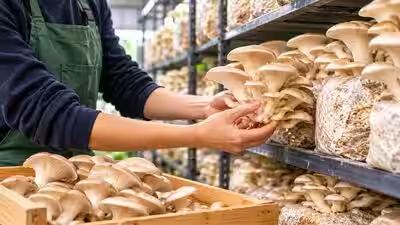

A mushroom-growing experiment that began in a basement closet eventually developed into a commercial farming operation producing hundreds of pounds of mushrooms every week. Julia Coffey, founder of Mycoterra Farm in Massachusetts, began cultivating mushrooms in January 2010, initially treating it as a small hobby business. What started with limited space and modest production gradually expanded as customers showed interest in her harvests. According to an interview published by Boston Voyager, Coffey reinvested earnings into the operation, eventually moving beyond her basement to greenhouses and, later, a dedicated farming facility.
How a basement closet mushroom experiment became a growing farm
Coffey’s journey into mushroom cultivation was shaped by earlier experience. In her interview with Boston Voyager, she explained that she had spent 4 years working at mushroom farmer Paul Stamets’ farm in Washington state before returning to her hometown of Westhampton, Massachusetts, in 2009.After struggling to find fulfilling employment, she decided to start growing mushrooms in January 2010. The initial operation occupied a closet in her basement, with cultivation primarily intended as a hobby business rather than a large agricultural enterprise.The mushrooms soon found customers at local food co-operatives and farmers markets. Their reception encouraged Coffey to reinvest the money she earned, alongside income from other jobs, into expanding the farm.The early growth was gradual because mushroom-growing equipment was expensive. Rather than immediately investing in a large facility, she increased production as resources became available, allowing the business to develop at a manageable pace.Boston Voyager reported that Coffey purchased the house she was renting in December 2012, enabling her to expand the mushroom laboratory further into the basement. She also began growing mushrooms in the garage, although she later acknowledged that it had not been the best decision.
What made mushroom growing suitable for a small space
The Fungi Academy explains why cultivation can be accessible to people without conventional farmland. A basement, garage, shed or spare bedroom can provide space for a small growing operation, while even a modest setup can produce mushrooms for household consumption.A basic mushroom-growing kit costing approximately $20 can provide two or three harvests with regular misting over around two weeks. A larger investment of roughly $100 beyond the kit could help someone establish a small urban mushroom farm capable of producing hundreds of pounds of gourmet and medicinal mushrooms.The approach does not mean that commercial farming is effortless. Coffey’s experience illustrated how a small operation could become more demanding as production increased. Her initial success required her to invest not only in additional equipment but also in more suitable growing environments.
Demand pushed the operation beyond its original space
As Mycoterra Farm attracted more customers, its original growing arrangements became increasingly difficult to maintain. Boston Voyager reported that Coffey’s partner, Chris, joined the business in autumn 2013, bringing additional enthusiasm and helping her pursue further expansion.The first major expansion was completed in January 2015. The farm added an insulated container that served as a walk-in cooler, alongside two greenhouses measuring 24 by 48 feet. Insulation and radiant heating helped the greenhouses support mushroom production throughout the year.The additional space allowed Coffey to increase output, but it did not take long for the expanded operation to encounter another limitation. As production grew to fill the greenhouses, the farm was again approaching its capacity.Coffey hired three employees during 2015, while a family member who had previously helped at farmers markets also began working on the farm. The growing team enabled Mycoterra to handle a larger operation and its increasing customer demand.According to Boston Voyager, the farm eventually used pallet racks extending from the floor towards the ceiling to make the most of its greenhouse space. This arrangement helped increase production to approximately 500 pounds of mushrooms a week, although demand continued to exceed what the facility could supply.
A larger facility transformed the small mushroom business
The next significant change came when Coffey and her partner discovered a vacant building that had previously operated as an equestrian centre. Boston Voyager reported that they encountered the property while making a delivery to a local restaurant around New Year.The building offered the space required to expand beyond the greenhouses. After months of negotiations and financing challenges, Coffey purchased the property in August 2016. But converting it into a mushroom-growing facility required extensive renovation.The farm finally moved from Westhampton to South Deerfield in December 2017. Boston Voyager reported that production quickly doubled to around 1,000 pounds a week following the relocation.
What mushrooms did the farm grow and sell
Mycoterra Farm developed a range of specialty mushrooms. In her Boston Voyager interview, Coffey listed shiitake, lion’s mane, chestnut, nameko, reishi and enokitake among the mushrooms grown at the farm.The business also expanded beyond selling fresh produce. Coffey explained that Mycoterra supplied mushroom-growing spawn to other cultivators and offered kits for people interested in growing mushrooms at home. She had also developed Mycoglow, a mushroom-based skincare range featuring products such as soaps, lotions, toners, bug sprays and scrubs.Fungi Academy describes mushroom cultivation as an activity that can serve several purposes, from supplying food to supporting small businesses. It highlights the potential for home growers to produce gourmet varieties, including oyster mushrooms, shiitake and lion’s mane, without requiring conventional agricultural land.For Coffey, the operation also involved maintaining the quality of the mushrooms as production increased. Boston Voyager reported that Mycoterra maintained its own culture library and produced spawn in-house, rather than relying entirely on commercial suppliers.
The challenges behind expanding mushroom production
Boston Voyager reported that she identified short shelf life, a lack of familiarity with mushrooms among some consumers and the need to maintain sterile conditions during early growth as particular challenges.Coffey told Boston Voyager that she had regularly worked more than 60 hours a week for 8 years. Mushroom cultivation required continuous attention, leaving limited opportunities for time off. The new South Deerfield facility also created opportunities to reach wholesale markets while retaining sales through farmers markets and restaurants.
Source link