A landfill near Istanbul generates electricity from captured waste gas, yet satellites detect methane escaping at about 7.4 tons an hour on average, new reporting finds as Turkey prepares to host COP31

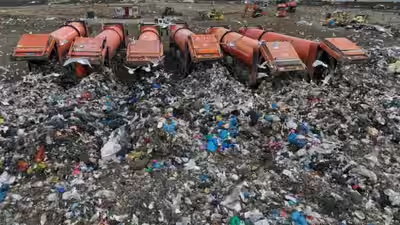

The great mountain of domestic refuse outside Istanbul is doing more than just being the last stop for the rubbish of the Turkish city. This organic material breaks down under the surface, producing methane. This methane is captured and converted into electricity. Waste can be a resource for energy. But even with efforts to cut emissions, huge amounts of the potent greenhouse gas still leak into the atmosphere. As Turkey braces to host the COP31 climate summit, new satellite data have refocused attention on the country’s struggles to curb landfill emissions, reports Reuters.
A major methane emitter
Researchers at the University of California, Los Angeles (UCLA) analyzed satellite observations that revealed significant methane emissions from several Turkish landfill sites, Reuters said. The results were based on publicly available Carbon Mapper data from the Tanager-1 satellite from January 2025 through the end of May 2026.Analysis reported by Reuters found 70 methane plumes across Turkey’s 10 highest emitting waste sites. The emissions detected varied between 841 kg/hour and 7.4 metric tons/hour on average. Three of the big sites were found around Istanbul, while other sites were located near Ankara, Izmir and Antalya, and the city of Turkey is to host COP31 from Nov 9 to 20.The landfill near Seymen, west of Istanbul, had an average detected emission rate of about 7.4 tons an hour, putting it near the world’s highest emitting landfill sites.
Waste gas to power conversion
The Reuters report states that the Seymen facility receives about 8,500 tons of household waste daily, a significant portion of the estimated 20,000 tons of waste generated daily in Istanbul.The methane is produced as organic waste buried underground decays and is collected by municipal operator ISTAC, Reuters reports. The gas captured is then used by an energy company to generate electricity at a facility that began operating in 2020. The plant generates roughly 22,000 megawatt-hours of electricity every month, according to a 2025 report by the energy news website Enerji Gunlugu.Yet the existence of collection infrastructure has not stopped large emissions. Researchers have not yet figured out how much methane the facility captures, and ISTAC officials have questioned whether the satellite observations are representative of the facility’s typical emissions.Representatives of the operator said emissions normally ran between four and six tons an hour. An unusually high satellite reading on one day was caused by maintenance work on methane collection pipes, an uncovered area of about 30 hectares and low atmospheric pressure, they said.
Why cutting methane matters
Methane is the second biggest driver of climate change after carbon dioxide, with a warming potential more than 80 times greater than carbon dioxide over its first 20 years in the atmosphere. Cutting the amount released therefore has relatively rapid climate benefits.According to Reuters, Turkey is the world’s fifth-largest emitter of methane from solid waste, behind China, the United States, Russia and Brazil, Climate TRACE says.According to data from the World Bank, Turkey’s methane emissions from the waste sector have increased nearly 25% between 2014 and 2024, compared to a 6.5% increase globally.
COP31 attracts new scrutiny
Turkey’s waste management system is an opportunity for large emissions reductions. “There is an opportunity to improve the gas collection infrastructure, to fix damaged landfill covers, and to divert organic waste away from disposal sites,” said Tia Scarpelli, waste sector lead at Carbon Mapper.Turkey’s Environment Ministry has been promoting its Zero Waste Initiative, which seeks to boost recycling and reduce the volume of waste going to landfill. The country’s waste recovery rate increased to 37.53% in 2025 from 13% in 2017, the report said.Turkey, however, is not a signatory to the Global Methane Pledge that was launched at COP26 in 2021 to cut methane emissions collectively by 30% from 2020 levels by 2030.
Beyond climate change, the effects
Communities near landfill operations also bear the burden. Residents of Seymen, a town about five kilometers from the waste site, say they have been bothered by bad smells, especially in the summer.Reuters said methane is odorless, but pungent compounds are emitted by decomposing organic waste. With COP31 on the horizon, Turkey has a major opportunity to demonstrate how better waste management can deliver tangible climate action. The challenge now is not just to produce electricity from waste material, but to do so without the additional cost of continuing greenhouse gas emissions.Image Courtesy: Reuters
Source link