
In 2010, artists began turning a vacant Houston lot into a park using broken dishes, bottle caps, shells, keys and discarded tiles; 16 years later, more than 300 artists have filled it with a 400-foot mosaic wall and free public art

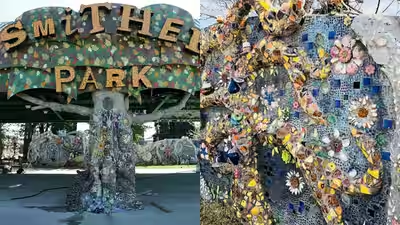

What began as an abandoned patch of land in southeast Houston has slowly transformed into something far more magical: a public park assembled from the fragments of everyday life. Broken crockery, discarded tiles, shells, bottle caps, keys and scraps of found objects have found new purpose here, brought together by hundreds of artists into a sprawling celebration of colour, memory and imagination.Sixteen years after work began, Smither Park has become a living example of what can happen when discarded materials are given another chance, states an October 2016 report by the Houston Chronicle.
From vacant lot to visual wonder
According to the online report, before artists arrived, the half-acre site on Munger Street was little more than an eyesore. The land, already owned by the Orange Show Center for Visionary Art, was chosen for a new park dedicated to the memory of John Smither, a collector and supporter of outsider art.His wife, Stephanie Smither, a longtime Orange Show board member, wanted the space to honour his legacy. The project found an ideal creative partner in builder and artist Dan Phillips, whose work frequently incorporates reclaimed and discarded materials, adds the report.Construction began in 2010, with the foundations of what would become the park’s signature feature: a 400-foot mosaic memory wall.
A wall made of memories
As per the report, the wall is less a conventional piece of public art than a giant collage assembled from thousands of fragments. Bathroom tiles sit alongside nail polish bottles, shells, clay figures, broken dishes and other salvaged objects.Across its length, the colourful surface forms animals, abstract patterns and playful figures. More than 300 artists have contributed to the project over the years, turning individual pieces of material into a collective artwork.The result feels deliberately eclectic and nothing appears too precious or perfectly matched. Instead, the charm comes from the unexpected combinations and the sense that almost anything can become part of the composition.
Whimsy at every turn
According to the report, the mosaic wall is only the beginning. Over the years, the park has grown to include a pavilion decorated with recycled glass bottles, a fish-themed band shell, a swing set, a meditation garden and a marble tower.The tower is among the park’s more interactive attractions, designed around the simple pleasure of watching a marble travel through an elaborate sequence of cups, saucers, roasting pans and fan blades. Its playful mechanics fit naturally into a space where art is meant to be touched, explored and experienced rather than simply observed.The park’s various structures each have their own visual language, yet the use of recycled and donated materials ties everything together.
Art without a price tag
The report claims that the project was completed for around $1.2 million, largely through private donations. Many of the artists contributed their time without payment, while much of the material was donated, recycled or rescued from being discarded. That approach is central to Smither Park’s character. Its raw materials are not hidden behind polished finishes. Their previous lives remain visible, giving the work an unusual sense of history.Even after the park’s formal opening, the creative process has continued. Artists still visit the materials warehouse, sorting through boxes of fragments in search of something that might complete their next idea.
A portrait of Houston
More than a collection of colourful objects, Smither Park has become a portrait of its city and its people. Its mixture of cultures, materials, ideas and artistic styles reflects a place that is constantly being rebuilt and reimagined.The park’s greatest achievement may be the way it turns the overlooked into the unforgettable. A broken dish becomes part of a wall; a discarded bottle becomes a detail in a pavilion; an empty lot becomes a gathering place.Images Courtesy: Houston Chronicle
Source link


