In 2017, Germany’s Freiburg opened a city hall with solar-powered walls designed to produce more energy than the building needs | World News

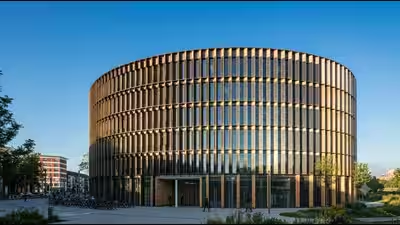

In Freiburg, south-west Germany, a city hall has been designed to do something unusual for a government building: produce more energy than it consumes. Completed in 2017, the city’s latest town hall combines high-performance solar panels with an energy-efficient design that sharply reduces the building’s demand for heating, cooling, ventilation and lighting. The World Green Building Council lists City Hall Freiburg at Fehrenbachallee and describes it as a surplus-energy building, noting that photovoltaic units on the roof and sun-exposed parts of the façade generate more electricity than the building requires. The project goes beyond simply adding solar panels to an existing office. Its insulation, ventilation, heating and cooling systems were designed together as part of a wider energy concept. Freiburg’s official tourism site also notes that construction began in 2014 and that, after completion in 2017, the building was expected to generate more energy than it needed.
Freiburg’s newest town hall was designed as an energy-producing building
The building is located at Fehrenbachallee in Freiburg, Baden-Württemberg, rather than at the historic Rathausplatz associated with Freiburg’s older town halls. The World Green Building Council identifies its construction/refurbishment date as 2017 and records its address as Fehrenbachallee, Freiburg, Baden-Württemberg 79106, Germany. That distinction is useful because Freiburg has several buildings referred to as town halls. The city’s official tourism website explains that the latest town hall was constructed between 2014 and 2017, while the older New Town Hall is a much earlier Renaissance complex. The modern building was therefore created specifically for contemporary administration, with energy performance incorporated into its architecture from the beginning. Rather than treating electricity generation as an addition, its designers made renewable energy and low consumption central to the building’s operation.

Freiburg’s newest town hall was designed as an energy-producing building (Image: AI Generated)
Solar panels cover the parts of the building exposed to sunlight
One of the most distinctive elements of the project is the way photovoltaic technology has been incorporated into both the roof and façade. The roof and areas of the façade exposed to direct sunlight are fitted with high-performance solar energy panels. These panels have a dual function: they generate electricity while also shielding parts of the building from direct solar radiation. That approach makes the building itself part of its energy infrastructure. Instead of requiring a separate solar farm or relying entirely on rooftop space, the architecture provides additional surfaces for electricity generation. The strategy is particularly relevant in urban areas, where land can be expensive and limited. Freiburg’s latest town hall demonstrates how walls and roofs that would normally serve only structural or protective purposes can also contribute to a building’s energy supply. The result is a structure where renewable-energy production is visible in the architecture rather than hidden away.
Its insulation and ventilation systems help keep energy demand low
Producing large quantities of solar electricity is only half of the building’s energy strategy. Freiburg’s town hall was also designed to need less energy in the first place. The building has outstanding thermal insulation that permits low-temperature heating and high-temperature cooling. Its ventilation system incorporates heat recovery, reducing the amount of energy lost through the movement of indoor and outdoor air. The building also uses groundwater as part of its heating and cooling strategy. A heat pump operates the heating system, while a plate heat exchanger provides cooling. These systems work alongside the building envelope and ventilation system rather than functioning as isolated technologies. This integrated approach is important because an energy-positive building cannot depend solely on generating more electricity. Its performance also depends on controlling how much energy is required to maintain comfortable conditions for the people working inside.
The building produces more electricity than it needs
The combination of low energy demand and substantial photovoltaic generation gives Freiburg’s town hall its defining characteristic. The World Green Building Council describes it as Europe’s biggest surplus-energy building and says its photovoltaic units produce more electricity than the building needs. The surplus does not simply disappear. The building can respond to requirements from the electricity network and feed excess electricity back into the grid. This means the town hall can function not only as an energy consumer but also as a small-scale producer contributing electricity beyond its own immediate needs. The concept changes the traditional relationship between buildings and power systems. Instead of a building continuously drawing electricity from an external network, the building can generate renewable power, satisfy its own requirements and return excess generation to the wider system.
Freiburg turned everyday government architecture into a renewable-energy showcase
The project is particularly striking because it applies advanced energy principles to an ordinary civic function. A city hall is primarily a workplace for public administration, yet Freiburg’s building has been designed to demonstrate what that workplace can achieve environmentally. The project is recorded under its net-zero operational carbon category and holds a DGNB Climate Positive certification. Freiburg’s official tourism information places the project within the city’s broader collection of town halls, but the 2017 building represents a sharp contrast with the historic structures. The older buildings reflect centuries of civic and architectural history; the latest one reflects a contemporary attempt to reduce the environmental cost of running a large public building. Its significance therefore lies not simply in the number of solar panels installed, but in how architecture, insulation, ventilation, heating, cooling and renewable generation were brought together into one energy concept.
A city hall where the building can give electricity back
Freiburg’s modern town hall demonstrates a different way of thinking about public buildings. Instead of designing a structure that simply consumes energy and then adding solar panels afterwards, the project combines low demand, renewable generation and energy-efficient systems from the outset. The building generates more energy than it requires for heating, cooling, ventilation and lighting, with surplus electricity capable of being fed into the grid. That makes the building more than an administrative workplace. Its roof and sun-facing façade generate power, its insulation reduces energy loss, its ventilation system recovers heat, and its heating and cooling systems make use of groundwater. Together, these features turn Freiburg’s town hall into a practical demonstration of how public architecture can contribute to the energy transition. Rather than merely occupying space within a city, the building actively produces some of the energy that the city and its occupants depend upon.
Source link