A US Air Force pilot bought a wrecked Boeing Stearman on eBay as a restoration project, but its serial number revealed it had trained the Tuskegee Airmen during World War II | World News

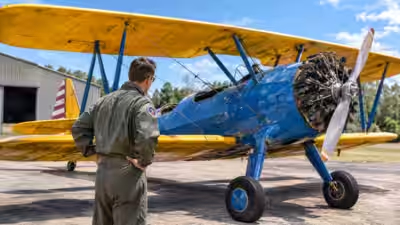

A damaged aircraft bought online as a restoration project turned out to have a history its new owners had not expected. US Air Force Captain Matt Quy and his wife, Tina, purchased a wrecked Boeing Stearman biplane on eBay in 2005, hoping to rebuild it and eventually take it flying. As they worked through the extensive repairs, a search into the aircraft’s military records revealed that it had once been used to train the Tuskegee Airmen, the pioneering group of Black military pilots who served during World War II. The discovery changed the couple’s plans, instead of treating the aircraft as a personal flying project, they began restoring it as a tribute to the men who had trained in it.
Matt Quy’s eBay purchase turned out to be a WWII training aircraft
Matt Quy had wanted to own a Stearman biplane since childhood. Growing up in Minnesota near a grass airstrip, he regularly watched a neighbour fly the aircraft, an experience that stayed with him long after he began pursuing a career in aviation. Years later, after becoming a pilot, he and his wife Tina decided to look for a biplane of their own.Buying an aircraft in flying condition was beyond their budget. As reported by Associated Press, their search eventually led them to a damaged Boeing PT-13 Stearman listed on eBay. The aircraft had been wrecked in an accident, leaving much of its structure in need of repair. The couple bought it in 2005, knowing that bringing it back into the air would require considerable time, money and mechanical work.At that stage, they were primarily interested in restoring vintage aircraft. Its connection to one of the most significant chapters in American military aviation history was still unknown to them.
How a serial number revealed the aircraft’s Tuskegee Airmen history
The turning point came when Quy decided to investigate the aircraft’s serial number. He contacted the Air Force Historical Research Agency at Maxwell Air Force Base in Alabama to establish where the plane had served. The records brought an unexpected answer: the Stearman had been assigned to the training programme at Moton Field in Alabama, where Black pilots were prepared for military service during the Second World War.The Air Force confirmed that the aircraft was among those used to train the Tuskegee Airmen. It was no longer simply an old biplane that could be brought back to flying condition. Its wartime service gave it a direct connection to the experiences of the men who had helped break racial barriers in American military aviation.Quy and Tina decided to change the purpose of their restoration project. They named the aircraft ‘The Spirit of Tuskegee’, intending to use it to introduce more people to the history of the airmen and their contribution.
The three-year restoration brought the biplane back to life
The Stearman had been badly damaged after an earlier engine failure led to an emergency landing on a road, where it struck a tree. Its wings had suffered extensive destruction, while parts of the fuselage, engine, landing gear and braking system also needed attention.Quy took on much of the work outside his military duties, spending his spare time rebuilding the aircraft. Reportedly, his wife helped with the project, as did aircraft mechanic Robbie Vajdos, who worked alongside him on the repairs. They also had to locate replacement components, although the fact that many Stearman aircraft had been converted into agricultural planes after the war meant that some parts could still be sourced.The restoration took approximately three years. By February 2008, the aircraft had returned to the skies, giving the couple an opportunity to see the results of their work. The original wartime appearance was also recreated, with a blue body, yellow wings and red markings on the tail.
How the aircraft brought former Tuskegee pilots back together
Rather than keeping the restored biplane as a private possession, Matt and Tina began travelling with it to events across the United States. Over the next six and a half years, they used the aircraft to draw attention to the Tuskegee Airmen and their wartime training.Some of the encounters were particularly meaningful because veterans who had trained in Stearman aircraft were able to see the restored machine again. At an aviation gathering in Reno, Nevada, four Tuskegee veterans were reunited with the aircraft, and all four had an opportunity to fly in it.One of them was retired Lieutenant Colonel Bill Holloman, a fighter pilot who had served during the Second World War and the Korean War. His flight with Quy was his first time in a Stearman since his own pilot training roughly six decades earlier.
The Smithsonian became the aircraft’s next home
The story eventually reached Paul Gardullo, a curator involved in preparing the National Museum of African American History and Culture in Washington, DC. The museum had been looking for an aircraft connected to the Tuskegee Airmen, and information about the Quys’ restored Stearman reached him through a colleague at the National Air and Space Museum.Gardullo travelled to an air show at Edwards Air Force Base in California to see the aircraft. The Quys were displaying it alongside Tuskegee veterans, and the curator approached them about the possibility of donating it to the new museum.The couple initially had reservations. They had spent years rebuilding the aircraft and understood that handing it over to a museum could mean the end of its flying days. However, they eventually agreed, recognising that the Smithsonian could give the aircraft a permanent place in a much wider account of African American military history.In July 2011, Matt Quy began its final cross-country journey. The couple made stops along the way, including at the Air Force Academy in Colorado, where Tuskegee veterans were waiting to meet the aircraft. The journey also included Moton Field in Alabama, the place where the Stearman had served during the war. The aircraft was subsequently handed over to the Smithsonian.
How nearly 1,000 Black pilots trained to serve during World War II
The restored Boeing Stearman PT-13D is displayed at the National Museum of African American History and Culture in Washington, DC. Its blue, yellow and red appearance reflects the aircraft’s restored wartime design, while its presence in the museum connects visitors with an important part of the history of Black Americans in the armed forces.The Tuskegee Airmen were trained at a time when the US military was segregated. Their training programme operated in and around Tuskegee, Alabama, with Moton Field serving as a primary flight-training site. Nearly 1,000 Black pilots trained there between 1941 and the mid-1940s, overcoming institutional discrimination and restrictions that had long limited their opportunities to serve as military aviators.
Source link