A DIY builder has turned more than 1,000 discarded laptop batteries into a home battery bank kept in a separate shed, storing solar power from his panels that can even run his washing machine | World News

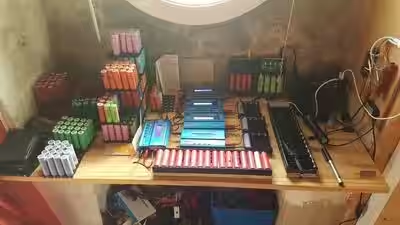

A DIY enthusiast in France has found a way to give discarded laptop batteries a second life by turning them into a large home energy storage system. Using more than 1,000 salvaged laptop batteries, the builder has assembled a battery bank inside a separate shed, where it stores electricity generated by his solar panels. The unique setup has gradually expanded over the years and can now supply power to household appliances, including a washing machine, according to reports detailing the project.
Discarded laptop batteries became a home energy storage bank
The project was started by a DIY builder known online as Glubux, who began documenting his efforts on the Second Life Storage forum in November 2016. According to Interesting Engineering, he initially had around 650 used laptop batteries, a small rooftop solar installation and an old forklift battery that he used to store electricity.Rather than throwing away the laptop batteries, Glubux realised that individual cells inside them could still hold electricity even when the complete battery pack had stopped working. Laptop battery packs contain several individual cells, and the failure of just one can sometimes make the entire pack unusable.This provided an opportunity to recover the working cells and reuse them for a different purpose. According to Futura-Sciences, Glubux began opening the discarded battery packs, testing their individual lithium-ion cells and separating those that could still be used.The builder’s approach was not simply to connect every recovered cell together. He tested the cells individually, removed weaker or damaged ones and grouped the usable units according to their capacity. The remaining cells were assembled into larger battery blocks, which eventually became the foundation of his home energy storage system.
What powers this unique battery bank
The storage system has grown considerably since its early days. Interesting Engineering reported that Glubux initially had around 1.4 kilowatts of rooftop solar panels, an old 24-volt forklift battery and a 3-kilovolt-ampere inverter.As the project developed, he expanded the solar installation by adding 24 more panels, each rated at 440 watts. This brought the total solar generation capacity to nearly 10.6 kilowatts, giving the system a considerably larger supply of electricity to store.Ecoportal reported that the battery bank’s storage capacity increased from approximately 7 kilowatt-hours at the beginning to around 56 kilowatt-hours over the years. This expansion allowed the builder to store considerably more electricity generated during daylight hours and use it later when sunlight was unavailable.The battery system operates at 24 volts and supplies electricity through a 3-kilovolt-ampere converter. As reported by TheCoolDown, the arrangement can power household appliances, with Glubux even claiming that his washing machine runs using electricity supplied by the homemade battery bank.The setup also includes the original forklift battery, which remained part of the system as it expanded. Interesting Engineering reported that it continued to help manage the electricity supply while the recycled laptop cells handled the growing storage requirements.
The builder keeps the batteries in a separate shed
One of the most distinctive features of the project is the location of the battery bank. Instead of installing hundreds of recycled lithium-ion cells inside his home, Glubux built a separate shed to accommodate the storage equipment.According to TheCoolDown, the shed is located approximately 50 metres from his house. It contains the battery racks, charge controllers and inverters that manage the electricity generated by the solar panels.The recovered cells are arranged in holders and connected together in organised groups. The electricity travels from the shed towards the house, where it is converted into a supply that can be used by ordinary household appliances.Keeping the equipment away from the main living space also separates the battery installation from the areas where the family spends its time.
How long has the recycled battery system continued working
The project’s longevity is another reason it has attracted attention. Glubux began sharing updates in 2016, and reports published nearly a decade later describe the system as continuing to operate.Interesting Engineering reported in November 2025 that the installation had been running for 8 years without a major failure. The report also stated that no individual battery cell had failed during that period.However, these performance figures come from the builder’s own accounts and project updates. Futura-Sciences highlighted that the reported 56-kilowatt-hour capacity has not been independently verified and that battery performance can decline over time.
The safety risks behind reusing old lithium-ion batteries
Reusing discarded laptop batteries is not a straightforward household project, particularly because lithium-ion cells can become dangerous if they are damaged, incorrectly connected or poorly managed.Futura-Sciences warned that old cells can develop internal damage and chemical deterioration, potentially leading to short circuits, overheating and fires. Differences in the age, condition and electrical resistance of individual cells can also create imbalances when they are connected in a large storage system.A damaged or overcharged cell can trigger a process known as ‘thermal runaway,’ in which rising temperatures can cause further overheating.
Source link