
World

Amazon: Amazon villagers say giant anacondas keep stealing their chickens; scientists discover why they kill the snakes and how simple coop changes could prevent attacks | World News

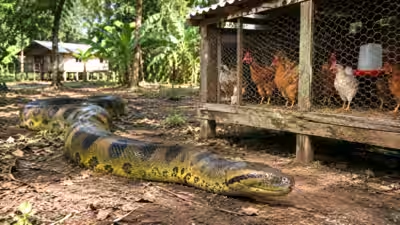
Amazon villagers say giant anacondas keep stealing their chickens; scientists discover why they kill the snakes and how simple coop changes could prevent attacks

Amazon villagers living along Brazil’s Lower Amazon say green anacondas are increasingly becoming a threat to their poultry, entering chicken coops and swallowing birds. A study based on interviews with residents of five riverside communities in Pará has examined how these encounters shape people’s attitudes towards the giant snakes. Researchers found that the loss of domestic animals, rather than fear alone, was the leading reason residents gave for killing anacondas. The findings also document local knowledge of the reptiles’ behaviour, traditional beliefs surrounding a mythical Great Snake and practical suggestions for protecting poultry, including reinforcing coops with mesh.

Why Amazon villagers are killing giant anacondas over stolen chickens

The research, titled The myth of the serpent: from the Great Snake to the henhouse, was published in Frontiers in Amphibian and Reptile Science on June 16, 2025. It was conducted in the Aritapera region of Santarém municipality in Brazil’s Pará state, focusing on five communities: Água Preta, Carapanatuba, Centro do Aritapera, Costa do Aritapera and Cabeça D’Onça.Researchers spent 64 days in the region in 2023, conducting interviews and recording conversations with residents. The study examined their experiences with anacondas, including encounters near homes, poultry losses, hunting practices and traditional beliefs.The findings showed that economic losses were the strongest reported motivation for killing the snakes. Protecting domestic animals, particularly chickens and chicks, accounted for 47.7% of the reported reasons. Personal safety accounted for 15.9%, the search for anaconda fat for 13.3%, fear for 6.8%, and the historical trade in snakeskin for another 15.9%.Residents described the frustration of spending time and money raising poultry only to lose birds to anacondas. One person interviewed by the researchers recalled finding a chicken inside a snake that had swallowed it moments earlier.

How giant anacondas enter chicken coops

According to residents, anacondas can enter poultry enclosures through small openings and gaps. Their ability to squeeze through narrow spaces makes ordinary structures less reliable as protection.The researchers recorded accounts of snakes entering coops to prey on chickens and ducks. Residents also described how an anaconda could struggle to leave through the same opening after swallowing a bird because its body expands around the meal.The study noted that keeping poultry inside enclosures can make it harder for snakes to reach them, but existing coops do not always prevent attacks. In some cases, the structures may trap an anaconda inside after it has fed, creating another source of conflict with residents.The researchers found that encounters around homes and chicken coops generally involved smaller snakes than those reported in waterways. Residents described anacondas seen near houses as averaging around 2.3 metres in length. These measurements came from local accounts rather than direct measurements of a surveyed snake population.

Researchers suggest simple chicken coop changes to prevent attacks

The study identifies stronger poultry enclosures as one of the most practical ways to reduce conflict between residents and anacondas. Rather than relying on killing the snakes, the researchers recommend modifying coop structures to prevent them from entering.Their analysis found that enclosures with closely spaced slats, covered with fine nylon mesh and an additional outer layer of plastic aviary grid, offered the best protection among the structures examined.The closely spaced slats help eliminate gaps through which snakes could pass. The nylon mesh acts as another barrier, while the outer grid protects the mesh from damage and helps block larger animals.The researchers said that because anacondas can squeeze through surprisingly small openings, the spacing between the structural elements is important. The proposed design aims to protect poultry while allowing the snakes to remain in their natural habitat.The researchers described improved henhouses as a promising first step towards reducing the number of anacondas killed in the region. Their findings also point to the need for conservation strategies developed in collaboration with local communities.

The Great Snake legend still shapes local perceptions

The research also explored the cultural relationship between residents and anacondas. In Amazonian folklore, the giant snake is associated with legends such as the Cobra Grande, or Great Snake, a mythical creature believed to inhabit the Amazon River.Some residents described the legendary creature as an enormous snake with eyes that appear to glow like fire in the darkness. The researchers recorded seven accounts from people who said they had seen, or knew someone who had seen, signs of the Great Snake.However, the study found that everyday encounters increasingly shape how residents view anacondas. Rather than seeing them primarily through the lens of folklore, many now regard them as a threat to their poultry and household income.Residents also demonstrated detailed knowledge of the reptiles’ behaviour, including their feeding habits, preferred habitats and seasonal appearances. They reported seeing anacondas more frequently during periods of flooding, when water levels rise across the surrounding floodplains.

Amazon villagers believe anaconda numbers have declined

Another finding concerned residents’ perceptions of the reptiles’ presence in the region. Across all five communities, many interviewees said they encountered fewer anacondas than in previous years.The proportion of accounts indicating a perceived decline ranged from 78.6% in Carapanatuba to 94.4% in Água Preta. These figures reflect residents’ observations and do not represent a scientific population survey.Interviewees suggested several possible explanations, including hunting, the loss of vegetation in wetland habitats, changes in flood levels, riverbank sedimentation and the expansion of settlements. Some also associated fewer sightings with changes in local poultry-keeping practices.The researchers noted that hunting for skins had historically been practised in the region, while killing anacondas to protect livestock remains a source of conflict. They also highlighted the role of habitat changes in shaping where the snakes are encountered.

Conservation efforts need to address local livelihoods

The study argues that protecting anacondas will require more than asking residents not to kill them. Since poultry losses are a major source of conflict, conservation efforts must also address the economic concerns of households that depend on raising domestic animals.The researchers suggest combining better-designed henhouses with community-led conservation measures and greater recognition of local knowledge. They also discuss the possibility of developing a management framework around the traditional use or trade of anaconda fat, an animal-derived remedy used by some residents.Their central finding is that reducing encounters around homes could help protect both poultry and anacondas. By making chicken coops more secure, communities may have fewer reasons to kill the snakes, shifting the relationship away from conflict and towards coexistence.


Source link

Related Articles

Leave a Reply

Your email address will not be published. Required fields are marked *

Back to top button
×
newsnation.aanest.com
Logo
Date of Publish : 11 November 2026, 12:00 am Digital Edition : News nation
Amazon: Amazon villagers say giant anacondas keep stealing their chickens; scientists discover why they kill the snakes and how simple coop changes could prevent attacks | World News

Amazon villagers living along Brazil’s Lower Amazon say green anacondas are increasingly becoming a threat to their poultry, entering chicken coops and swallowing birds. A study based on interviews with residents of five riverside communities in Pará has examined how these encounters shape people’s attitudes towards the giant snakes. Researchers found that the loss of domestic animals, rather than fear alone, was the leading reason residents gave for killing anacondas. The findings also document local knowledge of the reptiles’ behaviour, traditional beliefs surrounding a mythical Great Snake and practical suggestions for protecting poultry, including reinforcing coops with mesh.Why Amazon villagers are killing giant anacondas over stolen chickensThe research, titled The myth of the serpent: from the Great Snake to the henhouse, was published in Frontiers in Amphibian and Reptile Science on June 16, 2025. It was conducted in the Aritapera region of Santarém municipality in Brazil’s Pará state, focusing on five communities: Água Preta, Carapanatuba, Centro do Aritapera, Costa do Aritapera and Cabeça D’Onça.Researchers spent 64 days in the region in 2023, conducting interviews and recording conversations with residents. The study examined their experiences with anacondas, including encounters near homes, poultry losses, hunting practices and traditional beliefs.The findings showed that economic losses were the strongest reported motivation for killing the snakes. Protecting domestic animals, particularly chickens and chicks, accounted for 47.7% of the reported reasons. Personal safety accounted for 15.9%, the search for anaconda fat for 13.3%, fear for 6.8%, and the historical trade in snakeskin for another 15.9%.Residents described the frustration of spending time and money raising poultry only to lose birds to anacondas. One person interviewed by the researchers recalled finding a chicken inside a snake that had swallowed it moments earlier.How giant anacondas enter chicken coopsAccording to residents, anacondas can enter poultry enclosures through small openings and gaps. Their ability to squeeze through narrow spaces makes ordinary structures less reliable as protection.The researchers recorded accounts of snakes entering coops to prey on chickens and ducks. Residents also described how an anaconda could struggle to leave through the same opening after swallowing a bird because its body expands around the meal.The study noted that keeping poultry inside enclosures can make it harder for snakes to reach them, but existing coops do not always prevent attacks. In some cases, the structures may trap an anaconda inside after it has fed, creating another source of conflict with residents.The researchers found that encounters around homes and chicken coops generally involved smaller snakes than those reported in waterways. Residents described anacondas seen near houses as averaging around 2.3 metres in length. These measurements came from local accounts rather than direct measurements of a surveyed snake population.Researchers suggest simple chicken coop changes to prevent attacksThe study identifies stronger poultry enclosures as one of the most practical ways to reduce conflict between residents and anacondas. Rather than relying on killing the snakes, the researchers recommend modifying coop structures to prevent them from entering.Their analysis found that enclosures with closely spaced slats, covered with fine nylon mesh and an additional outer layer of plastic aviary grid, offered the best protection among the structures examined.The closely spaced slats help eliminate gaps through which snakes could pass. The nylon mesh acts as another barrier, while the outer grid protects the mesh from damage and helps block larger animals.The researchers said that because anacondas can squeeze through surprisingly small openings, the spacing between the structural elements is important. The proposed design aims to protect poultry while allowing the snakes to remain in their natural habitat.The researchers described improved henhouses as a promising first step towards reducing the number of anacondas killed in the region. Their findings also point to the need for conservation strategies developed in collaboration with local communities.The Great Snake legend still shapes local perceptionsThe research also explored the cultural relationship between residents and anacondas. In Amazonian folklore, the giant snake is associated with legends such as the Cobra Grande, or Great Snake, a mythical creature believed to inhabit the Amazon River.Some residents described the legendary creature as an enormous snake with eyes that appear to glow like fire in the darkness. The researchers recorded seven accounts from people who said they had seen, or knew someone who had seen, signs of the Great Snake.However, the study found that everyday encounters increasingly shape how residents view anacondas. Rather than seeing them primarily through the lens of folklore, many now regard them as a threat to their poultry and household income.Residents also demonstrated detailed knowledge of the reptiles’ behaviour, including their feeding habits, preferred habitats and seasonal appearances. They reported seeing anacondas more frequently during periods of flooding, when water levels rise across the surrounding floodplains.Amazon villagers believe anaconda numbers have declinedAnother finding concerned residents’ perceptions of the reptiles’ presence in the region. Across all five communities, many interviewees said they encountered fewer anacondas than in previous years.The proportion of accounts indicating a perceived decline ranged from 78.6% in Carapanatuba to 94.4% in Água Preta. These figures reflect residents’ observations and do not represent a scientific population survey.Interviewees suggested several possible explanations, including hunting, the loss of vegetation in wetland habitats, changes in flood levels, riverbank sedimentation and the expansion of settlements. Some also associated fewer sightings with changes in local poultry-keeping practices.The researchers noted that hunting for skins had historically been practised in the region, while killing anacondas to protect livestock remains a source of conflict. They also highlighted the role of habitat changes in shaping where the snakes are encountered.Conservation efforts need to address local livelihoodsThe study argues that protecting anacondas will require more than asking residents not to kill them. Since poultry losses are a major source of conflict, conservation efforts must also address the economic concerns of households that depend on raising domestic animals.The researchers suggest combining better-designed henhouses with community-led conservation measures and greater recognition of local knowledge. They also discuss the possibility of developing a management framework around the traditional use or trade of anaconda fat, an animal-derived remedy used by some residents.Their central finding is that reducing encounters around homes could help protect both poultry and anacondas. By making chicken coops more secure, communities may have fewer reasons to kill the snakes, shifting the relationship away from conflict and towards coexistence.

Source link