A rare Jamaican iguana was once thought extinct and fewer than 50 survived when it was rediscovered in 1990; after decades of captive rearing and predator control, its 1,000th release is planned for Saturday

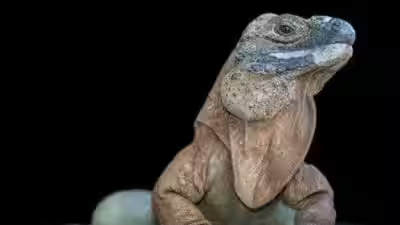

A reptile that was once declared extinct is finally approaching a conservation milestone in Jamaica. The country’s critically endangered Jamaican rock iguana, which was rediscovered in 1990 after fewer than 50 individuals were found in the wild, is set to reach its 1,000th head-started release on November 14. The National Environment and Planning Agency (NEPA), which coordinates the recovery programme with local and international partners, will return the iguanas to their natural habitat in the Hellshire Hills, St Catherine, after decades of captive rearing, habitat protection and predator control.According to the Jamaica Observer, 973 head-started iguanas have already been released into the wild, with another 114 scheduled for Saturday’s exercise. The milestone marks more than three decades of conservation work for a species that had disappeared from much of its former range. Jamaica’s Minister of Water, Environment and Climate Change, Matthew Samuda, described the upcoming release as the result of years of scientific research, habitat management and collaboration.
From presumed extinction to rediscovery
The Jamaican rock iguana, scientifically known as Cyclura collei, is endemic to Jamaica, meaning it is found naturally nowhere else in the world. It is also the island’s largest native animal, growing up to around five feet in length. Its body is generally dark-coloured, with a long tail and distinctive rows of spines running along its back.The species was declared extinct in 1948 after its population collapsed. The decline had been driven largely by introduced predators and habitat destruction. Mongooses, cats and stray dogs prey on iguana eggs and young hatchlings, while pigs can also threaten nests. The clearing of forests for agriculture, housing and charcoal production further reduced the habitat available to the reptiles.However, in 1990, researchers rediscovered a surviving population in the remote Hellshire Hills of southern Jamaica. Fewer than 50 individuals, most of them older adults, were found, raising concerns that the reptile could disappear permanently without urgent intervention. The Hellshire Hills, which contain the Caribbean’s largest dry forest, became the centre of the recovery effort. The area provides the vegetation and nesting grounds the iguanas need, but protecting the remaining wild population required more than simply preventing further habitat loss.
How captive rearing gives hatchlings a second chance
A central part of Jamaica’s recovery strategy is a conservation technique known as ‘head-starting’. Under this programme, hatchlings are collected from the wild and raised in a protected environment at the Headstart Facility at Hope Zoo in Kingston. They are cared for until they grow large and strong enough to have a better chance of surviving when returned to their natural habitat. Young iguanas are particularly vulnerable to predators, making the early stages of their lives a critical period. Raising them away from mongooses, cats and other invasive animals allows more individuals to reach a size at which they are less likely to be killed after release.The programme, which began releasing head-started iguanas in 1996, is coordinated by NEPA and supported by organisations including Hope Zoo, Fort Worth Zoo, the International Iguana Foundation and other conservation partners. Fort Worth Zoo has been involved in the effort since 1993, providing scientific expertise and support for the recovery programme. The facility currently cares for approximately 250 to 300 juvenile iguanas, according to the Jamaica Observer. Each animal is part of a carefully managed process that involves raising, monitoring and eventually returning it to the wild.
Removing predators and protecting nests
Captive rearing alone cannot ensure the species’ survival if the threats in its natural habitat remain. Conservation teams have therefore combined the head-start programme with predator control and protection of nesting sites.In the Hellshire Hills, NEPA and its partners monitor more than 280 live predator traps. The Jamaica Observer reported that more than 1,500 invasive predators have been removed from the iguanas’ core habitat over time. The effort focuses particularly on Indian mongooses and feral cats, which can kill hatchlings and destroy eggs.Conservationists also monitor nesting sites and maintain suitable artificial nesting areas to improve the chances of successful reproduction. The programme tracks released animals to understand how well they adapt to the wild and whether the population is reproducing independently.Iguana conservation specialist Tandora Del Grant, who has been involved in the project since 1995, told the Jamaica Observer that the survival and reproduction of released animals in the wild were encouraging signs. However, she stressed that continued conservation work would be necessary to prevent the population from declining again.The Jamaican rock iguana is important not only as a rare native species but also because of its role in maintaining the ecosystem. It feeds largely on fruits, leaves and other plant material, helping disperse seeds through its droppings. This supports the regeneration of trees and vegetation across the dry forest.NEPA ranger Jomo Pinkney highlighted this role in comments reported by the Jamaica Observer, explaining that iguanas help spread seeds after eating fruit. Their presence therefore contributes to the health and regeneration of the very habitat on which they depend.Despite the progress, the species remains classified as critically endangered. Its natural range is extremely restricted, and invasive predators, habitat degradation and human activity continue to pose threats. The International Iguana Foundation identifies the Hellshire Hills as the species’ remaining stronghold.Conservationists are now looking towards another potential milestone: reintroducing the iguanas to Goat Island, which could provide an additional safe habitat and sanctuary for the population. A move like this would require careful preparation, particularly ensuring that invasive predators are removed before iguanas are introduced.
Source link