
Brazil plants 840,000 trees to restore 607 hectares of Atlantic Forest and reconnect wildlife habitats after 20 years of conservation | World News

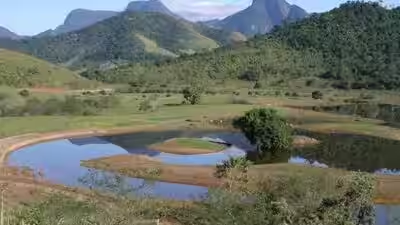

Brazil’s Atlantic Forest has lost much of its original cover after centuries of exploitation and deforestation. A conservation partnership between World Land Trust (WLT) and Brazilian NGO Reserva Ecológica de Guapiaçu (REGUA) has spent two decades protecting the remaining forest and restoring damaged habitats. REGUA has planted 840,000 trees on degraded land, restoring 607 hectares (1,500 acres) to forest.According to World Land Trust (WLT), the work has also created wildlife corridors between isolated forest fragments and helped reconnect populations of plants, animals and fungi. Alongside tree planting, REGUA has restored a lowland wetland where more than 220 bird species have been recorded.
How wetland restoration brought wildlife back to the Atlantic Forest
REGUA’s wetland restoration began in 2002 after the area had been converted to pasture and arable land in 1982. The original habitat consisted of swamp and flooded forest dominated by ‘Tabebuia cassinoides’ trees and tree ferns covered with bromeliads and orchids. Restoration involved building earth dams and diverting a small stream to create new lagoons.REGUA also reintroduced ‘Tabebuia’ trees and reforested the surrounding land. Over the following two decades, aquatic wildlife returned, including broad-snouted caiman, capybara, crakes, herons and wildfowl. More than 220 bird species have been recorded in the restored wetland. The habitat also proved suitable for reintroducing lowland tapir, marking the species’ return to Rio de Janeiro state after more than a century.
How REGUA has restored 607 hectares of Brazil’s Atlantic Forest
The Atlantic Forest once covered 150 million hectares (371 million acres) across South America. However, centuries of exploitation and deforestation have reduced its original cover to a small fraction. A 2009 study estimated that just 11.7% remained, while other estimates put the figure as low as 7%. Around 83% of the surviving forest consists of isolated secondary forest fragments smaller than 50 hectares (124 acres).These patches cannot sustain viable populations of many species, particularly those unable to cross the gaps between them. REGUA was established in 2001 to protect the forest and biodiversity of the Guapiaçu watershed in the Serra dos Órgãos mountains of south-east Brazil. It has worked with WLT since 2005 to expand protection and restore degraded land.
REGUA expanded its Atlantic Forest reserve to protect nearly 15,000 hectares
Protecting the remaining Atlantic Forest in the Guapiaçu watershed is a priority for REGUA. Expanding the reserve through land purchases helps secure habitats over the long term. In 2006, WLT funded one of REGUA’s earliest purchases, adding 259 hectares (641 acres) of protected forest. Donations from organisations and individuals have since enabled REGUA to add 10,139 hectares (25,053 acres) to the reserve.Over the past two decades, WLT has funded or part-funded 1,532 hectares (3,786 acres) of the land added to the reserve. REGUA also manages another 4,202 hectares (10,384 acres) through land management agreements and leases 652 hectares (1,611 acres). Together, these areas bring the total Atlantic Forest protected by REGUA to 14,993 hectares (37,048 acres), including degraded pasture and scrubland.
REGUA grows thousands of trees to rebuild damaged habitats
REGUA has planted 840,000 trees on degraded land, mostly on purchased pasture, restoring 607 hectares (1,500 acres) to forest. The restored areas also form wildlife corridors between previously isolated forest fragments, helping reconnect genetically separated populations of flora, fauna and funga.REGUA established its tree nursery in 2005, and it now produces around 60,000 saplings annually. Most grow from seeds collected in the forest by the reserve’s rangers. The nursery raises up to 180 tree species, including pioneer and climax species, to increase diversity and begin ecological succession in replanted forests. Staff nurture seedlings until they are mature enough to have a better chance of survival. Planting takes place during summer, when regular seasonal rains help sustain young trees.
Source link


