
World

Rotterdam dredges millions of cubic metres of mud from its waterways; researchers are turning the waste into bricks without firing or cement  |

Rotterdam dredges millions of cubic metres of mud from its waterways; researchers are turning the waste into bricks without firing or cement
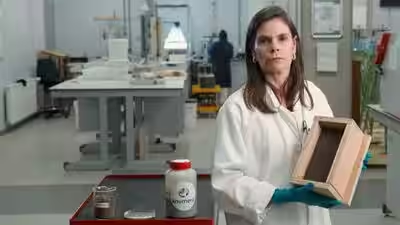
Kaumera as a bio-based ingredient in a brick made from dredged sediment. Image Credit: Kaumera/Official Website

Rotterdam’s waterways require constant dredging to keep the port’s channels and basins navigable, producing millions of cubic metres of sediment each year. Much of this material is currently disposed offshore, but a new research project is exploring a different use for it. MUDIS is investigating whether dredged sediment can be turned into bricks without the traditional firing process or cement. The project combines the sediment with Kaumera, a bio-based material recovered from wastewater treatment, creating a potential building product from two otherwise underused waste streams.

How could dredged mud become bricks without firing or cement

The MUDIS project is looking at whether material removed from busy ports can be given a second life in construction. According to Kaumera, ports such as Rotterdam dredge millions of cubic metres of sediment from their access channels and basins every year. This work is necessary to keep waterways open for ships, but the resulting sediment is largely treated as waste and disposed of offshore.The project brings together TU Delft, the Port of Rotterdam Authority, Harwich Haven Authority, Netics, Kaumera and SmartPort. The proposed bricks do not depend on the conventional combination of clay, firing and cement-based binding. Instead, researchers are testing Kaumera as the material that holds the dredged sediment together.Kaumera is recovered from wastewater treatment and is described as a bio-based binder. In the MUDIS process, it is being combined with dredged sediment to provide the binding properties needed to form a solid product. This creates a link between wastewater treatment and port maintenance, with materials from both processes being explored for another use.The approach could also have an environmental benefit. Both Kaumera and SmartPort report that avoiding conventional firing and cement could potentially reduce carbon dioxide emissions associated with producing the material. However, the project is still at the research stage, so the actual performance and environmental savings have yet to be established.

Making a brick from dredged sediment is difficult

The material being tested is not simply a replacement for the clay normally used in brickmaking. Kaumera explains that dredged sediment behaves very differently from traditional brick clay, making the right mixture difficult to achieve. Researchers need to find a composition that can be shaped and dried while also developing enough strength for practical use.At TU Delft, researchers are already drying, mixing, moulding and testing the first sediment-based bricks. TU Delft Research Portal identifies Alex Kirichek, Caroline Grilo and Annu Mathew as researchers involved in this work, with the laboratory process examining how the unusual properties of dredged mud affect the resulting material.Rather than assuming that every type of dredged material will work in the same way, the team is focusing on finding a suitable formulation. The aim is to produce a material with the mechanical properties needed for possible construction applications.

Possible uses of the new bricks

The researchers are not limiting the idea to one type of building. According to Kaumera and SmartPort, potential applications being considered include facing bricks, partition walls and reinforcement for dikes. These uses would give dredged sediment a practical role in construction while reducing the need to treat it solely as a material that has to be removed from waterways.The possible uses remain targets rather than established products. The team first has to determine whether the bricks can meet the necessary performance requirements. Their work involves more than simply proving that sediment can be shaped into a brick. It must also establish whether the finished material can withstand the demands of its intended application.

What will researchers compare before the material moves forward

The next stage will put the experimental bricks alongside conventional bricks for a more direct comparison. According to Kaumera, the researchers plan to assess strength, costs and carbon dioxide emissions. These comparisons will help determine whether the sediment-based approach offers a practical alternative rather than simply an interesting lab experiment.SmartPort and TU Delft Research Portal both report that the first results are expected in February 2027.MUDIS represents a broader attempt to look at waste materials differently. Instead of treating dredged sediment and wastewater-derived Kaumera as separate residual products, the project is testing whether they can work together as ingredients in a new building material.


Source link

Related Articles

Leave a Reply

Your email address will not be published. Required fields are marked *

Back to top button
×
newsnation.aanest.com
Logo
Date of Publish : 10 October 2026, 2:13 pm Digital Edition : News nation
Rotterdam dredges millions of cubic metres of mud from its waterways; researchers are turning the waste into bricks without firing or cement  |
Kaumera as a bio-based ingredient in a brick made from dredged sediment. Image Credit: Kaumera/Official Website Rotterdam’s waterways require constant dredging to keep the port’s channels and basins navigable, producing millions of cubic metres of sediment each year. Much of this material is currently disposed offshore, but a new research project is exploring a different use for it. MUDIS is investigating whether dredged sediment can be turned into bricks without the traditional firing process or cement. The project combines the sediment with Kaumera, a bio-based material recovered from wastewater treatment, creating a potential building product from two otherwise underused waste streams.How could dredged mud become bricks without firing or cementThe MUDIS project is looking at whether material removed from busy ports can be given a second life in construction. According to Kaumera, ports such as Rotterdam dredge millions of cubic metres of sediment from their access channels and basins every year. This work is necessary to keep waterways open for ships, but the resulting sediment is largely treated as waste and disposed of offshore.The project brings together TU Delft, the Port of Rotterdam Authority, Harwich Haven Authority, Netics, Kaumera and SmartPort. The proposed bricks do not depend on the conventional combination of clay, firing and cement-based binding. Instead, researchers are testing Kaumera as the material that holds the dredged sediment together.Kaumera is recovered from wastewater treatment and is described as a bio-based binder. In the MUDIS process, it is being combined with dredged sediment to provide the binding properties needed to form a solid product. This creates a link between wastewater treatment and port maintenance, with materials from both processes being explored for another use.The approach could also have an environmental benefit. Both Kaumera and SmartPort report that avoiding conventional firing and cement could potentially reduce carbon dioxide emissions associated with producing the material. However, the project is still at the research stage, so the actual performance and environmental savings have yet to be established.Making a brick from dredged sediment is difficultThe material being tested is not simply a replacement for the clay normally used in brickmaking. Kaumera explains that dredged sediment behaves very differently from traditional brick clay, making the right mixture difficult to achieve. Researchers need to find a composition that can be shaped and dried while also developing enough strength for practical use.At TU Delft, researchers are already drying, mixing, moulding and testing the first sediment-based bricks. TU Delft Research Portal identifies Alex Kirichek, Caroline Grilo and Annu Mathew as researchers involved in this work, with the laboratory process examining how the unusual properties of dredged mud affect the resulting material.Rather than assuming that every type of dredged material will work in the same way, the team is focusing on finding a suitable formulation. The aim is to produce a material with the mechanical properties needed for possible construction applications.Possible uses of the new bricksThe researchers are not limiting the idea to one type of building. According to Kaumera and SmartPort, potential applications being considered include facing bricks, partition walls and reinforcement for dikes. These uses would give dredged sediment a practical role in construction while reducing the need to treat it solely as a material that has to be removed from waterways.The possible uses remain targets rather than established products. The team first has to determine whether the bricks can meet the necessary performance requirements. Their work involves more than simply proving that sediment can be shaped into a brick. It must also establish whether the finished material can withstand the demands of its intended application.What will researchers compare before the material moves forwardThe next stage will put the experimental bricks alongside conventional bricks for a more direct comparison. According to Kaumera, the researchers plan to assess strength, costs and carbon dioxide emissions. These comparisons will help determine whether the sediment-based approach offers a practical alternative rather than simply an interesting lab experiment.SmartPort and TU Delft Research Portal both report that the first results are expected in February 2027.MUDIS represents a broader attempt to look at waste materials differently. Instead of treating dredged sediment and wastewater-derived Kaumera as separate residual products, the project is testing whether they can work together as ingredients in a new building material.

Source link