
World

Florida rebuilt a degraded offshore oyster reef with dolomite limestone in 2018; within six months live-oyster density rose from near zero to 91 per square metre, and by year five it had reached 244

Florida rebuilt a degraded offshore oyster reef with dolomite limestone in 2018; within six months live-oyster density rose from near zero to 91 per square metre, and by year five it had reached 244
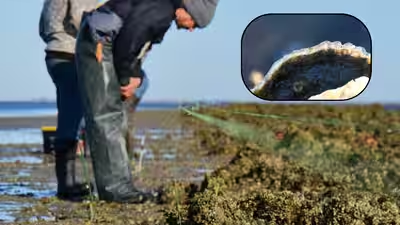
Florida restored a degraded oyster reef in 2018; density rose to 91 per sq m in six months and 244 by year five (Image Credit: UF/IFAS)

Florida’s Lone Cabbage Reef, once a productive oyster habitat that had deteriorated into a sandbar, began recovering after researchers and local oyster harvesters rebuilt it with dolomite limestone in 2018. According to the University of Florida’s Institute of Food and Agricultural Sciences (UF/IFAS), the restoration created a suitable surface for oyster larvae to settle and grow. A research study published in Marine and Coastal Fisheries subsequently documented the scale of that recovery, with live-oyster density at fixed restored offshore stations rising from near zero to 91 per square metre within six months and reaching 244 by the fifth year. The findings show how rebuilding lost reef structure can help revive a damaged marine ecosystem, although restoration alone cannot reverse every cause of oyster decline.

How Florida’s oyster reef deteriorated

Lone Cabbage Reef lies near the mouth of the East Pass of the Suwannee River in Suwannee Sound, along Florida’s Gulf Coast. Historically, it supported oyster populations, provided habitat for fish and wildlife, and helped reduce wave action along the shoreline. Over roughly three decades, however, oyster numbers declined until the once-thriving reef collapsed and became a sandbar. The loss mattered beyond the oysters themselves. Healthy oyster reefs provide habitat for other marine life, support fisheries and help protect coastal areas from waves.Researchers spent more than a decade investigating the problem and testing possible restoration methods. Field assessments and smaller experiments conducted between 2010 and 2017 suggested that the reef’s recovery was being limited by the lack of suitable hard surfaces, rather than a shortage of oyster larvae. That distinction shaped the restoration strategy: instead of relying on oysters to return to the degraded seabed on their own, the project rebuilt the physical structure they needed to settle and grow.

Why researchers chose dolomite limestone

The large-scale restoration was completed in the summer of 2018 with support from the National Fish and Wildlife Foundation. The project brought together University of Florida researchers, local contractors, quarry operators and members of the Cedar Key Oystermen’s Association. The team placed locally sourced dolomite limestone across the footprint of the degraded reef. Rocks measuring between six and 36 inches were used to recreate the uneven structure of a natural oyster reef. The restored surface was also built to an elevation of about 15 to 18 inches, similar to nearby healthy reefs.This design was important because oyster larvae, known as spat, need a firm surface on which to attach and grow. The gaps between rocks also provided places for young oysters to settle. The approach produced early results. According to UF/IFAS, oyster larvae appeared within a few months of construction, and monitoring showed that the restored reef’s oyster population increased annually during the five years following restoration.

Oyster density increased over five years

The research paper, Restoration is a partial but not complete solution for long-term declines in oyster populations: A case history from the northeastern Gulf of America, examined the reef’s recovery through repeated monitoring and comparisons between restored and unrestored areas. At four fixed restored offshore monitoring stations, mean live-oyster density increased from near zero to 91 oysters per square metre within six months. By the fifth year, it had reached 244 oysters per square metre.The study also examined the wider reef landscape. Across restored offshore sites and post-restoration monitoring periods, average oyster density was approximately 83 oysters per square metre. Model-based estimates for restored offshore reefs reached 218 oysters per square metre during the final sampling period. These figures describe different measurements: the 244 figure comes from fixed monitoring stations, while the 218 figure represents a model-based estimate at the broader landscape scale.Unrestored reefs did not show the same consistent recovery. Depending on their distance from shore, oyster densities at these sites either remained broadly stable or declined during the same period. The researchers concluded that restoring the underlying reef structure helped re-establish the conditions oysters needed to survive and grow. Fishing activity and river discharge also mattered to the wider ecosystem, but their associations with oyster density were weaker and less consistent once restoration was considered.

Benefits for wildlife and local oyster harvesters

The recovery had practical implications for the local fishing community. UF/IFAS reported that oyster sizes at restored and unrestored sites had become similar within three years of the work. In the portion of the restored reef open to commercial harvesting, local oyster harvesters began finding legally sized oysters on and near the reef in 2022.Estimates indicated that the work generated $5.08 million in total industry output, including $3.02 million in regional value added, and supported 44 full-time and part-time jobs with $1.01 million in labour income. However, the results do not mean that rebuilding one reef can solve Florida’s wider oyster losses. UF/IFAS estimates that the Lone Cabbage restoration replaced only about 3% to 4% of the oyster reef area lost across the Big Bend region. Monitoring also found no evidence that the restoration changed salinity patterns in Suwannee Sound, based on measurements collected at six locations over more than five years.

What the restoration means for Florida’s coast

The Lone Cabbage project demonstrates that large-scale oyster reef restoration can produce sustained improvements when the underlying habitat is rebuilt appropriately. It also highlights the value of combining scientific research with the knowledge of people who depend on the ecosystem for their livelihoods. The researchers caution, however, that restoration is only part of the solution. The causes of widespread oyster declines in the region remain incompletely understood, and the loss of reefs must be addressed on a much larger scale. The central lesson is that providing suitable limestone substrate can help oysters return to a degraded reef, but lasting recovery will also require understanding why oyster populations declined in the first place and protecting the remaining reef habitats.


Source link

Related Articles

Leave a Reply

Your email address will not be published. Required fields are marked *

Back to top button
×
newsnation.aanest.com
Logo
Date of Publish : 10 October 2026, 1:56 pm Digital Edition : News nation
Florida rebuilt a degraded offshore oyster reef with dolomite limestone in 2018; within six months live-oyster density rose from near zero to 91 per square metre, and by year five it had reached 244

Florida restored a degraded oyster reef in 2018; density rose to 91 per sq m in six months and 244 by year five (Image Credit: UF/IFAS) Florida’s Lone Cabbage Reef, once a productive oyster habitat that had deteriorated into a sandbar, began recovering after researchers and local oyster harvesters rebuilt it with dolomite limestone in 2018. According to the University of Florida’s Institute of Food and Agricultural Sciences (UF/IFAS), the restoration created a suitable surface for oyster larvae to settle and grow. A research study published in Marine and Coastal Fisheries subsequently documented the scale of that recovery, with live-oyster density at fixed restored offshore stations rising from near zero to 91 per square metre within six months and reaching 244 by the fifth year. The findings show how rebuilding lost reef structure can help revive a damaged marine ecosystem, although restoration alone cannot reverse every cause of oyster decline.How Florida’s oyster reef deterioratedLone Cabbage Reef lies near the mouth of the East Pass of the Suwannee River in Suwannee Sound, along Florida’s Gulf Coast. Historically, it supported oyster populations, provided habitat for fish and wildlife, and helped reduce wave action along the shoreline. Over roughly three decades, however, oyster numbers declined until the once-thriving reef collapsed and became a sandbar. The loss mattered beyond the oysters themselves. Healthy oyster reefs provide habitat for other marine life, support fisheries and help protect coastal areas from waves.Researchers spent more than a decade investigating the problem and testing possible restoration methods. Field assessments and smaller experiments conducted between 2010 and 2017 suggested that the reef’s recovery was being limited by the lack of suitable hard surfaces, rather than a shortage of oyster larvae. That distinction shaped the restoration strategy: instead of relying on oysters to return to the degraded seabed on their own, the project rebuilt the physical structure they needed to settle and grow.Why researchers chose dolomite limestoneThe large-scale restoration was completed in the summer of 2018 with support from the National Fish and Wildlife Foundation. The project brought together University of Florida researchers, local contractors, quarry operators and members of the Cedar Key Oystermen’s Association. The team placed locally sourced dolomite limestone across the footprint of the degraded reef. Rocks measuring between six and 36 inches were used to recreate the uneven structure of a natural oyster reef. The restored surface was also built to an elevation of about 15 to 18 inches, similar to nearby healthy reefs.This design was important because oyster larvae, known as spat, need a firm surface on which to attach and grow. The gaps between rocks also provided places for young oysters to settle. The approach produced early results. According to UF/IFAS, oyster larvae appeared within a few months of construction, and monitoring showed that the restored reef’s oyster population increased annually during the five years following restoration.Oyster density increased over five yearsThe research paper, Restoration is a partial but not complete solution for long-term declines in oyster populations: A case history from the northeastern Gulf of America, examined the reef’s recovery through repeated monitoring and comparisons between restored and unrestored areas. At four fixed restored offshore monitoring stations, mean live-oyster density increased from near zero to 91 oysters per square metre within six months. By the fifth year, it had reached 244 oysters per square metre.The study also examined the wider reef landscape. Across restored offshore sites and post-restoration monitoring periods, average oyster density was approximately 83 oysters per square metre. Model-based estimates for restored offshore reefs reached 218 oysters per square metre during the final sampling period. These figures describe different measurements: the 244 figure comes from fixed monitoring stations, while the 218 figure represents a model-based estimate at the broader landscape scale.Unrestored reefs did not show the same consistent recovery. Depending on their distance from shore, oyster densities at these sites either remained broadly stable or declined during the same period. The researchers concluded that restoring the underlying reef structure helped re-establish the conditions oysters needed to survive and grow. Fishing activity and river discharge also mattered to the wider ecosystem, but their associations with oyster density were weaker and less consistent once restoration was considered.Benefits for wildlife and local oyster harvestersThe recovery had practical implications for the local fishing community. UF/IFAS reported that oyster sizes at restored and unrestored sites had become similar within three years of the work. In the portion of the restored reef open to commercial harvesting, local oyster harvesters began finding legally sized oysters on and near the reef in 2022.Estimates indicated that the work generated $5.08 million in total industry output, including $3.02 million in regional value added, and supported 44 full-time and part-time jobs with $1.01 million in labour income. However, the results do not mean that rebuilding one reef can solve Florida’s wider oyster losses. UF/IFAS estimates that the Lone Cabbage restoration replaced only about 3% to 4% of the oyster reef area lost across the Big Bend region. Monitoring also found no evidence that the restoration changed salinity patterns in Suwannee Sound, based on measurements collected at six locations over more than five years.What the restoration means for Florida’s coastThe Lone Cabbage project demonstrates that large-scale oyster reef restoration can produce sustained improvements when the underlying habitat is rebuilt appropriately. It also highlights the value of combining scientific research with the knowledge of people who depend on the ecosystem for their livelihoods. The researchers caution, however, that restoration is only part of the solution. The causes of widespread oyster declines in the region remain incompletely understood, and the loss of reefs must be addressed on a much larger scale. The central lesson is that providing suitable limestone substrate can help oysters return to a degraded reef, but lasting recovery will also require understanding why oyster populations declined in the first place and protecting the remaining reef habitats.

Source link