SC seeks EC response on changes during SIR: Why has Form 6 become a flashpoint — explained | India News

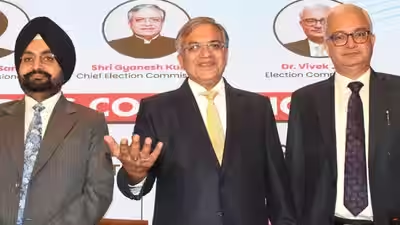

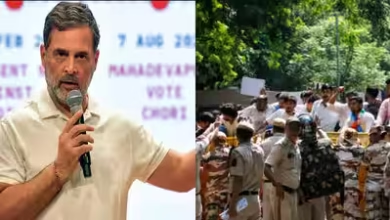
NEW DELHI: The Supreme Court on Monday raised questions over changes allegedly made to Form 6, the application used for registering a voter, during the Election Commission‘s Special Intensive Revision (SIR) of electoral rolls.The issue came up while the court was hearing petitions alleging that several decisions linked to the SIR exercise were taken without the approval of all three election commissioners, particularly Sukhbir Singh Sandhu and Vivek Joshi, who were at odds with poll body chief Gyanesh Kumar on multiple occasions.A bench comprising Chief Justice Surya Kant and Justices Joymalya Bagchi and V Mohana sought responses from the Election Commission, the Centre, the CEC and the other two election commissioners before examining whether the poll panel’s statutory procedure was followed.The bench, however, refused to pass an immediate order seeking the suspension of CEC Gyanesh Kumar, while considering the controversy over Form 6, which was one of the central issues raised in the petitions.
What is Form 6
Form 6 is the application through which an eligible person seeks inclusion of their name in the electoral roll. The Election Commission’s guidelines states the application is addressed to the Electoral Registration Officer of the constituency where the applicant ordinarily resides.The form requires basic details such as the applicant’s name, details of a relative, Aadhaar information, gender, date of birth and present ordinary residence. Applicants are also required to complete a declaration, with the guidelines warning that making a false statement in it is punishable under Section 31 of the Representation of the People Act, 1950.The Election Commission’s instructions also mandates that an applicant can fill the form either in English or in the official language of the state. Also, an applicant who does not know the number or name of the relevant constituency cannot have the application rejected merely for that reason.For age verification, applicants can submit a self-attested copy of one of the documents specified in the form. The guidelines also provide for verification by the Electoral Registration Officer in cases where the prescribed documents are unavailable.
The Form 6
The dispute over Form 6
The petitions allege that additional requirements connected with the SIR were introduced into Form 6 through the Election Commission’s software.One of the allegations is that details concerning an applicant’s ancestry (details of father or grandfather) and a link to the previous SIR were incorporated into the process without an amendment to the Registration of Electors Rules, 1960.The petitioners have further alleged that Election Commissioner Vivek Joshi objected to the modification and that Election Commissioner Sukhbir Singh Sandhu subsequently endorsed the objection. Therefore, the issue therefore goes beyond the information sought from voters.

Chagnes were made to Form 6 without amending the electoral rules.
At the heart of the dispute is whether the Election Commission could alter the form and introduce SIR-linked requirements through its software without following the legal process required for changing the relevant electoral rules. During the hearing, the CJI specifically flagged the question of who authorised the modification.“Any modified Form 6 has not been approved by us. Let’s be clear. When record has produced, we would like to see who has modified. But, your prayers appear jumbled up,” the CJI noted, as quoted by LiveLaw.The court, however, did not accept the petitioners’ allegations as established facts at this stage as Justice Bagchi said the court would first need responses from the concerned authorities and records before deciding whether any decision was taken contrary to the statutory framework.“If records show some decision was not unanimous etc., we will injunct those decisions and say they are ultra-vires. Can we ex-parte come to decision that all decisions were unilateral? We expect them to respond in a clear, transparent manner,” Justice Bagchi added.
The larger SIR controversy
The Form 6 dispute forms part of a broader challenge to how the Election Commission has allegedly handled the SIR exercise. The petitions rely on claims that the two other Election Commissioners formally raised objections on at least 14 occasions over several months to decisions and orders concerning the revision of electoral rolls.The allegations include changes to electoral-roll software, communications issued in the name of the Election Commission and other decisions allegedly taken without the approval of all members of the multi-member poll panel.The petitioners have invoked Section 18 of the Chief Election Commissioner and Other Election Commissioners Act, 2023. The provision states that the Commission’s business should, as far as possible, be transacted unanimously and that where the members differ, the matter is to be decided according to the majority view.The pleas argue that this framework means powers vested in the Election Commission cannot be exercised individually by the CEC where the law requires the Commission to act collectively.The petitioners have sought several forms of relief, including suspension of Gyanesh Kumar as CEC until the matter is decided, preservation of electoral-roll data and audit trails, and restrictions on further substantive changes to Form 6.
Share your thoughts in the comments
Be respectful · TOI community guidelines
Another plea has sought criminal proceedings against the CEC and other officials and argued that decisions, guidelines and software changes allegedly made without the full Commission’s agreement should be declared unconstitutional, ultra vires and void ab initio.The Supreme Court has therefore, at this stage, not ruled on whether the alleged changes to Form 6 or other SIR-related decisions were unlawful. The immediate question before the court is whether the Election Commission followed the statutory decision-making process.The court will consider the records and responses of the respondents before deciding whether any particular decision can be struck down.
Source link