
Silicon Valley investor AJ Scaramucci quietly built a collection of comics, trading cards and dinosaur fossils; now he sees them as alternative assets | World News

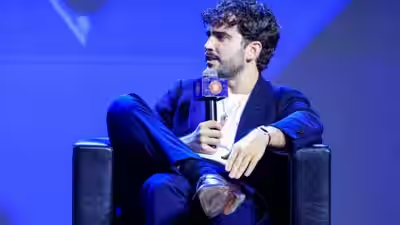

For years, Silicon Valley investor AJ Scaramucci quietly assembled an unusual collection of comics, trading cards and even dinosaur bones. Now he argues these objects belong alongside gold and bitcoin as serious alternative assets. Scaramucci founded Solari Capital, a venture firm that has just emerged from stealth after deploying roughly 350 million dollars, and he launched a collectables holding company called Treasure Trove earlier this year. He reasons that scarce cultural treasures can protect wealth when currencies lose value. This article explains the collection, the investment logic behind it, and how it connects to his wider technology investment thesis.
Who is AJ Scaramucci, the Solari Capital founder with 350 million dollars invested
Scaramucci began in science, with an early interest in amateur astronomy and time in a bioelectronics laboratory, before moving to the Bay Area, joining Tesla in 2013 and then spending a rotation at Google. According to Fortune, he credits Peter Diamandis’s book Abundance with shaping his worldview, and he later worked under Diamandis as an entrepreneur-in-residence and at Kai-Fu Lee’s Sinovation Ventures.Solari Capital is the result. According to the report, it has put roughly 350 million dollars into early-stage investing, late-stage growth cheques and companies it incubates itself. Backers include Ron Conway, Jim Breyer, Stephen Pagliuca, Eric Schmidt and Diamandis.
His company is buying grail comics and record-setting Pokémon cards
The collection now has a corporate home. Treasure Trove, launched earlier this year, has bought a first-appearance Iron Man comic for 2 million dollars and, separately, a record-setting Pokémon card. Scaramucci says he has been buying one-of-one “grail” assets, meaning unique items that cannot be replicated, because he believes they deliver uncorrelated returns.His stated ambition is to open the market to ordinary investors, and not only the ultrawealthy. He calls collectables a sleeping giant that institutional capital has largely ignored, and he claims the category is worth 25 trillion dollars and has never been properly institutionalised. That figure is his own claim, not an independently verified number.

Image: Treasure Trove
Why collectables, trading cards and dinosaur fossils are a hedge
The logic starts with money. Scaramucci notes that gold and bitcoin together have created more market value since 2008 than the group of seven giant technology stocks known as the Magnificent Seven. He argues that currency debasement, the steady loss of purchasing power, is a defining feature of twenty-first-century finance, and he puts the average life expectancy of a currency at around twenty-six years.In his framing, gold is the physical store of value and bitcoin the digital one, while collectables are what he calls a “cultural store of value.” He describes buying them as a debasement trade, a bet that scarce objects hold their worth as currencies erode.
How the shortage of Tyrannosaurus rex fossils caught his attention
As per Fortune, Dinosaur fossils are the most unusual piece. Andrea Pasinetti, founder of the education company Kira Learning and a Solari portfolio founder, recalled that around a year and a half to two years ago Scaramucci was already talking about the short supply of Tyrannosaurus rex fossils. A few months before the report, Sotheby’s sold the most expensive Tyrannosaurus rex fossil ever transacted, and Pasinetti said Scaramucci had been discussing that very specimen long before.Scaramucci presents collectables as the flip side of his main thesis, which he calls Programmable Reality. That idea holds that as computing power compounds, biology, intelligence, matter and money become things that can be engineered with software-like precision. Solari’s portfolio is organised around four themes, programmable intelligence, biology, matter and finance.One trade, he says, is the artificial intelligence or singularity trade, where computing power keeps doubling. The other is the scarcity trade, or cultural trade. In his view, the two sit side by side, one bets on abundance created by technology, the other on things that cannot be made again.
Source link