
A Connecticut man paid $35 for a bowl at a yard sale in 2020; experts revealed it was a rare 15th-century Chinese treasure and it sold for $721,800 | World News

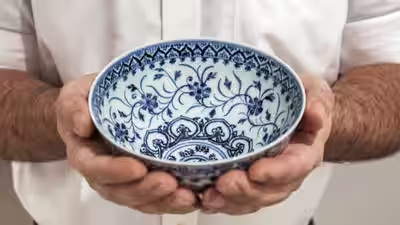

A Connecticut man paid $35 for a small blue-and-white porcelain bowl at a yard sale near New Haven in 2020, unaware that he had stumbled upon an exceptionally rare Chinese imperial-era artefact. The unnamed antiques enthusiast suspected the bowl might be special and later sent photographs to Sotheby’s for an evaluation. Specialists identified it as a Ming dynasty bowl dating to the early 15th century, during the reign of the Yongle Emperor. Only seven comparable bowls were known to exist, including the Connecticut discovery. Sotheby’s initially estimated that it could sell for $300,000 to $500,000. When the bowl went under the hammer in New York on March 17, 2021, it attracted 15 bids and eventually sold for $721,800, including fees.
A $35 find at a Connecticut yard sale
The discovery began at a yard sale in the New Haven area in 2020. The buyer, whose identity was not disclosed, was an antiques enthusiast browsing the items when he noticed the small porcelain bowl.Unlike someone who simply stumbled across an object by chance, the buyer apparently had enough knowledge to suspect that the bowl could be valuable. He paid the $35 asking price without haggling and took it home. He later contacted Sotheby’s and sent photographs of the piece, asking the auction house to assess it.The decision to seek an expert opinion proved crucial. Sotheby’s receives photographs and inquiries about potentially valuable objects regularly, but specialists Angela McAteer, head of the auction house’s Chinese works of art department, and specialist Hang Yin recognised something unusual in the bowl. When they examined it in person, they determined that its shape, glaze, cobalt-blue decoration and other characteristics were consistent with early 15th-century Chinese porcelain.
Experts identify a Ming dynasty treasure
Sotheby’s identified the object as an exceptional blue-and-white floral bowl from the Ming dynasty’s Yongle period. The Yongle Emperor ruled from 1403 to 1424, placing the bowl’s production in the early 15th century.The bowl measures approximately 6¼ inches, or 16 centimetres, in diameter. Its shape resembles a lotus bud or what is sometimes described as a chicken-heart form. The interior contains a central medallion and intricate floral and geometric decoration, while the exterior features four different flowers: lotus, peony, chrysanthemum and pomegranate.Sotheby’s described the piece as a quintessential example of Yongle-period porcelain made for the imperial court. During the Yongle reign, the imperial kilns at Jingdezhen produced sophisticated blue-and-white porcelain, and the bowl reflects the distinctive craftsmanship and decorative style associated with that period.
Only seven comparable bowls were known
The bowl’s age was only part of what made it remarkable. Its rarity was even more significant.Sotheby’s specialists said that only six other comparable bowls were known to exist, making seven including the Connecticut example. Most were held by major museums and institutions rather than private American collections.Known examples included bowls in collections associated with the National Palace Museum in Taipei, museums in London and the National Museum of Iran in Tehran. Sotheby’s said there were no other examples of the type in US museums at the time.The fact that such a scarce imperial-era object had appeared at an ordinary Connecticut yard sale made its discovery particularly striking. How the bowl reached the sale was not known. Sotheby’s suggested that it may have passed through generations of a family that did not realise how unusual it was.
Sotheby’s estimates the bowl at up to $500,000
After authentication, Sotheby’s prepared the bowl for its Important Chinese Art auction in New York. The auction house placed a presale estimate of $300,000 to $500,000.That estimate represented an extraordinary jump from the $35 paid at the yard sale. At the upper estimate of $500,000, the bowl would already have been worth more than 14,000 times its purchase price.The auction listing provided extensive details about the bowl’s construction and decoration. Sotheby’s described its rich cobalt-blue painting, delicate floral motifs and distinctive shape, all of which helped specialists establish its relationship to Yongle-period imperial porcelain.
Fifteen bids push the price beyond expectations
The bowl was offered at Sotheby’s New York on March 17, 2021, as part of the auction house’s Important Chinese Art sale during Asia Week.Bidding quickly moved beyond the lower end of the estimate. Contemporary reports said the auction attracted 15 bids, beginning at $200,000 from an online bidder. The competition eventually pushed the hammer price to $580,000.After Sotheby’s fees were added, the official price realised was $721,800. Four bidders were reported to have competed for the bowl during the auction.The final price substantially exceeded Sotheby’s $500,000 upper estimate. Compared with the original $35 purchase, the $721,800 result represented more than 20,000 times what the buyer had paid.
A bowl made for the Yongle court
The Yongle period was an important stage in the development of Chinese blue-and-white porcelain. The imperial court encouraged new styles and high-quality production at the Jingdezhen kilns in present-day Jiangxi province.The Connecticut bowl reflects that tradition through its carefully painted floral decoration. The outside alternates lotus, peony, chrysanthemum and pomegranate blossoms with other decorative emblems, while the interior contains additional geometric and floral designs.Its small size also belies the complexity of its decoration. Despite measuring only about 16 centimetres across, the bowl contains multiple layers of painted motifs and carefully executed patterns.
From an ordinary yard sale to a major auction
The buyer had paid the $35 asking price after spotting the bowl at a yard sale. Rather than leaving it as an unidentified piece of pottery, he sought professional advice and contacted Sotheby’s. That decision led specialists to identify a rare Ming dynasty object that had survived for more than six centuries.The bowl’s final auction price also showed the importance of rarity, craftsmanship and imperial provenance in the market for Chinese ceramics. Its appearance at a New Haven-area yard sale remains unexplained, but its subsequent examination established that the seemingly modest purchase was an exceptionally rare example of Yongle-period porcelain.On March 17, 2021, the $35 yard-sale purchase completed its extraordinary transformation when it sold at Sotheby’s for $721,800 including fees.
Source link