
In 1984, NASA sent 12.5 million tomato seeds to space; in 1990 they had to be brought back to Earth and were planted across 40,000 schools in 40 countries

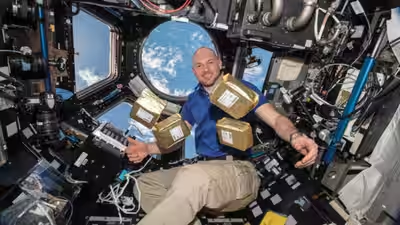

The seeds that NASA sent to space in 1984, returned to Earth six years later in 1990 and had to be distributed among students as plant kits. What lies behind this statement is a tale of space motion that many remain unaware of. The mission was to determine whether exposure to the space environment would affect the germination and plant growth of the seeds, but the agency was never able to observe the same.
A hopeful experiment
The project was called SEEDS, which stands for Space Exposed Experiment Developed for Students. It involved NASA headquarters, the Langley Research Centre and the company George W. Park Seed, a traditional seed supplier in US. The idea was to send a group of seeds into space and keep a group on Earth. Then, both sets of identical seeds would be distributed to the schools so that students could plant them side by side and compare the results.All 12.5 million seeds belonged to the variety Rutgers California Supreme, a common tomato in American cultivation. This was chosen because using a single variety prevents genetic differences from skewing the results. The equipment that carried the seeds into space was the Long Duration Exposure Facility (LDEF), a twelve-sided cylindrical structure, weighing about 9.7 tons, designed to remain stationary in space while experiments attached to its surface were exposed to vacuum, radiation and micrometeorites. The LDEF had no propulsion or power generation of its own. It was built to be released by one space shuttle and collected by another, and it carried dozens of experiments from various countries, not just the seed experiments.The Space Shuttle Challenger released the LDEF into orbit on April 7, 1984, during the STC-41 C mission. The plan was to retrieve it within a year during a subsequent, pre-scheduled mission. Two years later, the same shuttle exploded 73 seconds after launch on January 28, 1986, killing all seven crew members. The entire fleet was grounded, and planned missions were reorganised.Without an engine to correct its trajectory, the LDEF gradually lost altitude, slowed by the residual atmosphere that exists even hundreds of kilometres up. Over the years, its orbit dropped to about 280 kilometres. When the rescue finally arrived, the platform was mere weeks away from re-entering the atmosphere and disintegrating. In this case, the 12.5 million seeds would have burned up as well.The Space Shuttle Columbia captured the platform on January 12, 1990, during the STS-32 mission, bringing it back with the seeds intact. Combined, this amounted to 69 months in orbit, nearly six years and over 32,000 orbits around Earth. The seeds remained sealed in containers inside the platform, with no cultivation in orbit. Nothing germinated in space; the exposure was only to the environment. During this time, they were exposed to solar radiation, cosmic rays and microgravity.
Planting kits for students

Each kit contained both group of seeds, the ones that had spent nearly six years in space and the ones that had been stored in a controlled environment for the same duration. Image credit: NASA
After the return, as planned, the educational phase of the project began. According to a NASA educational report, approximately 132,000 planting kits were distributed to teachers at about 40,000 schools, reaching about 3.3 million students. The outreach covered all 50 US states, the District of Columbia and another 30 countries across the world. It included classes from preschool to universities.Each kit contained both group of seeds, the ones that had spent nearly six years in space and the ones that had been stored in a controlled environment for the same duration. This second group is what science refers to as the control: it serves as a benchmark to determine whether any observed differences were actually due to the journey, rather than the variety or planting method. The kits included forms to record any observations made.Students recorded how many seeds germinated, how long it took for the first sprout to appear and how the plants developed over the weeks. They also noted the appearance of the flowers, formation of the fruit and the condition of leaves and stems. The recorded data was sent back to NASA which compiled the information for analysis. The agency received nearly 8,000 reports submitted by entire classes.Preliminary data showed a germination rate of 73.8% for the space seeds, compared to 70.3% for the Earth seeds. In tests conducted in the first six months after retrieval, the space seeds averaged germination in 8 days, while the Earth seeds took 8.3 days. There was also a tendency for initial growth to be faster in the first three to four weeks. After this period, the terrestrial plants caught up to the others.The project’s summary did not identify any overall differences between the two groups of plants or their fruits. The small initial advantages did not persist through the end of the cycle.SEEDS (Space Exposed Experiment Developed for Students) has become one of the largest science projects ever conducted in classrooms with material that has been exposed to space, both in terms of participant numbers and geographical reach.
Source link