An Australian woman bought cleared sugarcane land and planted trees; 10 years later, 119,000 trees transformed it into a rainforest home to flying-foxes | World News

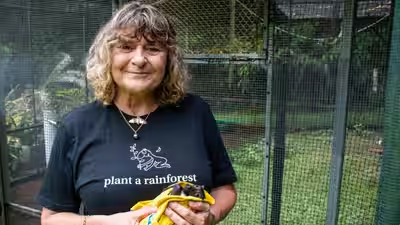

Annie Schoenberger bought cleared land near Wonga Beach in Queensland, Australia, with a simple but ambitious goal of bringing rainforest back to a property once used for sugarcane. What followed was a decade-long restoration effort at her NightWings Rainforest Centre, where native trees were planted with the help of Rainforest Rescue, volunteers and supporters. More than 119,000 trees have now been planted across 18 hectares, gradually replacing the cleared agricultural landscape with young rainforest habitat. The project has also attracted native wildlife and helped restore wetland areas and improve water quality. In May 2026, the restoration reached another major milestone when the Queensland Government recognised the 18-hectare area as being of high nature conservation value, giving the recovering vegetation Category A protection under Queensland’s vegetation management framework.
From cleared sugarcane land to a young rainforest
Schoenberger purchased the property in 2014 after much of the land had been cleared for sugarcane farming. She wanted to restore the landscape to lowland Daintree rainforest and create habitat for native wildlife. Restoration work began in 2015, followed by the first community tree-planting event in 2016. Rainforest Rescue became a major partner in the effort, helping organise planting events, supply rainforest seedlings and bring volunteers together to restore the former agricultural land.The original restoration target was around 15 hectares, but the area eventually expanded to 18 hectares. Instead of establishing a conventional plantation, the project focused on planting a diverse selection of native rainforest species that could gradually recreate the structure and ecological functions of the original forest.

More than 119,000 trees planted over a decade
The transformation was built through repeated planting efforts rather than a single large-scale operation. Over 10 years, volunteers, conservation workers and supporters returned to NightWings to put thousands of native seedlings into the ground.Rainforest Rescue’s latest 2026 update says more than 119,000 trees had been planted at NightWings, with the final planting completed in 2025. The organisation says the decade-long effort involved hundreds of people who helped Schoenberger turn the cleared property into a growing rainforest landscape.The planting has also focused on species diversity. At a 2023 community planting day, more than 140 people planted 3,300 trees representing about 90 rainforest species. Such diversity is important because rainforest restoration is intended to recreate a functioning ecosystem rather than simply increase the number of trees.
Wildlife began using the recovering habitat
As vegetation grew, the restored property began providing habitat and food resources for wildlife. NightWings is particularly connected to the spectacled flying-fox, a species Schoenberger has cared for through her wildlife rehabilitation work.Southern cassowaries have also been recorded at the property. A juvenile cassowary was photographed at NightWings in 2018, with Rainforest Rescue describing the sighting as particularly significant because it was the first recorded sighting south of the Daintree River in more than four decades. Later observations have continued to demonstrate that native wildlife is using the recovering landscape.Other fauna recorded around the property include various birds, mammals, reptiles, frogs and bats. Surveys have recorded more than 75 fauna species, including several species listed as endangered, vulnerable or near threatened.The wildlife records do not mean that every species returned solely because of the restoration, but they provide evidence that the recovering vegetation is being used as habitat.

The restoration helped rebuild wetland habitat
Tree planting was only one part of the restoration. Wetland habitat at NightWings has also been restored, adding another type of ecosystem to the property.Rainforest Rescue has reported improvements in water quality associated with the restoration, including reduced sediment and turbidity entering nearby waterways. Re-establishing vegetation can help stabilise soil, slow runoff and create conditions that support healthier waterways.The location is also important because the property sits within the Wet Tropics region of Queensland, an area known for its exceptional rainforest biodiversity and its ecological connection to surrounding coastal environments.
A former farm became a wildlife corridor
The restoration was intended to do more than improve a single property. Re-establishing rainforest on cleared land can help reconnect fragmented habitat, giving wildlife additional areas through which to move, feed and shelter.NightWings forms part of the broader effort to restore lowland rainforest in the Daintree region, where agricultural and other development have historically removed or fragmented sections of native vegetation.For Schoenberger, the project also had a personal connection. Her work caring for flying-foxes helped shape her desire to create a landscape where native fruiting trees could provide food and habitat for wildlife rather than leaving the animals dependent entirely on fragmented natural areas.
The 18 hectares gained conservation protection
The biggest development came in May 2026, when the Queensland Government formally recognised the restored NightWings vegetation as an area of high nature conservation value under the Vegetation Management Act 1999.The 18 hectares are now mapped as Category A vegetation on Queensland’s regulated vegetation management map. This gives the restored vegetation a higher level of protection against clearing and formally recognises the conservation importance of the recovering forest.The designation is particularly notable because the land was once used for agriculture. A landscape that had been cleared for sugarcane is now recognised by the state for its conservation value after a decade of restoration.
A decade turned a cleared landscape into a restoration success
NightWings shows how long-term restoration can gradually change land that had been cleared for agriculture. Schoenberger bought the former sugarcane property, began restoring it with conservation partners and continued the effort for a decade as volunteers planted tens of thousands of native trees.By the completion of planting in 2025, Rainforest Rescue reported more than 119,000 trees planted across the restoration area. In 2026, the 18 hectares of restored vegetation gained recognition as an area of high nature conservation value and Category A protection.The forest is still young and its ecological development will continue for decades, but the transformation is already substantial. What began as cleared sugarcane land is now a growing rainforest landscape providing habitat for native wildlife and carrying formal recognition for its conservation value.
Source link