
At 14, a Kerala girl turned an everyday bicycle into a low-cost washing machine for Rs 2,000 that could wash clothes without electricity |

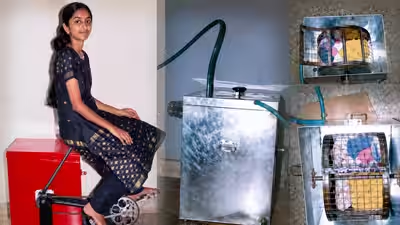

At a time when laundry was one more task competing with school, travel and family responsibilities, a Kerala schoolgirl began thinking about a surprisingly simple alternative to the washing machine she did not have. Remya, who was studying in the 10th standard, was already spending hours travelling to school each day and helping her twin sister with the household washing. Her mother had fallen ill, while her father was undergoing cancer treatment, leaving little time for anything else. Instead of accepting the situation, Remya looked at how an electric washing machine made its drum move and wondered whether a bicycle could provide the same motion.What began as an idea eventually became a pedal-powered washing machine, built with help from a local automobile workshop using a bicycle mechanism, a metal drum and an aluminium enclosure.
How Remya turned a familiar bicycle mechanism into a washing machine
Remya had already seen how an electric washing machine worked. She did not have formal engineering training, but she understood the basic sequence well enough to question one part of it: the source of the movement.If an electric motor could turn a drum, she reasoned, there was no reason that a pedal mechanism could not do the same job. A bicycle already converted human effort into rotary motion through pedals, a chain and gears. She began sketching a machine that combined those familiar parts with a container for washing clothes.The idea was fairly direct on paper. A horizontal cylinder made from iron mesh would sit inside an aluminium enclosure. Clothes would go into the cylinder, while the surrounding compartment would hold the water. A bicycle-style seat and pedals would be attached to the drum through a chain mechanism.Turning the sketch into something that could actually work was the harder part. Her father took the drawing to a nearby automobile workshop. He arranged for the mechanics to make the parts when they had spare time and bought the materials according to Remya’s instructions. On at least one occasion, she had to explain the proposed arrangement to a mechanic herself. The workshop was not a specialist laboratory. It was simply a place where people knew how to cut, shape and assemble metal and mechanical components.
How a few minutes of pedalling could clean and spin-dry clothes
The finished device looked rather like an exercise bicycle joined to a washing tub. Once the clothes were loaded into the wire cylinder, water was added to the required level and washing powder was put in. The clothes were left to soak for about 10 minutes before the mechanical work began.Remya would then pedal for roughly three to four minutes. The cylinder rotated rapidly, moving the clothes through the soapy water. After the wash, the dirty water could be drained and the compartment filled again for rinsing.The same pedal arrangement had another use at the end of the cycle. With the water removed, continued rotation allowed the spinning drum to act as a simple centrifuge. The clothes could come out around 80 per cent dry, reducing the amount of time they needed on a washing line. There was no motor, electrical control panel or dependence on a power socket. The person operating it supplied the energy.
The low-cost alternative built for life without reliable power
The design made sense in the setting for which it was intended. A conventional washing machine required an initial purchase that many families could not easily afford, followed by electricity to operate it. In areas where power interruptions were common, a wash could also be disrupted.According to the National Innovation Foundation (NIF), Remya’s machine avoided both issues. Its reported construction cost was about Rs 2,000, and it could be moved rather than permanently installed. The pedal mechanism also meant that the machine could double as a form of exercise.There was no need for a complicated electrical system or a specialised installation. Much of the mechanical work could be understood through ordinary bicycle and workshop technology.
The personal circumstances that inspired Remya’s invention
The circumstances were unusually demanding for a school student. Remya had to change three buses on the journey to and from school, spending about two hours travelling in each direction. As reported by NIF, her mother became ill while she was sitting her 10th standard examinations, while her father was undergoing treatment for cancer.Laundry was therefore not simply an inconvenience. It competed directly with schoolwork and the small amount of free time left after travelling.Remya and her twin sister, Soumya, shared the washing. Without an electric machine at home, the clothes had to be washed manually. The amount of work involved eventually pushed Remya towards finding a mechanical alternative.Her first step was not to buy equipment or seek out an engineer. She watched an electric washing machine, thought about what made the drum move and tried to reproduce that movement using something available to almost any household: a bicycle mechanism.
How Remya’s family reacted to her unusual invention
Her father, a high school Hindi teacher, became the person who helped turn the sketch into a physical object. Yet he initially had doubts about the idea.According to the account recorded by India’s National Innovation Foundation, he even suggested that learning to wash clothes by hand might be more useful, since she might one day move to a household without a washing machine.Her mother was also concerned that Remya was spending too much time on inventions when she should have been concentrating on her studies. That attitude changed as the machine took shape and began attracting attention.Soumya supported her twin’s experiments, while friends heard about the project as it developed. Some were initially sceptical. Remya continued explaining what she wanted to achieve, and the working machine eventually provided the clearest answer to their doubts.
From a homemade machine to a National Innovation Foundation record
The machine did not remain confined to the workshop or the family home. Remya’s invention was documented by the National Innovation Foundation, which records grassroots innovations from across India.According to NIF, a patent application was filed in 2003 under the number 643/CHE/2003, dated 7 August 2003. The invention was recorded as a “Washing Cum Exercise Machine”, reflecting its two intended functions.Remya and her invention soon became a source of pride in her local community, where friends and neighbours affectionately came to know her as the “little scientist”. Her pedal-powered washing machine attracted attention beyond her neighbourhood, leading to interviews and demonstrations featured in the regional newspapers Madhyamam and Malayala Manorama.Her local church also organised a special felicitation ceremony in recognition of her achievement, where the Bishop presented her with a trophy. Interest in the innovation continued to grow, with media channels expressing interest in producing feature stories about the machine and an engineer from Delhi offering to help refine and improve the design further.
Source link