
World

A wooden relic that survived the sack of Jerusalem’s First Temple was unearthed by archaeologists, now they are finding shocking answers

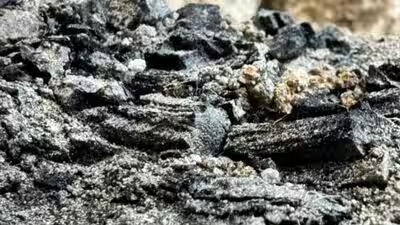
A wooden relic that survived the sack of Jerusalem's First Temple was unearthed by archaeologists, now they are finding shocking answers
Image credit: Reut VilfImage source: Tel Aviv University

In the current world, it is highly unlikely to come across intact wood that is thousands of years old and yet untouched. During an archaeological excavation in the area known as the Givati Parking Lot in the City of David, a team of researchers recently uncovered charred remains dating to the Iron Age, from the time of the destruction of Jerusalem’s First Temple in 586 B.C. as per a report by AS. Alongside these fragments, researchers also found conifer wood containing numerous well-preserved growth rings.

A preserved relic

A preserved relic

The thick beams discovered were made of sycamore wood and as per experts, once formed part of the roof of an interior courtyardImage credit: Efrat BocherImage source: Tel Aviv University

The thick beams discovered were made of sycamore wood and as per experts, once formed part of the roof of an interior courtyard. Efrat Bocher, an excavation director, said that the beams “appear to have served as the roof of an inner courtyard.” “During the destruction, they collapsed onto the floor,” Bocher said in a statement.They date back to roughly 2,600 years, likely the remnants of the destruction of Solomon’s Temple. The discovery was announced by the Israel Antiquities Authority (IAA) in July. IAA officials said the wood was found “within a building that collapsed by the intense fire at the time of the First Temple’s destruction.”Their statement added, “What likely preserved the beams for approximately 2,600 years was plaster that melted from the building’s walls, sealing the burnt wood beneath it.”The big question is how they managed to survive for so long. The answer lies in the very fire that destroyed the building. When the flames consumed the structure, the timbers collapsed to the ground and were immediately covered by plaster from the walls, which the intense heat had altered. This layer of material acted as a nearly perfect protective seal, preventing the remains from disintegrating over the centuries.Researcher Johanna Regev explained that combining the analysis of these rings with modern radiocarbon testing makes it possible to determine dates with much greater precision. Until now, experts often had to work with margins of error spanning hundreds of years when dating objects this ancient. With this material, however, the time frame can be narrowed to just a decade.

Preserved among the ruins

Solomon’s Temple, also called the First Temple, was destroyed by Babylonian King Nebuchadnezzar II in 586 B.C., after his army captured Jerusalem following a lengthy siege. It was originally built by King Solomon in the 10th century B.C. as the permanent house for the Ark of the Covenant, according to Scripture. The destruction of Solomon’s Temple ushered in the Second Temple period, the era of Judaism in which Jesus lived and practised.Experts leading the project believe that the people who returned to the city decades after the sack made a conscious decision not to clear the area, leaving the burned remains exactly where they lay. The purpose of this act may have been to keep the memory of the disaster alive, with new streets later built directly over the ashes.“Preserving memory is a human need, seeking to preserve what once existed,” excavation director Yiftah Shalev said in a statement. “Here we see it in its clearest form: a deliberate choice to leave ruins in place as a testament to the destruction and build the new layer over them.”This historic discovery also coincides on the calendar with the traditional dates commemorating the fall of the ancient city at the hands of the Babylonians. The event is still remembered in the region each year through Tisha B’Av, which involves various days of mourning and fasting.In a statement, Bocher called the discovery “deeply moving.” It “makes you feel that you are witnessing the very moment of destruction, the moment when it all happened,” she said.Jerusalem, known as the Eternal City, is the setting of countless notable archaeological discoveries per year. Last year, archaeologists in Jerusalem uncovered the longest and best-preserved section of the city’s Hasmonean-era wall. And earlier this year, excavators uncovered a “mysterious and impressive” ancient tunnel near Jerusalem’s biblical-era Kingdom of Judah.


Source link

Related Articles

Leave a Reply

Your email address will not be published. Required fields are marked *

Back to top button
×
newsnation.aanest.com
Logo
Date of Publish : 29 August 2026, 2:26 pm Digital Edition : News nation
A wooden relic that survived the sack of Jerusalem’s First Temple was unearthed by archaeologists, now they are finding shocking answers

Image credit: Reut VilfImage source: Tel Aviv University In the current world, it is highly unlikely to come across intact wood that is thousands of years old and yet untouched. During an archaeological excavation in the area known as the Givati Parking Lot in the City of David, a team of researchers recently uncovered charred remains dating to the Iron Age, from the time of the destruction of Jerusalem's First Temple in 586 B.C. as per a report by AS. Alongside these fragments, researchers also found conifer wood containing numerous well-preserved growth rings.A preserved relicThe thick beams discovered were made of sycamore wood and as per experts, once formed part of the roof of an interior courtyardImage credit: Efrat BocherImage source: Tel Aviv UniversityThe thick beams discovered were made of sycamore wood and as per experts, once formed part of the roof of an interior courtyard. Efrat Bocher, an excavation director, said that the beams "appear to have served as the roof of an inner courtyard." "During the destruction, they collapsed onto the floor," Bocher said in a statement.They date back to roughly 2,600 years, likely the remnants of the destruction of Solomon's Temple. The discovery was announced by the Israel Antiquities Authority (IAA) in July. IAA officials said the wood was found "within a building that collapsed by the intense fire at the time of the First Temple's destruction."Their statement added, "What likely preserved the beams for approximately 2,600 years was plaster that melted from the building's walls, sealing the burnt wood beneath it."The big question is how they managed to survive for so long. The answer lies in the very fire that destroyed the building. When the flames consumed the structure, the timbers collapsed to the ground and were immediately covered by plaster from the walls, which the intense heat had altered. This layer of material acted as a nearly perfect protective seal, preventing the remains from disintegrating over the centuries.Researcher Johanna Regev explained that combining the analysis of these rings with modern radiocarbon testing makes it possible to determine dates with much greater precision. Until now, experts often had to work with margins of error spanning hundreds of years when dating objects this ancient. With this material, however, the time frame can be narrowed to just a decade.Preserved among the ruinsSolomon's Temple, also called the First Temple, was destroyed by Babylonian King Nebuchadnezzar II in 586 B.C., after his army captured Jerusalem following a lengthy siege. It was originally built by King Solomon in the 10th century B.C. as the permanent house for the Ark of the Covenant, according to Scripture. The destruction of Solomon's Temple ushered in the Second Temple period, the era of Judaism in which Jesus lived and practised.Experts leading the project believe that the people who returned to the city decades after the sack made a conscious decision not to clear the area, leaving the burned remains exactly where they lay. The purpose of this act may have been to keep the memory of the disaster alive, with new streets later built directly over the ashes."Preserving memory is a human need, seeking to preserve what once existed," excavation director Yiftah Shalev said in a statement. "Here we see it in its clearest form: a deliberate choice to leave ruins in place as a testament to the destruction and build the new layer over them."This historic discovery also coincides on the calendar with the traditional dates commemorating the fall of the ancient city at the hands of the Babylonians. The event is still remembered in the region each year through Tisha B’Av, which involves various days of mourning and fasting.In a statement, Bocher called the discovery "deeply moving." It "makes you feel that you are witnessing the very moment of destruction, the moment when it all happened," she said.Jerusalem, known as the Eternal City, is the setting of countless notable archaeological discoveries per year. Last year, archaeologists in Jerusalem uncovered the longest and best-preserved section of the city's Hasmonean-era wall. And earlier this year, excavators uncovered a "mysterious and impressive" ancient tunnel near Jerusalem's biblical-era Kingdom of Judah.

Source link