World

Meet Peter Fernández Dulay, the Florida eighth-grader who asked four AI generators what scientists look like; only 17.4% of the images showed women alone

Meet Peter Fernández Dulay, the Florida eighth-grader who asked four AI generators what scientists look like; only 17.4% of the images showed women alone
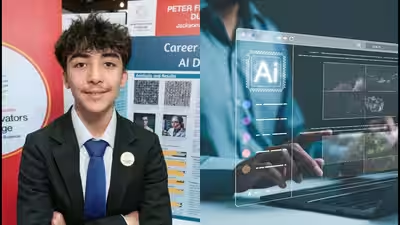
The idea came about when Peter and his younger sister Elisa were using the Magic Media AI tool by Canva. (Images: istock and Society for Science)

Peter Fernández Dulay’s younger sister asked an AI tool to draw a scientist and hoped to see someone who looked like the scientists she might be one day. The pictures, however, showed the same figure again and again: an older man with light skin and gray, frizzy hair. According to Society for Science data, that simple observation sparked Peter, an eighth-grader from Florida, to launch a research project on how artificial intelligence represents people in science and technology. His findings posed a troubling question: If AI learns from existing data that contains stereotypes, does the technology reproduce those same biases? Scroll down to know what exactly happened.

A simple question with bigger implications

The idea came about when Peter and his younger sister Elisa were using the Magic Media AI tool by Canva. Elisa was writing a story about a mad scientist and she needed an image to go with it. But the results took her by surprise. The images mostly featured older, light-skinned men, rather than producing a wide diversity of scientists. Seeing his sister’s dismay, Peter started to wonder if the pattern was limited to one AI tool. According to the project background, women make up about 35 percent of STEM graduates. Peter wanted to see if AI image generators would show women in science at anything like that proportion.

Testing 4 AI image generators

Peter tried out four popular AI image-generating platforms: Shutterstock, Canva, DALL-E and Midjourney. Rather than request images of scientists in general, he chose five specific careers in science and technology: actuary, data scientist, information security analyst, operations research analyst and computer and information research scientist. The tools produced several image sets for each prompt. Peter then viewed and coded the images for whether they depicted men or women. The results demonstrated a large gender imbalance across the entire experiment. According to the report, he analyzed 1,459 images of men and 347 images of women. Women alone accounted for only 17.4 percent of the images. The only one of the five career prompts where women’s representation in the results was at least as high as the percentage of women in that field was information security analyst.

Not all AI tools are created equally

Peter’s experiment also showed differences between the platforms. His analysis found that of the four tools he tested, Shutterstock yielded the least biased results, while Midjourney was the most biased. But the findings don’t necessarily mean that an AI system is biased on purpose. AI image generators are trained on patterns learned from huge swathes of existing material – and those swathes can contain historic inequalities and stereotypes. But when these patterns are repeated over and over again, they can shape the way people think about certain careers. That may be important to a young student like Elisa. If the default image of a scientist is always an older man, kids may absorb the idea that science belongs to people who look like that, without even realizing it.

Fencing to robots

But Peter’s interests go far beyond AI research. He is a regionally ranked fencer and on his school’s robotics team. He calls fencing “physical chess,” a sport that demands quick decisions and a close analysis of an opponent, the report by Society for Science states. Fencing has taught him how to deal with stress, and robotics lets him explore his technical interests, he says in the post. His range of interests may also explain why he is thinking about technology through a human lens.

Envisioning a more inclusive AI

Peter would like to become a psychologist, and he has an idea of how AI could someday fit into that career. He is bilingual and multicultural and he sees the creation of an AI companion that can speak to people in different languages and can also recognize psychological stress via language patterns. For now, his research offers a useful lesson about artificial intelligence: technology does not exist separate from the information used to create it.


Source link

Related Articles

Leave a Reply

Your email address will not be published. Required fields are marked *

Back to top button
×
newsnation.aanest.com
Logo
Date of Publish : 23 August 2026, 2:21 pm Digital Edition : News nation
Meet Peter Fernández Dulay, the Florida eighth-grader who asked four AI generators what scientists look like; only 17.4% of the images showed women alone

The idea came about when Peter and his younger sister Elisa were using the Magic Media AI tool by Canva. (Images: istock and Society for Science) Peter Fernández Dulay’s younger sister asked an AI tool to draw a scientist and hoped to see someone who looked like the scientists she might be one day. The pictures, however, showed the same figure again and again: an older man with light skin and gray, frizzy hair. According to Society for Science data, that simple observation sparked Peter, an eighth-grader from Florida, to launch a research project on how artificial intelligence represents people in science and technology. His findings posed a troubling question: If AI learns from existing data that contains stereotypes, does the technology reproduce those same biases? Scroll down to know what exactly happened.A simple question with bigger implicationsThe idea came about when Peter and his younger sister Elisa were using the Magic Media AI tool by Canva. Elisa was writing a story about a mad scientist and she needed an image to go with it. But the results took her by surprise. The images mostly featured older, light-skinned men, rather than producing a wide diversity of scientists. Seeing his sister’s dismay, Peter started to wonder if the pattern was limited to one AI tool. According to the project background, women make up about 35 percent of STEM graduates. Peter wanted to see if AI image generators would show women in science at anything like that proportion.Testing 4 AI image generatorsPeter tried out four popular AI image-generating platforms: Shutterstock, Canva, DALL-E and Midjourney. Rather than request images of scientists in general, he chose five specific careers in science and technology: actuary, data scientist, information security analyst, operations research analyst and computer and information research scientist. The tools produced several image sets for each prompt. Peter then viewed and coded the images for whether they depicted men or women. The results demonstrated a large gender imbalance across the entire experiment. According to the report, he analyzed 1,459 images of men and 347 images of women. Women alone accounted for only 17.4 percent of the images. The only one of the five career prompts where women’s representation in the results was at least as high as the percentage of women in that field was information security analyst.Not all AI tools are created equallyPeter’s experiment also showed differences between the platforms. His analysis found that of the four tools he tested, Shutterstock yielded the least biased results, while Midjourney was the most biased. But the findings don’t necessarily mean that an AI system is biased on purpose. AI image generators are trained on patterns learned from huge swathes of existing material – and those swathes can contain historic inequalities and stereotypes. But when these patterns are repeated over and over again, they can shape the way people think about certain careers. That may be important to a young student like Elisa. If the default image of a scientist is always an older man, kids may absorb the idea that science belongs to people who look like that, without even realizing it.Fencing to robotsBut Peter’s interests go far beyond AI research. He is a regionally ranked fencer and on his school’s robotics team. He calls fencing "physical chess," a sport that demands quick decisions and a close analysis of an opponent, the report by Society for Science states. Fencing has taught him how to deal with stress, and robotics lets him explore his technical interests, he says in the post. His range of interests may also explain why he is thinking about technology through a human lens.Envisioning a more inclusive AIPeter would like to become a psychologist, and he has an idea of how AI could someday fit into that career. He is bilingual and multicultural and he sees the creation of an AI companion that can speak to people in different languages and can also recognize psychological stress via language patterns. For now, his research offers a useful lesson about artificial intelligence: technology does not exist separate from the information used to create it.

Source link